

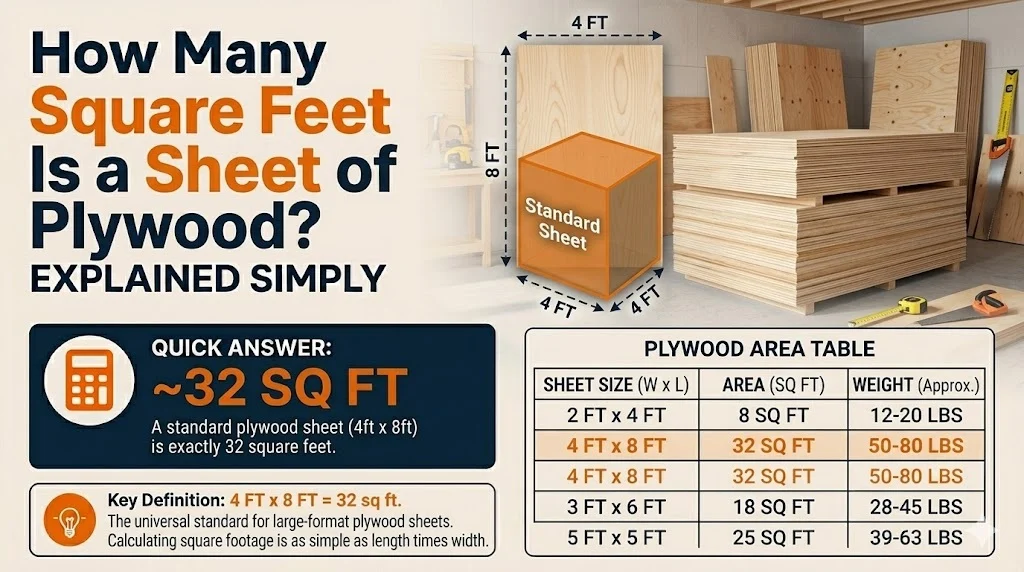
If you are planning a construction, remodeling, or DIY project, you may wonder: how many square feet is a sheet of plywood?
The answer depends on the plywood size, but the most common plywood sheet used in construction is:
4 ft×8 ft=32 square feet
That means a standard 4×8 sheet of plywood covers 32 square feet.
Knowing plywood coverage is important when estimating materials for:
- Flooring
- Roofing
- Wall sheathing
- Cabinets
- Furniture
- Subfloors
- DIY woodworking projects
In this guide, you will learn standard plywood dimensions, square footage calculations, coverage charts, practical examples, and expert tips for estimating plywood accurately.
Standard Plywood Sheet Size
Plywood comes in several sizes, but one size dominates the construction industry.
Most Common Plywood Dimensions
The standard plywood sheet size is:
- 4 feet wide
- 8 feet long
This size is widely used because it works efficiently with standard wall studs, joists, and framing layouts.
Why 4×8 Sheets Are Standard
A 4×8 plywood sheet fits well with:
- 16-inch stud spacing
- 24-inch framing systems
- Standard room dimensions
It also reduces waste during installation.
Builders commonly use 4×8 sheets for:
- Floors
- Roofs
- Walls
- Exterior sheathing
How Many Square Feet Is a Standard Sheet of Plywood?
The most common answer is:
4×8=32 square feet
So, one standard sheet of plywood covers 32 square feet.
This measurement refers to surface area coverage, not thickness.
Simple Calculation
To calculate square footage:
Square Feet=Length×Width
For a standard plywood sheet:
8×4=32
Common Plywood Sizes and Square Footage
Although 4×8 sheets are most common, plywood also comes in other dimensions.
4×8 Plywood
Coverage:
4×8=32 sq ft
Best for:
- Flooring
- Wall panels
- Roofing
- General construction
4×10 Plywood
Coverage:
4×10=40 sq ft
Often used for:
- Tall walls
- Large panels
- Specialty construction
5×5 Plywood
Coverage:
5×5=25 sq ft
Common for:
- Cabinet making
- Furniture
- Specialty woodworking
Baltic birch plywood often comes in this size.
Specialty Sizes
Some manufacturers produce:
- 2×2 sheets
- 2×4 project panels
- Oversized industrial panels
Always verify exact dimensions before purchasing.
How to Calculate Plywood Square Footage
Calculating plywood coverage is straightforward.
Formula Explained
Use this formula:
Area=Length×Width
Measurements should be in feet.
Step-by-Step Examples
Standard Sheet
A plywood sheet measuring 4 feet by 8 feet:
4×8=32
Coverage equals 32 square feet.
Large Sheet
A 4×10 plywood sheet:
4×10=40
Coverage equals 40 square feet.
Small Project Panel
A 2×4 plywood panel:
2×4=8
Coverage equals 8 square feet.
Plywood Coverage Chart
A quick reference chart makes estimating materials easier.
Single Sheet Coverage
| Plywood Size | Square Feet |
|---|---|
| 2×4 | 8 sq ft |
| 4×4 | 16 sq ft |
| 4×8 | 32 sq ft |
| 4×10 | 40 sq ft |
| 5×5 | 25 sq ft |
Multiple Sheet Coverage
| Number of 4×8 Sheets | Total Coverage |
|---|---|
| 1 | 32 sq ft |
| 5 | 160 sq ft |
| 10 | 320 sq ft |
| 20 | 640 sq ft |
| 50 | 1,600 sq ft |
Real-World Plywood Calculation Examples
Understanding practical applications helps avoid material shortages.
Flooring Example
Suppose a room measures:
- 12 feet wide
- 16 feet long
Calculate floor area:
12×16=192 sq ft
Each plywood sheet covers 32 square feet:
32192=6
You need at least 6 sheets.
Add extra for cuts and waste.
Wall Sheathing Example
A wall measures:
- 8 feet high
- 20 feet long
Area:
8×20=160 sq ft
Sheets required:
32160=5
You need about 5 sheets.
Roof Decking Example
A roof section measures:
- 24 feet by 40 feet
Area:
24×40=960 sq ft
Sheets required:
32960=30
You need roughly 30 plywood sheets before waste.
Factors That Affect Plywood Coverage
Actual plywood usage may differ from simple calculations.
Waste and Cuts
Most projects create leftover scraps due to:
- Angled cuts
- Window openings
- Door openings
- Irregular layouts
Professionals usually add:
- 5% waste for simple jobs
- 10–15% for complex layouts
Thickness Differences
Plywood thickness affects:
- Strength
- Weight
- Structural performance
However, thickness does not change square footage coverage.
Common thicknesses include:
- 1/4 inch
- 1/2 inch
- 5/8 inch
- 3/4 inch
Orientation and Layout
Proper sheet orientation reduces waste and improves strength.
For example:
- Roof sheathing should align perpendicular to rafters
- Flooring panels should stagger seams
Good planning saves material.
Common Mistakes When Estimating Plywood
Small errors can lead to expensive shortages.
Forgetting Waste Factor
Ordering exact coverage often leaves projects short.
Always buy extra material.
Ignoring Cutouts
Windows, doors, and odd corners complicate layouts.
Not all leftover pieces are reusable.
Using Nominal Dimensions Incorrectly
Actual plywood dimensions may differ slightly from labeled sizes due to manufacturing standards.
For example:
- A “1/2-inch” sheet is usually slightly thinner
This matters for precision woodworking.
Expert Tips for Buying Plywood
Professionals recommend several best practices.
Choose the Correct Grade
Different grades suit different projects:
- CDX for construction
- Sanded plywood for furniture
- Marine plywood for moisture resistance
Buy Slightly Extra
Extra plywood helps cover:
- Mistakes
- Damage
- Future repairs
Store Sheets Properly
Keep plywood:
- Flat
- Dry
- Off the ground
Improper storage can cause warping.
Check Sheet Quality
Inspect for:
- Delamination
- Moisture damage
- Broken corners
- Warping
Better sheets reduce installation problems.
FAQs
1. How many square feet does a 4×8 sheet of plywood cover?
A standard 4×8 plywood sheet covers:
4×8=32 square feet
2. What is the standard size of plywood?
The most common plywood size is 4 feet by 8 feet.
3. How many plywood sheets do I need for 1,000 square feet?
Divide total area by 32:
321000≈31.25
You need approximately 32 sheets plus waste allowance.
4. Does plywood thickness affect square footage?
No. Thickness changes strength and weight but not surface coverage.
5. Should I buy extra plywood?
Yes. Most experts recommend buying 5% to 15% extra for waste and mistakes.
Conclusion
So, how many square feet is a sheet of plywood?
The standard answer is:
4×8=32 square feet
A standard 4×8 plywood sheet covers 32 square feet, making it the most common choice for flooring, roofing, wall sheathing, cabinets, and woodworking projects.
Understanding plywood coverage helps you:
- Estimate materials accurately
- Reduce waste
- Control project costs
- Avoid shortages
By using proper calculations, accounting for waste, and choosing the right plywood type, you can complete construction and DIY projects more efficiently and professionally.
Discover More Articles
How Many Square Feet Is a One Car Garage?