
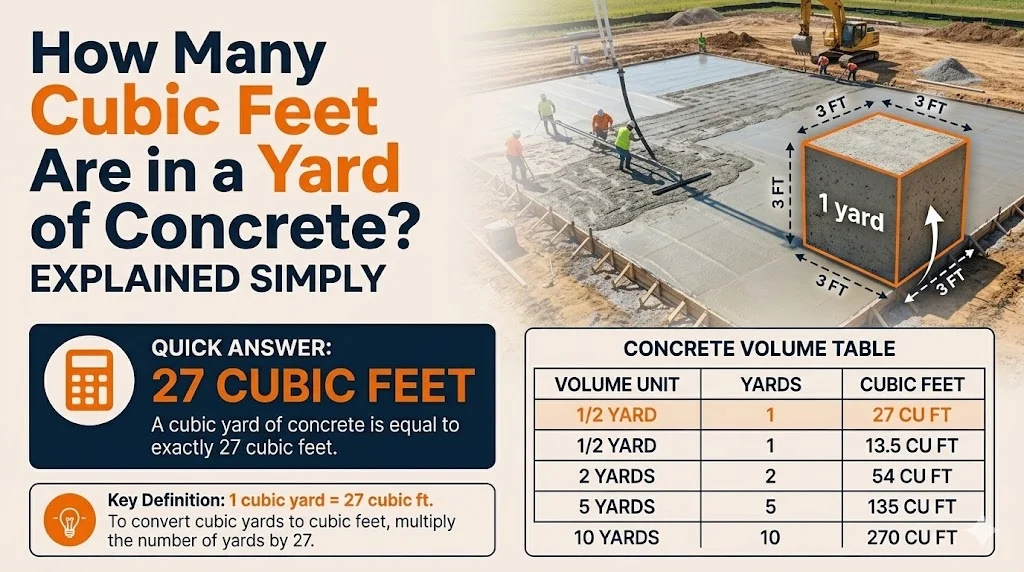
If you are planning a concrete project, one of the first questions you may ask is: how many cubic feet are in a yard of concrete?
This is one of the most important measurements in construction, landscaping, and home improvement. Whether you are pouring a driveway, patio, sidewalk, or concrete slab, understanding the relationship between cubic feet and cubic yards helps you order the right amount of concrete and avoid costly mistakes.
The simple answer is:
1 cubic yard=27 cubic feet
That means every cubic yard of concrete contains exactly 27 cubic feet.
However, there is much more to know if you want accurate calculations for real projects. In this guide, you will learn how concrete volume measurements work, how to convert cubic yards to cubic feet, practical examples, estimation tips, and common mistakes to avoid.
Understanding Concrete Volume Measurements
Before calculating concrete, it helps to understand the basic units used in construction.
What Is a Cubic Foot?
A cubic foot is a unit of volume. It measures a space that is:
- 1 foot long
- 1 foot wide
- 1 foot deep
In math terms:
1 ft×1 ft×1 ft=1 cubic foot
Cubic feet are commonly used for:
- Small concrete jobs
- Gravel calculations
- Soil measurements
- Appliance capacity
What Is a Cubic Yard?
A cubic yard is a larger unit of volume equal to a cube measuring:
- 3 feet long
- 3 feet wide
- 3 feet deep
Since each side is 3 feet:
3×3×3=27
That equals 27 cubic feet.
Why Concrete Is Measured in Cubic Yards
Concrete suppliers typically sell ready-mix concrete by the cubic yard because:
- Large projects require high volumes
- It simplifies delivery pricing
- Contractors use standard yard measurements
Smaller DIY projects may use bags of concrete instead.
How Many Cubic Feet Are in a Yard of Concrete?
The official conversion is:
1 cubic yard=27 cubic feet
This conversion applies to:
- Wet concrete
- Dry concrete mix
- Ready-mix concrete
- Cement-based materials
Quick Reference Chart
| Cubic Yards | Cubic Feet |
|---|---|
| 1 yard | 27 cubic feet |
| 2 yards | 54 cubic feet |
| 3 yards | 81 cubic feet |
| 4 yards | 108 cubic feet |
| 5 yards | 135 cubic feet |
This chart helps when estimating materials for larger pours.
How to Convert Cubic Yards to Cubic Feet
Converting cubic yards into cubic feet is very easy.
Simple Formula Explained
Use this formula:
Cubic Feet=Cubic Yards×27
Step-by-Step Examples
Example 1: Convert 2 Cubic Yards
2×27=54 cubic feet
So, 2 cubic yards equals 54 cubic feet.
Example 2: Convert 5 Cubic Yards
5×27=135 cubic feet
So, 5 cubic yards equals 135 cubic feet.
Converting Cubic Feet Back to Cubic Yards
If you know cubic feet and want cubic yards:
Cubic Yards=27Cubic Feet
For example:
2781=3 cubic yards
How to Calculate Concrete for a Project
Knowing how many cubic feet are in a yard of concrete is only part of the process. You also need to calculate your project’s total volume.
Measure Length, Width, and Depth
Start by measuring:
- Length
- Width
- Thickness or depth
Always use feet for easier calculations.
Convert Inches to Feet
Concrete depth is often measured in inches.
Use this conversion:
| Inches | Feet |
|---|---|
| 4 inches | 0.33 feet |
| 6 inches | 0.5 feet |
| 8 inches | 0.67 feet |
| 12 inches | 1 foot |
Calculate Total Volume
Use this formula:
Volume=Length×Width×Depth
This gives the total cubic feet.
Then divide by 27 to convert to cubic yards.
Concrete Conversion Chart
A conversion chart makes estimating concrete much faster.
Cubic Yards to Cubic Feet Table
| Cubic Yards | Cubic Feet |
|---|---|
| 0.5 | 13.5 |
| 1 | 27 |
| 1.5 | 40.5 |
| 2 | 54 |
| 2.5 | 67.5 |
| 3 | 81 |
| 4 | 108 |
| 5 | 135 |
| 10 | 270 |
Cubic Feet to Bags of Concrete
Most concrete bags list yield in cubic feet.
Approximate yields:
| Bag Size | Cubic Feet |
|---|---|
| 40 lb bag | 0.30 cubic feet |
| 50 lb bag | 0.37 cubic feet |
| 60 lb bag | 0.45 cubic feet |
| 80 lb bag | 0.60 cubic feet |
For example, one cubic yard equals 27 cubic feet. Using 80-pound bags:
0.6027≈45
You would need about 45 bags.
Real-World Concrete Calculation Examples
Let’s look at practical examples to understand how these calculations work.
Driveway Example
Suppose your driveway is:
- 20 feet long
- 10 feet wide
- 4 inches thick
First, convert thickness:
4 inches=0.33 feet
Now calculate volume:
20×10×0.33=66 cubic feet
Convert to cubic yards:
2766≈2.44 cubic yards
You should order about 2.5 cubic yards.
Patio Example
A patio measures:
- 12 feet by 12 feet
- 6 inches thick
Convert depth:
6 inches=0.5 feet
Volume:
12×12×0.5=72 cubic feet
Cubic yards:
2772≈2.67
You would likely order 2.75 to 3 yards.
Fence Post Example
Each fence post hole:
- 1 foot diameter
- 2 feet deep
Approximate volume per hole:
- About 1.5 cubic feet
For 10 posts:
- 15 cubic feet total
Convert to yards:
2715≈0.56
You need roughly half a yard of concrete.
Common Mistakes When Estimating Concrete
Many DIYers order the wrong amount of concrete because of simple errors.
Forgetting Depth Conversion
One of the biggest mistakes is failing to convert inches into feet before calculating volume.
Always convert depth correctly.
Ordering Too Little Concrete
Running short during a pour creates:
- Weak joints
- Uneven surfaces
- Delays
It is usually safer to order slightly extra.
Ignoring Waste Factor
Concrete spills, uneven ground, and form leakage can increase usage.
Most experts recommend adding:
- 5% extra for small jobs
- 10% extra for complex projects
Expert Tips for Accurate Concrete Estimation
Professionals use several tricks to improve accuracy.
Add Extra Material
Ordering slightly more concrete prevents shortages.
Even experienced contractors rarely order the exact amount.
Use Online Calculators
Concrete calculators can help verify your math quickly.
However, understanding the manual calculation is still important.
Consult a Ready-Mix Supplier
Suppliers can:
- Recommend quantities
- Suggest mix strength
- Help estimate delivery needs
This is especially useful for large pours.
Know the Difference Between Wet and Dry Volume
Dry concrete ingredients occupy more space before mixing with water.
Ready-mix concrete suppliers already account for this adjustment.
Why Knowing Cubic Feet in a Yard of Concrete Matters
Understanding how many cubic feet are in a yard of concrete helps you:
- Estimate projects accurately
- Avoid overspending
- Reduce material waste
- Prevent construction delays
- Communicate better with suppliers
Whether you are pouring a small sidewalk or a large foundation, accurate concrete calculations save time and money.
It also improves project quality because you can maintain a continuous pour without interruptions.
FAQs
1. How many cubic feet are in one cubic yard of concrete?
There are exactly 27 cubic feet in one cubic yard of concrete.
2. Why is concrete sold by the cubic yard?
Concrete is usually sold by the cubic yard because construction projects often require large volumes, making yard measurements more practical.
3. How do I convert cubic feet to cubic yards?
Divide cubic feet by 27.
For example:
54÷27=2 cubic yards
4. How many 80-pound bags of concrete equal one yard?
One cubic yard requires approximately 45 bags of 80-pound concrete mix.
5. Should I order extra concrete?
Yes. Most contractors recommend adding 5% to 10% extra to account for waste and uneven surfaces.
Conclusion
So, how many cubic feet are in a yard of concrete?
The answer is simple:
1 cubic yard=27 cubic feet
This basic conversion is essential for concrete estimation, construction planning, and DIY projects. Once you understand how cubic yards and cubic feet relate, calculating concrete becomes much easier.
By measuring carefully, converting dimensions correctly, and adding a small waste factor, you can confidently order the right amount of concrete for driveways, patios, slabs, sidewalks, and more.
Whether you are a homeowner tackling a weekend project or a contractor managing a large pour, mastering concrete volume calculations helps you save money, reduce waste, and complete projects successfully.