
If you have ever watched a baseball game, you may have wondered: exactly how many feet between bases in baseball? The answer is simple, but the reason behind it is more interesting than many fans realize.
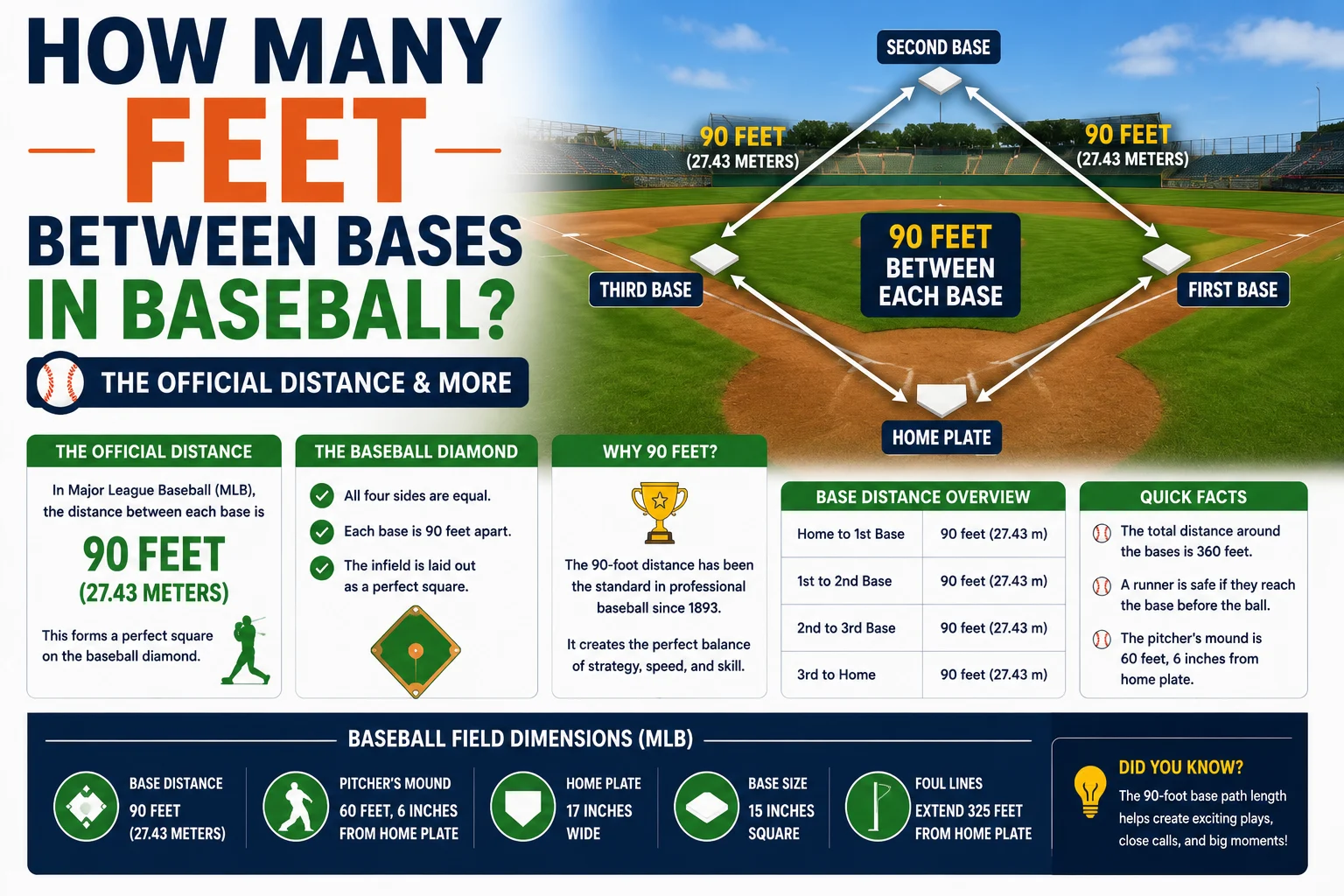
In official Major League Baseball (MLB), the distance between each base is 90 feet. This measurement forms the famous baseball diamond used in professional games across the world.
However, base distances can change depending on the age group, league, and level of play. Youth leagues often use shorter distances to match player ability and safety needs. Understanding these measurements helps players, coaches, parents, and fans better appreciate the game.
In this guide, you will learn everything about baseball base distances, field dimensions, why the 90-foot rule exists, and how baseball compares to softball.
Official Distance Between Bases in Baseball
The official distance between bases in professional baseball is:
90 feet
That means:
- Home plate to first base = 90 feet
- First base to second base = 90 feet
- Second base to third base = 90 feet
- Third base to home plate = 90 feet
These measurements create a square known as the baseball diamond.
MLB Standard Measurements
Major League Baseball follows strict field dimension rules established by official MLB regulations. Every professional field must maintain:
- 90-foot base paths
- 60 feet 6 inches from pitcher’s mound to home plate
- Standard-sized bases
Although outfield wall distances vary by stadium, the infield measurements remain the same.
Why the Distance Matters
The 90-foot distance creates a balance between:
- Speed and defense
- Hitting and pitching
- Base stealing and fielding
If bases were closer together, runners would reach safely too often. If they were farther apart, scoring would become much harder. The 90-foot rule creates competitive balance that has worked for generations.
Understanding the Baseball Diamond Layout
A baseball field looks simple, but its geometry is carefully designed.
Distance From Home Plate to First Base
The path from home plate to first base measures:
90 feet
This is often the most important sprint in baseball because hitters race to first after putting the ball in play.
Fast players can run from home to first in:
- Around 4 seconds in MLB
- 5–6 seconds in youth baseball
Distance From Home Plate to Second Base
The straight-line distance from home plate to second base is longer because it cuts across the diamond diagonally.
Using geometry:
d=902+902
The result is approximately:
- 127 feet 3 inches
This matters for:
- Double plays
- Stolen bases
- Outfield throws
Pitcher’s Mound Distance
Another critical baseball measurement is the pitcher’s mound distance.
In MLB:
60 feet 6 inches
This distance gives pitchers enough reaction time while still challenging hitters.
Baseball Base Distances by League and Age Group
Not every baseball field uses 90-foot base paths. Younger players use smaller fields designed for skill development and safety.
Little League
Little League fields usually have:
- 60-foot base paths
- 46-foot pitching distance
These smaller dimensions help children:
- Learn fundamentals
- Improve throwing accuracy
- Build confidence
Intermediate Divisions
As players grow older, fields gradually increase in size.
Typical distances include:
- 70-foot bases
- 50-foot pitching mound
This transition prepares players for full-size baseball fields.
High School Baseball
Most high school baseball fields use:
- 90-foot base paths
- 60 feet 6 inches pitching distance
At this stage, players compete under dimensions nearly identical to MLB rules.
College Baseball
College baseball also uses:
- 90-foot bases
- Standard pitching distance
However, some field dimensions like fence distances may differ slightly.
Major League Baseball
MLB follows the official standard:
- 90 feet between bases
- Uniform infield measurements
This consistency allows fair competition across all professional stadiums.
Why Are Baseball Bases 90 Feet Apart?
Many fans ask why baseball settled on exactly 90 feet instead of another number.
The answer combines history, player performance, and game strategy.
History of the 90-Foot Rule
The 90-foot standard dates back to the 1840s and early organized baseball games in New York.
Alexander Cartwright, often credited with helping formalize baseball rules, supported standardized field dimensions. Over time, 90 feet became accepted because it created exciting gameplay without favoring offense or defense too heavily.
Once professional leagues adopted the measurement, it became baseball tradition.
Balance Between Offense and Defense
The 90-foot distance creates:
- Close plays at first base
- Strategic stolen base attempts
- Balanced scoring opportunities
A runner must be:
- Fast enough to beat throws
- Smart enough to time steals
- Skilled enough to round bases efficiently
Meanwhile, defenders need:
- Strong arms
- Quick reactions
- Accurate throws
This balance is one reason baseball remains so competitive.
Comparison Table of Baseball Field Dimensions
| Baseball Level | Distance Between Bases | Pitching Distance |
|---|---|---|
| Little League | 60 feet | 46 feet |
| Intermediate | 70 feet | 50 feet |
| High School | 90 feet | 60 ft 6 in |
| College | 90 feet | 60 ft 6 in |
| MLB | 90 feet | 60 ft 6 in |
This chart helps explain how baseball fields evolve as players mature.
How to Measure a Baseball Diamond Correctly
Setting up a baseball field requires precision. Even small errors can affect gameplay.
Tools Needed
To measure a baseball diamond, you typically need:
- Measuring tape
- Field chalk
- Stakes
- String line
- Base anchors
Professional grounds crews often use laser measuring tools for greater accuracy.
Step-by-Step Setup
Mark Home Plate
Place home plate first because every other measurement starts here.
Measure to First Base
Measure exactly:
90 feet
Measure to Third Base
Repeat the same distance on the opposite side.
Position Second Base
Second base sits directly across from home plate, forming a square.
Check Diagonal Measurements
Verify that the diamond is even by measuring diagonals carefully.
Accurate field setup ensures fair play and player safety.
Common Mistakes When Measuring Baseball Bases
Even experienced coaches sometimes make measurement mistakes.
Here are the most common issues:
Measuring From the Wrong Spot
Base distances are measured:
- From the back tip of home plate
- To the back corner of first and third base
- To the center of second base
Incorrect measuring points can create uneven fields.
Uneven Base Alignment
If bases are not perfectly square:
- Throws become awkward
- Base paths feel uneven
- Gameplay suffers
Ignoring League Rules
Different leagues require different field sizes. Always confirm official regulations before setting up a field.
Baseball vs Softball Base Distances
Although baseball and softball look similar, field dimensions differ significantly.
Baseball Base Distance
Professional baseball:
90 feet
Softball Base Distance
Most softball leagues use:
- 60 feet
- 65 feet
- 70 feet depending on division
Softball also features:
- Shorter pitching distances
- Larger balls
- Faster reaction times
These adjustments match the style and pace of softball gameplay.
Interesting Facts About Baseball Field Dimensions
Baseball field measurements contain many fascinating details.
The Diamond Is Actually a Square
People call it a “diamond” because of its appearance, but mathematically it is a square with:
- Four equal sides
- Equal angles
Bases Recently Increased in Size
MLB recently enlarged bases from:
- 15 inches
to - 18 inches
The goal was to:
- Improve player safety
- Encourage stolen bases
- Reduce collisions
Outfield Sizes Can Vary
Unlike the infield, MLB outfields are not standardized.
Some stadiums have:
- Deep center fields
- Short porches
- Unique wall angles
This creates personality and strategy differences between ballparks.
FAQs
How many feet are between bases in MLB baseball?
In Major League Baseball, the distance between each base is 90 feet.
How far is home plate to second base?
The straight-line distance from home plate to second base is about 127 feet 3 inches.
Why are baseball bases 90 feet apart?
The 90-foot distance creates a competitive balance between offense and defense while maintaining exciting gameplay.
Are youth baseball fields smaller?
Yes. Youth baseball leagues often use 60-foot or 70-foot base paths depending on player age.
What is the pitching distance in baseball?
In MLB, the pitcher’s mound is 60 feet 6 inches from home plate.
Conclusion
So, how many feet between bases in baseball? The official answer is 90 feet for professional and most advanced levels of the game. This distance has shaped baseball strategy, speed, defense, and excitement for more than a century.
From Little League to MLB, field dimensions are carefully designed to match player skill and create balanced competition. Understanding baseball base distances also helps coaches, players, and fans appreciate the precision behind America’s pastime.
Whether you are setting up a field, coaching young athletes, or simply curious about the sport, knowing how many feet between bases in baseball gives you a deeper understanding of how the game works.
Discover More Articles
How Many Square Feet Is a Sheet of Plywood?