

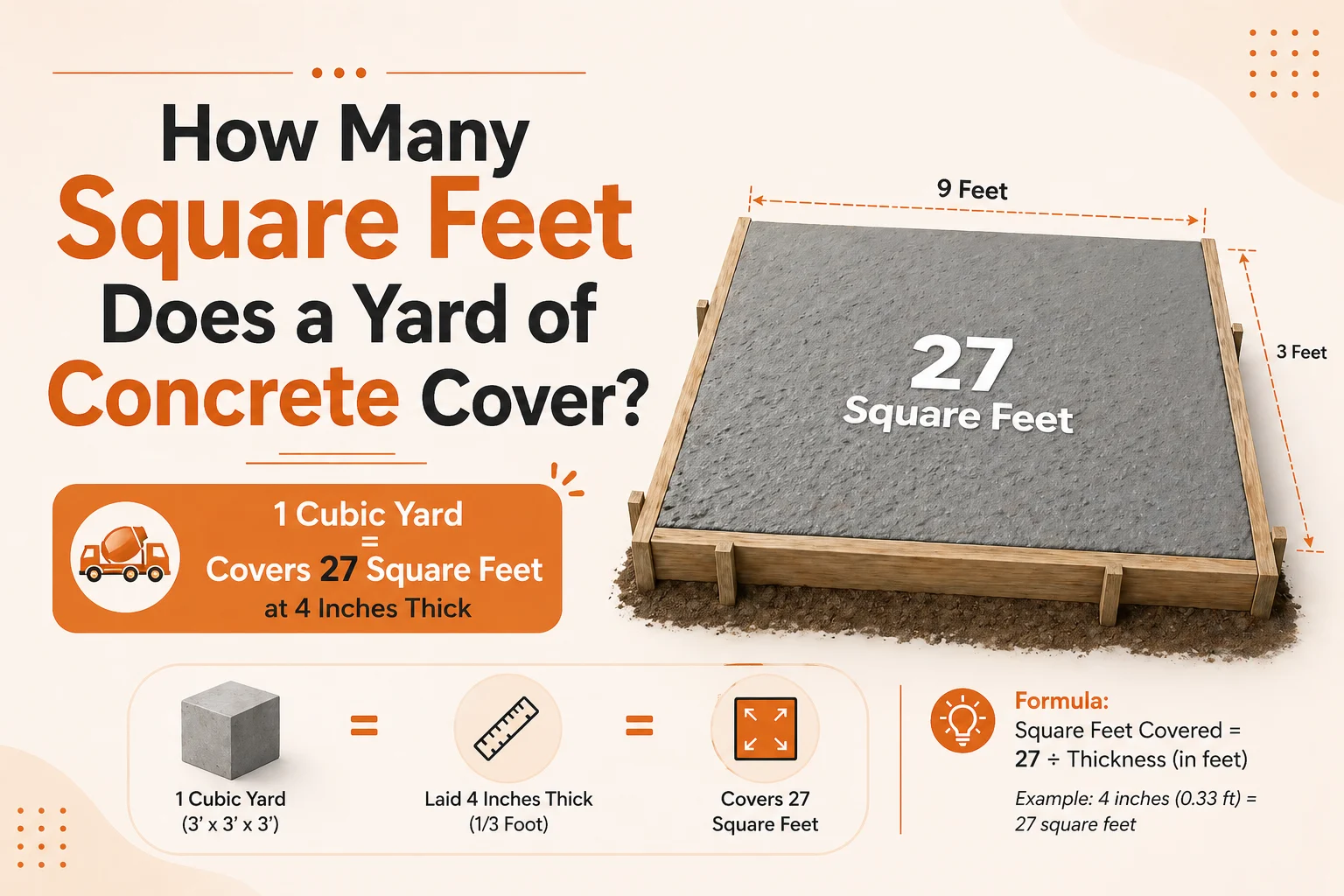
If you’re planning a concrete project, one of the most important questions you’ll ask is how many square feet does a yard of concrete cover. Whether you’re pouring a driveway, patio, or slab, knowing this helps you estimate materials correctly and avoid wasting money.
The answer depends on one key factor: depth. A cubic yard measures volume, but square feet measure area. So, you must consider thickness to get an accurate result.
Understanding Concrete Measurements
Before calculating coverage, it’s important to understand the basics.
What Is a Cubic Yard of Concrete
A cubic yard is a unit of volume. It equals 27 cubic feet of material. Concrete is usually sold in cubic yards, especially for large construction projects.
Why Depth Matters
Concrete is poured at different thicknesses depending on the project. For example, a driveway needs more thickness than a sidewalk. The thicker the concrete, the less area it will cover.
How Many Square Feet Does a Yard of Concrete Cover
Here’s a simple rule to remember
One cubic yard of concrete covers
81 square feet at 4 inches thick
65 square feet at 5 inches thick
54 square feet at 6 inches thick
So, the coverage depends entirely on how deep the concrete layer is.
Coverage Formula Explained
To calculate coverage, you need to convert volume into area using depth.
Area (sq ft)=Depth in feet27
Step-by-Step Calculation
First, convert depth into feet. For example, 4 inches equals 0.33 feet. Then divide 27 cubic feet by the depth. The result gives you the square footage covered by one cubic yard.
Thickness Impact
If the depth increases, the area decreases. This is because the same volume is spread over a thicker layer.
Concrete Coverage Chart by Depth
Here is a quick reference guide
3 inches thick covers about 108 square feet
4 inches thick covers about 81 square feet
5 inches thick covers about 65 square feet
6 inches thick covers about 54 square feet
8 inches thick covers about 40 square feet
This chart is very useful when estimating materials for different projects.
Real-Life Examples
Driveway
A standard driveway is usually 4 to 6 inches thick. If you use 4 inches, one yard will cover about 81 square feet. If your driveway is 400 square feet, you will need around 5 cubic yards.
Patio
Patios are often 4 inches thick. If your patio is 200 square feet, you will need about 2.5 cubic yards of concrete.
Sidewalk
Sidewalks are typically 4 inches thick. For a 100 square foot sidewalk, you’ll need around 1.25 cubic yards.
How to Calculate Concrete for Your Project
Follow these steps
Measure length and width in feet
Multiply to get total square feet
Choose your desired thickness
Use the coverage chart or formula
Add 5 to 10 percent extra for safety
This method ensures you order the right amount of concrete.
Common Mistakes to Avoid
One common mistake is ignoring thickness. Many people assume one yard covers a fixed area, which is incorrect. Another mistake is not converting inches to feet properly. Rounding numbers too early can also lead to inaccurate estimates.
Practical Uses
This calculation is useful for driveways, patios, sidewalks, foundations, and flooring projects. It helps you budget correctly and prevents shortages or over-ordering.
Expert Tips
Always measure carefully before ordering concrete. Choose the correct thickness based on your project type. Add extra material to account for uneven surfaces and waste. If unsure, consult a contractor or use a reliable calculator.
FAQs
How many square feet does 1 yard of concrete cover at 4 inches
It covers about 81 square feet
How much area does a yard of concrete cover at 6 inches
It covers about 54 square feet
Does thicker concrete cover less area
Yes, thicker concrete reduces the total coverage area
How many yards do I need for 100 square feet
At 4 inches thick, you need about 1.25 cubic yards
Why is depth important in concrete calculation
Because it determines how far the volume spreads across an area
Conclusion
So, how many square feet does a yard of concrete cover The answer depends on thickness. At 4 inches thick, one cubic yard covers about 81 square feet, but this changes as depth increases. Understanding this relationship helps you plan better, save money, and complete your project successfully.