
If you are dealing with land measurements, you might wonder 5 acres is how many square feet. This is a common question for buyers, farmers, and anyone planning land use. Understanding this conversion helps you visualize land size and make better decisions.
The good news is that converting acres to square feet is simple once you know the formula. Let’s break it down in an easy and practical way.
Understanding Acres and Square Feet
Before jumping into the answer, it is important to understand what these units mean.
What Is an Acre
An acre is a unit of land area commonly used in real estate and agriculture. It is often used to measure large plots of land.
One acre equals 43,560 square feet.
What Is a Square Foot
A square foot is a unit of area that represents a square measuring one foot on each side. It is commonly used for smaller spaces like rooms, houses, and plots.
5 Acres Is How Many Square Feet Exact Answer
Here is the direct answer
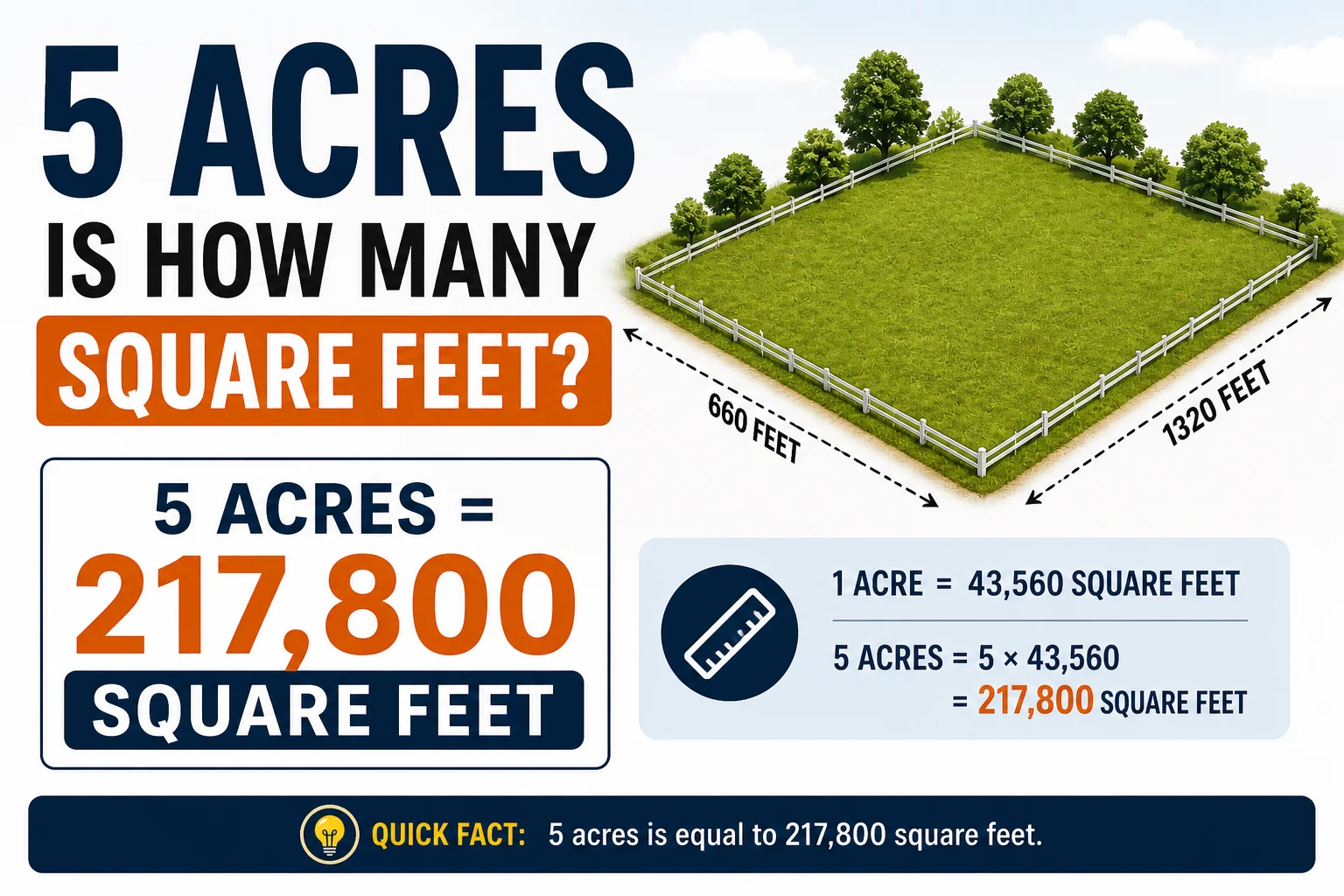
5 acres equals 217,800 square feet
Conversion Formula Explained
Square Feet=Acres×43,560
Step-by-Step Calculation
Start with 5 acres and multiply by 43,560. The result is 217,800 square feet.
Why the Formula Works
This works because one acre is defined as 43,560 square feet. Multiplying gives the total area in square feet.
Acres to Square Feet Conversion Chart
Here is a quick reference
1 acre equals 43,560 square feet
2 acres equals 87,120 square feet
3 acres equals 130,680 square feet
4 acres equals 174,240 square feet
5 acres equals 217,800 square feet
10 acres equals 435,600 square feet
Real-Life Examples
Land Size Visualization
It can be hard to picture 5 acres. Think of it as about five football fields placed side by side. This gives you a better idea of the size.
Farming Use
Farmers often use acres to measure land. Knowing the square footage helps in planning irrigation, planting, and fencing.
Real Estate
In property deals, land may be listed in acres, but buyers often think in square feet. Converting helps compare properties easily.
How to Convert Square Feet Back to Acres
To convert square feet into acres, divide by 43,560.
For example, 217,800 square feet divided by 43,560 equals 5 acres.
Common Mistakes to Avoid
One common mistake is forgetting the exact value of one acre. Some people round numbers too early, which leads to errors. Another mistake is confusing square feet with linear feet. Always remember that acres measure area, not length.
Practical Uses
This conversion is useful in real estate, agriculture, construction, and land planning. It helps you estimate land value, plan usage, and understand property size clearly.
Expert Tips
Always double-check your calculations when dealing with land measurements. Use full numbers instead of rounding early. If you are buying or selling land, verify measurements with official documents. Using online calculators can also save time and reduce errors.
FAQs
How many square feet are in 5 acres exactly
There are 217,800 square feet in 5 acres
How many square feet are in 1 acre
One acre equals 43,560 square feet
How do you convert acres to square feet
Multiply the number of acres by 43,560
Is 5 acres a large area
Yes, it is a large area suitable for farming or large properties
How many acres is 200,000 square feet
It is approximately 4.59 acres
Conclusion
So, 5 acres is how many square feet The answer is 217,800 square feet. This simple conversion helps you understand land size more clearly and make informed decisions. Whether you are buying property, farming, or planning a project, knowing how to convert acres into square feet is a valuable skill.