

If you’ve ever worked on a home project, landscaping job, or construction task, you’ve probably asked: how many cubic feet per yard?
This is one of the most common volume conversions, and getting it right can save you time, money, and materials. Whether you’re ordering soil, pouring concrete, or calculating storage space, understanding this conversion is essential.
Let’s break it down in a simple, practical way.
Understanding Cubic Measurements
Before jumping into the answer, it helps to understand what these units actually mean.
What Is a Cubic Foot?
A cubic foot is a unit of volume. It represents a cube that measures:
- 1 foot long
- 1 foot wide
- 1 foot high
So, a cubic foot is the space inside that cube.
What Is a Cubic Yard?
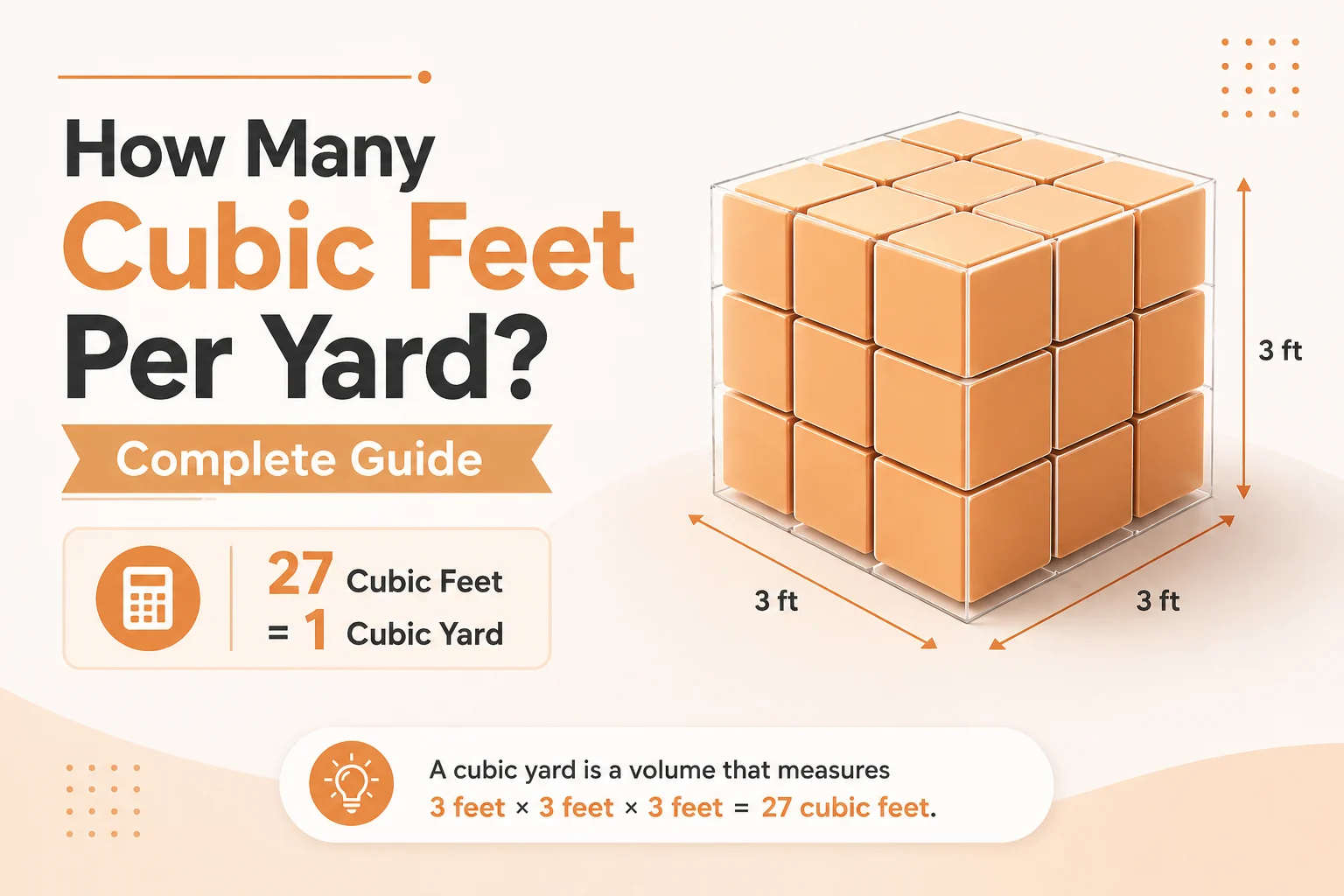
A cubic yard is a larger unit of volume. It represents a cube that measures:
- 1 yard (3 feet) long
- 1 yard (3 feet) wide
- 1 yard (3 feet) high
Since 1 yard = 3 feet, this makes a big difference when calculating volume.
How Many Cubic Feet Per Yard?
Here’s the key answer:
👉 1 cubic yard = 27 cubic feet
This is the standard conversion used in construction, landscaping, and engineering.
Conversion Formula Explained
To fully understand this, let’s look at the formula behind it.
1 cubic yard=3×3×3=27 cubic feet
Step-by-Step Breakdown
- 1 yard = 3 feet
- Volume = length × width × height
- So:
- 3 × 3 × 3 = 27
That’s why one cubic yard equals 27 cubic feet.
Why the Formula Works
Volume increases in three dimensions, not just one.
So when converting from yards to feet, you must multiply by 3 three times, not just once. This is where many beginners make mistakes.
Conversion Chart (Yards to Cubic Feet)
Here’s a quick reference chart you can use:
| Cubic Yards | Cubic Feet |
|---|---|
| 1 | 27 |
| 2 | 54 |
| 3 | 81 |
| 5 | 135 |
| 10 | 270 |
| 15 | 405 |
| 20 | 540 |
This chart is especially useful when ordering materials.
Real-World Examples
Let’s look at how this conversion is used in everyday situations.
Landscaping Projects
If you’re buying mulch or soil:
- A small garden might need 2 cubic yards
- That equals:
- 2 × 27 = 54 cubic feet
This helps you compare bag sizes at stores, which are often sold in cubic feet.
Concrete Calculations
Concrete is often ordered in cubic yards.
Example:
- You need 4 cubic yards of concrete
- In cubic feet:
- 4 × 27 = 108 cubic feet
Knowing this helps when mixing or estimating costs.
Moving and Storage
Storage units are measured in cubic feet.
If a container holds:
- 81 cubic feet → that equals 3 cubic yards
This helps when estimating space for furniture or materials.
How to Convert Cubic Feet Back to Cubic Yards
Sometimes you’ll need to go the other way.
Formula:
- Divide cubic feet by 27
Example:
- 54 cubic feet ÷ 27 = 2 cubic yards
Common Mistakes to Avoid
Even simple conversions can go wrong. Here are the most common errors:
1. Forgetting It’s Cubic
People often multiply by 3 instead of 27.
👉 Always remember: volume is 3D.
2. Mixing Units
Don’t mix feet and yards in the same calculation.
👉 Convert everything to one unit first.
3. Rounding Too Early
Rounding numbers too soon can lead to inaccurate estimates.
👉 Keep full numbers until the final step.
4. Ignoring Depth
In landscaping, depth matters just as much as area.
👉 Always include height in calculations.
Practical Applications
Understanding how many cubic feet per yard has real value in multiple fields.
Construction
- Concrete pouring
- Foundation work
- Material estimation
Accurate conversions prevent over-ordering or shortages.
Gardening
- Soil and compost calculations
- Mulch coverage
- Raised bed planning
You can avoid buying too much or too little material.
Home Improvement
- Gravel for driveways
- Sand for leveling
- Debris removal
This helps keep your project within budget.
Expert Tips for Accurate Measurement
Want to get it right every time? Follow these tips:
Measure in Feet First
It’s easier to calculate volume in feet, then convert to yards.
Use the Formula:
- Length × Width × Height = Cubic Feet
Then divide by 27 for cubic yards.
Add a Safety Margin
Always order 5–10% extra material.
Why?
- Spillage
- Uneven surfaces
- Compaction
Use Online Calculators
For complex shapes, digital tools can save time and reduce errors.
FAQs
1. How many cubic feet are in 1 yard?
There are exactly 27 cubic feet in one cubic yard.
2. Why is it 27 cubic feet per yard?
Because a yard equals 3 feet, and volume is calculated as 3 × 3 × 3 = 27.
3. How do I convert cubic feet to cubic yards?
Divide the number of cubic feet by 27.
4. How many cubic feet in 2 cubic yards?
2 × 27 = 54 cubic feet.
5. Is cubic yard the same as square yard?
No.
- Cubic yard = volume (3D)
- Square yard = area (2D)
Conclusion
So, how many cubic feet per yard?
The answer is simple but powerful:
👉 1 cubic yard = 27 cubic feet
This conversion is essential for construction, landscaping, and everyday projects. Once you understand the formula, you can confidently estimate materials, avoid waste, and plan better.
Whether you’re pouring concrete, buying mulch, or organizing storage, mastering this conversion will make your work easier and more accurate.