
Whether you’re ordering mulch, concrete, gravel, topsoil, or planning a construction project, one of the most common questions is:
How many cubic feet are in 1 cubic yard?
Understanding the relationship between cubic yards and cubic feet is essential for estimating material quantities, comparing supplier pricing, and avoiding costly ordering mistakes.
While many people know that a yard equals 3 feet in length, converting cubic yards to cubic feet requires understanding volume rather than simple distance.
This comprehensive guide explains exactly how many cubic feet are in a cubic yard, how the conversion works, and how to apply it to real-world projects.
Quick Answer
The standard conversion is:
1 cubic yard=27 cubic feet
Final Answer
1 cubic yard equals 27 cubic feet.
This conversion never changes and is used throughout construction, landscaping, excavation, and material delivery industries.
Understanding Cubic Measurements
Before calculating conversions, it’s important to understand what a cubic measurement represents.
A cubic measurement describes:
- Length
- Width
- Height
combined into a single volume measurement.
Unlike feet, which measure length, cubic feet and cubic yards measure three-dimensional space.
What Is a Cubic Foot?
A cubic foot is a cube measuring:
- 1 foot long
- 1 foot wide
- 1 foot high
Mathematically:
1×1×1=1 cubic foot
This small cube represents one cubic foot of volume.
What Is a Cubic Yard?
A cubic yard is a cube measuring:
- 1 yard long
- 1 yard wide
- 1 yard high
Since:
1 yard=3 feet
each dimension equals 3 feet.
How to Calculate Cubic Feet in a Cubic Yard
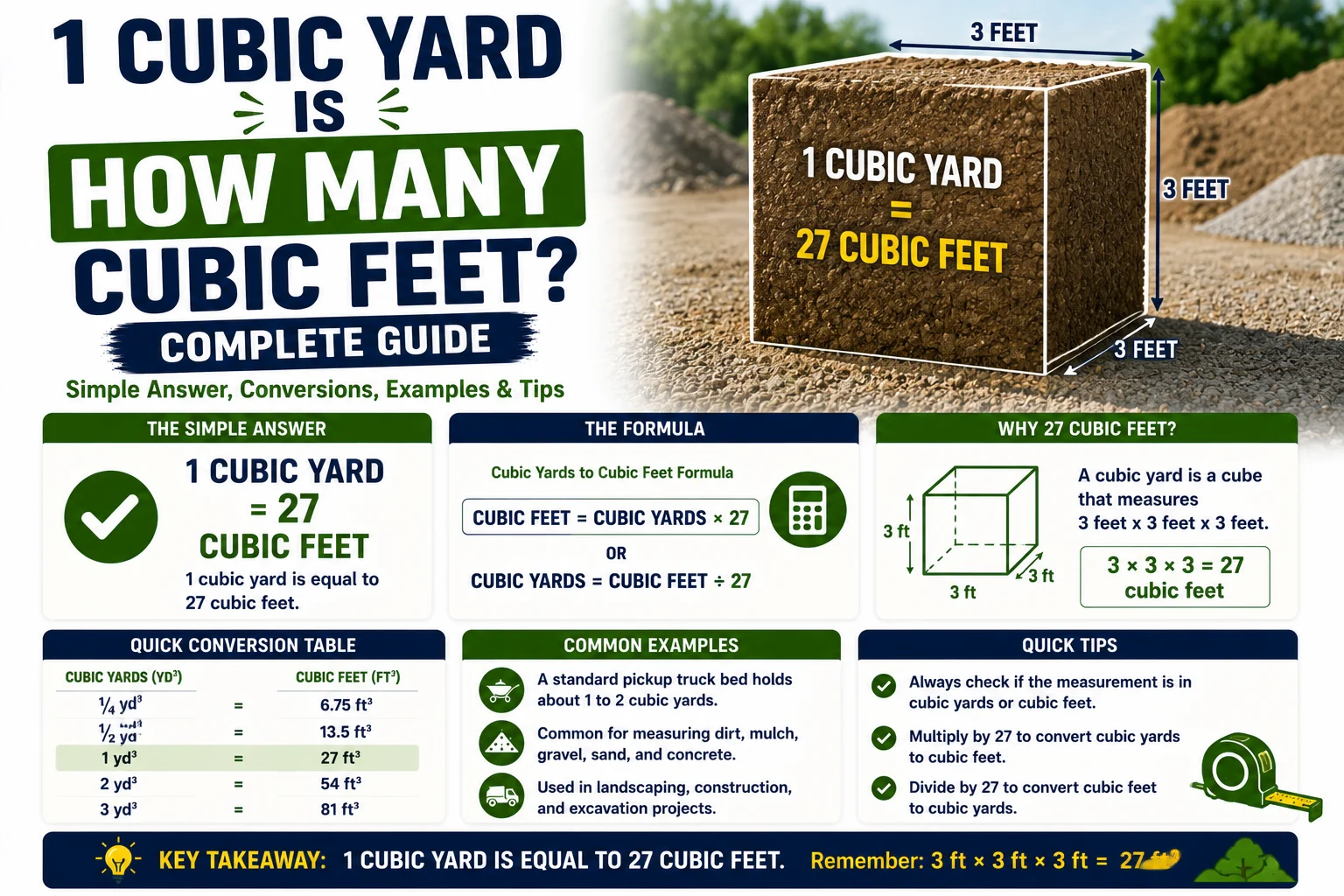
A cubic yard measures:
- 3 feet long
- 3 feet wide
- 3 feet high
Volume formula:
Volume=Length×Width×Height
Substituting values:
3×3×3=27
Therefore:
1 cubic yard=27 cubic feet
Why the Conversion Is 27
Many people mistakenly multiply by 3 because they know:
- 1 yard = 3 feet
However, volume requires converting all three dimensions.
Since:
33=27
the correct conversion is 27 cubic feet per cubic yard.
Visualizing One Cubic Yard
Imagine a cube:
- 3 feet tall
- 3 feet wide
- 3 feet deep
That entire cube contains:
27 cubic feet
This visualization helps when estimating materials.
Common Uses for Cubic Yards
Cubic yards are commonly used for:
Landscaping
- Mulch
- Topsoil
- Compost
- Decorative stone
Construction
- Concrete
- Sand
- Gravel
Excavation
- Dirt removal
- Backfill
- Site grading
Mulch Example
Suppose you purchase:
2 cubic yards of mulch
Convert to cubic feet:
2×27=54 cubic feet
You receive:
54 cubic feet of mulch.
Gravel Example
If a driveway requires:
5 cubic yards
Convert:
5×27=135 cubic feet
The project requires:
135 cubic feet of gravel.
Concrete Example
A concrete contractor orders:
10 cubic yards
Convert:
10×27=270 cubic feet
This equals:
270 cubic feet of concrete.
Cubic Yard Conversion Formula
To convert cubic yards to cubic feet:
Cubic Feet=Cubic Yards×27
This is the most commonly used formula in construction and landscaping.
Reverse Conversion
To convert cubic feet into cubic yards:
Cubic Yards=27Cubic Feet
Example:
54÷27=2 cubic yards
Conversion Table
| Cubic Yards | Cubic Feet |
|---|---|
| 1 | 27 |
| 2 | 54 |
| 3 | 81 |
| 5 | 135 |
| 10 | 270 |
| 20 | 540 |
Why Contractors Use Cubic Yards
Most bulk materials are sold by the cubic yard because:
- Easier to estimate large volumes
- Simplifies pricing
- Matches truck capacities
For example:
A dump truck may carry:
- 10–15 cubic yards
rather than listing capacity in cubic feet.
How Much Does a Cubic Yard Weigh?
Weight depends on the material.
Examples:
| Material | Approximate Weight per Cubic Yard |
|---|---|
| Mulch | 400–800 lbs |
| Topsoil | 2,000–2,700 lbs |
| Gravel | 2,400–3,000 lbs |
| Concrete | 4,000+ lbs |
Even though all equal 27 cubic feet, the weight varies significantly.
Estimating Material Coverage
One cubic yard can cover different areas depending on depth.
3 Inches Deep
Coverage:
108 square feet at 3 inches depth
4 Inches Deep
Coverage:
81 square feet at 4 inches depth
6 Inches Deep
Coverage:
54 square feet at 6 inches depth
Real-World Landscaping Example
Suppose a flower bed measures:
- 18 feet long
- 9 feet wide
Area:
18×9=162 square feet
At 2 inches deep, approximately 1 cubic yard of mulch may cover the area.
Common Mistakes
Confusing Square Feet and Cubic Feet
Square feet measure area.
Cubic feet measure volume.
These are not interchangeable.
Multiplying by 3 Instead of 27
Many people incorrectly assume:
1 cubic yard=3 cubic feet
This is incorrect.
The correct conversion is:
1 cubic yard=27 cubic feet
Ignoring Material Compaction
Some materials settle after installation.
Additional material may be needed for:
- Soil
- Mulch
- Gravel
Industry Applications
Professionals use cubic yard conversions in:
Construction
- Concrete estimates
- Excavation calculations
Landscaping
- Mulch purchases
- Soil delivery
Agriculture
- Compost planning
- Soil management
Waste Removal
- Dumpster capacity calculations
FAQs
How many cubic feet are in 1 cubic yard?
27 cubic feet
Why is the answer 27?
Because:
3×3×3=27
A cubic yard measures 3 feet in all three dimensions.
How many cubic feet are in 5 cubic yards?
5×27=135 cubic feet
How many cubic yards are in 54 cubic feet?
54÷27=2 cubic yards
Is a cubic yard the same as a square yard?
No.
A square yard measures area.
A cubic yard measures volume.
Conclusion
So, 1 cubic yard is how many cubic feet?
The answer is:
1 cubic yard equals 27 cubic feet.
This conversion comes from the fact that a cubic yard measures 3 feet in length, width, and height. By multiplying those three dimensions together, you get 27 cubic feet. Understanding this relationship is essential for landscaping, construction, excavation, concrete work, and material ordering. Whether you’re buying mulch, gravel, soil, or concrete, knowing that one cubic yard equals 27 cubic feet helps ensure accurate estimates and successful project planning.