

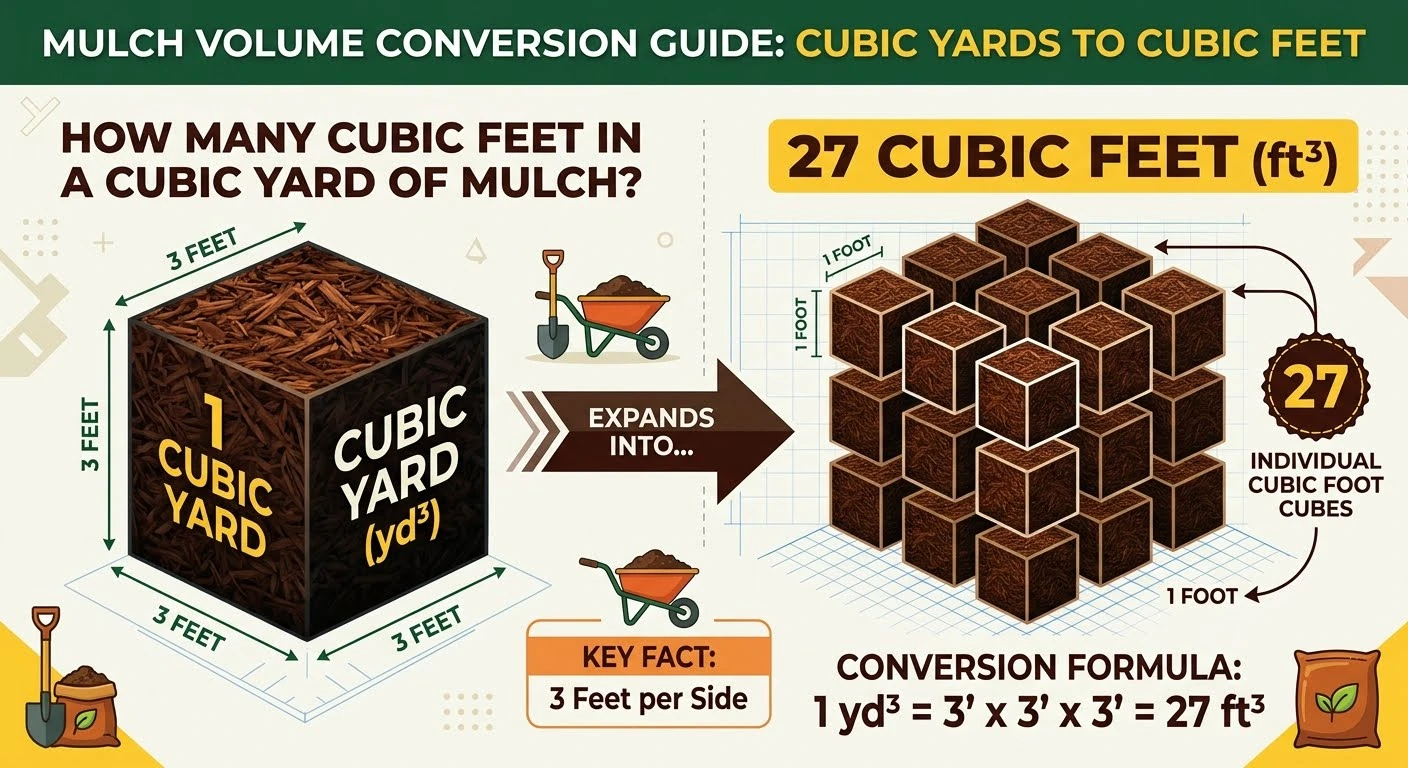
If you’re planning to mulch a garden, landscape a yard, or cover flower beds, knowing how many cubic feet are in a cubic yard of mulch can help you order the right amount and avoid unnecessary expenses. The good news is that this conversion is simple: 1 cubic yard of mulch equals 27 cubic feet.
However, the amount of ground a cubic yard of mulch can cover depends on how thickly you spread it. A cubic yard can cover 324 square feet at a depth of 1 inch, 162 square feet at 2 inches, or 108 square feet at 3 inches.
In this guide, you’ll learn how to convert cubic yards to cubic feet, calculate mulch coverage, estimate the amount needed for your garden, and avoid common ordering mistakes.
How Many Cubic Feet Are in a Cubic Yard of Mulch?
One cubic yard of mulch contains exactly 27 cubic feet.
A cubic yard measures 3 feet long, 3 feet wide, and 3 feet high. Multiplying these dimensions gives the total volume:
3 feet × 3 feet × 3 feet = 27 cubic feet
This conversion applies to mulch regardless of whether it is made from shredded bark, wood chips, pine needles, or another material.
| Measurement | Equivalent |
|---|---|
| 1 cubic yard | 27 cubic feet |
| 1 cubic yard | 46,656 cubic inches |
| 1 cubic yard | 0.7646 cubic meters |
| 1 cubic yard | 202 U.S. gallons, approximately |
Remember that cubic feet and cubic yards measure volume, not the surface area covered by mulch. Coverage depends on the depth at which you spread it.
How to Convert Cubic Yards of Mulch to Cubic Feet
Converting cubic yards to cubic feet requires only one multiplication.
The Formula
Cubic feet = Cubic yards × 27
Since one cubic yard contains 27 cubic feet, multiply the number of cubic yards by 27 to find the equivalent volume.
Examples of Cubic Yard to Cubic Feet Conversion
| Cubic yards of mulch | Cubic feet |
|---|---|
| 0.25 cubic yards | 6.75 cubic feet |
| 0.5 cubic yards | 13.5 cubic feet |
| 1 cubic yard | 27 cubic feet |
| 2 cubic yards | 54 cubic feet |
| 3 cubic yards | 81 cubic feet |
| 4 cubic yards | 108 cubic feet |
| 5 cubic yards | 135 cubic feet |
| 10 cubic yards | 270 cubic feet |
For example, if you order 3 cubic yards of mulch, you receive a total volume of 81 cubic feet.
How Much Area Does One Cubic Yard of Mulch Cover?
One cubic yard of mulch covers different amounts of ground depending on the depth of the layer. A thicker layer uses more mulch per square foot, reducing the total coverage.
For 27 cubic feet of mulch, the approximate coverage is:
| Mulch depth | Approximate coverage |
|---|---|
| 1 inch | 324 square feet |
| 2 inches | 162 square feet |
| 3 inches | 108 square feet |
| 4 inches | 81 square feet |
| 6 inches | 54 square feet |
These figures assume an even layer and no material loss. Real-world coverage can vary because of uneven ground, mulch texture, settling, and handling.
How Much Mulch Should You Spread?
For many established garden beds, a layer of about 2–3 inches is a common starting point. The ideal depth depends on the mulch type, the plants, and whether mulch is already present.
- Around 1 inch: Useful for light coverage or certain fine materials, depending on the application.
- Around 2 inches: Often suitable for refreshing an existing layer.
- Around 3 inches: A common depth for many landscape beds.
- Around 4 inches: May be appropriate in some situations, but excessive depth can cause problems for certain plants.
Keep mulch away from tree trunks and plant stems, and avoid piling it against building siding. Follow guidance appropriate for your plants and local conditions.
How to Calculate How Much Mulch You Need
To estimate the amount of mulch required, measure the area you want to cover and decide how deep the mulch should be.
Step 1: Measure the Area
For a rectangular garden bed, multiply the length by the width.
For example, a bed measuring 20 feet long and 10 feet wide has an area of:
20 × 10 = 200 square feet
Step 2: Choose the Mulch Depth
Suppose you want to apply 3 inches of mulch.
Convert the depth into feet:
3 ÷ 12 = 0.25 feet
Step 3: Calculate the Volume in Cubic Feet
Multiply the surface area by the depth in feet:
200 × 0.25 = 50 cubic feet
Step 4: Convert Cubic Feet to Cubic Yards
Divide the volume by 27:
50 ÷ 27 = 1.85 cubic yards
Answer: You need approximately 1.85 cubic yards of mulch to cover a 200-square-foot garden bed at a depth of 3 inches. Depending on how mulch is sold, you may need to order 2 cubic yards.
Mulch Coverage Calculator
Use this simple calculator to estimate the mulch volume required for a rectangular garden bed.
{@body const [bedLength, setBedLength] = DIL.useState(“20”)}
{@body const [bedWidth, setBedWidth] = DIL.useState(“10”)}
{@body const [mulchDepth, setMulchDepth] = DIL.useState(“3”)}
{@body const area = Math.max(0, Number(bedLength) || 0) * Math.max(0, Number(bedWidth) || 0)}
{@body const cubicFeet = area * Math.max(0, Number(mulchDepth) || 0) / 12}
{@body const cubicYards = cubicFeet / 27}
Enter the dimensions in feet and the desired mulch depth in inches.
Bed length (feet)
Bed width (feet)
Mulch depth (inches)
2 inches
3 inches
4 inches
Area to cover
How Many Bags of Mulch Equal One Cubic Yard?
Mulch is often sold in bags measured in cubic feet. To determine how many bags make one cubic yard, divide 27 cubic feet by the volume of each bag.
| Bag size | Bags per cubic yard |
|---|---|
| 1 cubic foot | 27 bags |
| 1.5 cubic feet | 18 bags |
| 2 cubic feet | 13.5 bags, so 14 full bags |
| 3 cubic feet | 9 bags |
For example, if you purchase 2-cubic-foot bags, you need 14 full bags to obtain at least 27 cubic feet of mulch.
Bagged mulch can be convenient for small garden beds, while bulk mulch may be more economical for large landscaping projects. Compare the price per cubic foot rather than comparing the bag price with the bulk price alone.
Is Bulk Mulch Better Than Bagged Mulch?
The best option depends on the size of your project, delivery costs, and how you plan to distribute the material.
Bulk Mulch
Bulk mulch is usually sold by the cubic yard and can be a practical option for large areas.
Advantages include:
- Convenient for ordering several cubic yards at once.
- Often less packaging waste.
- May offer a lower cost per cubic foot for large quantities.
Considerations include delivery fees, where the pile can be placed, and whether you have a way to move it to your garden beds.
Bagged Mulch
Bagged mulch is commonly available in garden centers and home-improvement stores.
Advantages include:
- Easier handling for small projects.
- Convenient storage and transport in manageable quantities.
- Easier to distribute in separate beds.
However, buying many bags may cost more and create additional packaging waste. Check the labeled volume on each bag before calculating your total.
Does the Type of Mulch Affect Cubic Feet?
No. A cubic yard is always 27 cubic feet, regardless of the material.
However, different types of mulch can vary significantly in weight, texture, moisture content, and how they settle after application.
For example, shredded bark, wood chips, and pine bark nuggets may have different densities. Wet mulch can also weigh substantially more than dry mulch.
If you’re arranging delivery, check the supplier’s weight limits and material specifications. If you are estimating volume, use cubic yards or cubic feet rather than relying on weight alone.
Common Mistakes When Calculating Mulch
Avoid these mistakes to help ensure you order the correct quantity.
- Confusing volume with area: Cubic feet measure volume, while square feet measure surface area.
- Forgetting the depth: A garden bed’s area alone is not enough to determine the amount of mulch required.
- Mixing up cubic yards and cubic feet: Always multiply cubic yards by 27 to convert to cubic feet.
- Ignoring existing mulch: If you are refreshing a bed, determine whether you need a full new layer or just a thinner top-up.
- Overapplying mulch: A deeper layer is not always better. Excessive mulch can restrict air and water movement and harm plant roots.
- Rounding down too early: Calculate the full volume first, then round to the quantity your supplier sells.
FAQs
1. Is one cubic yard of mulch equal to 27 cubic feet?
Yes. One cubic yard equals exactly 27 cubic feet. This is a standard volume conversion that applies to all materials, including mulch, soil, sand, and gravel.
2. How many square feet will one cubic yard of mulch cover?
Coverage depends on the depth. One cubic yard covers approximately 324 square feet at 1 inch deep, 162 square feet at 2 inches, 108 square feet at 3 inches, or 81 square feet at 4 inches.
3. How many cubic feet are in 2 cubic yards of mulch?
Two cubic yards equal 54 cubic feet because 2 × 27 = 54.
4. How many bags of mulch make one cubic yard?
It depends on bag size. You need 27 bags of 1-cubic-foot mulch, 18 bags of 1.5-cubic-foot mulch, or 14 full bags of 2-cubic-foot mulch to get at least one cubic yard.
5. How much does one cubic yard of mulch weigh?
The weight varies by material type, moisture level, and density. Wet mulch generally weighs more than dry mulch. Ask the supplier for an estimated weight if you need to check vehicle capacity or transportation limits.
6. Is a cubic yard of mulch enough for a garden?
It may be enough for a small or medium-sized garden bed. At 3 inches deep, one cubic yard covers approximately 108 square feet. Measure your garden and choose a suitable depth before ordering.
7. How many cubic yards of mulch do I need for 1,000 square feet?
For 1,000 square feet, the approximate amount needed is:
- At 2 inches deep: 6.17 cubic yards.
- At 3 inches deep: 9.26 cubic yards.
- At 4 inches deep: 12.35 cubic yards.
These estimates assume an even layer and do not include additional material for uneven ground or settling.
Conclusion
One cubic yard of mulch equals 27 cubic feet, making the conversion easy to remember for landscaping and gardening projects. The amount of ground that volume covers depends on how deeply you spread the mulch: approximately 162 square feet at 2 inches deep or 108 square feet at 3 inches deep.
To order the right amount, measure your garden bed, choose an appropriate depth, and calculate the volume before purchasing. Comparing bulk mulch with bagged mulch by price per cubic foot can also help you manage your landscaping budget.


Pingback: How Many Square Feet Is a 4x8 Sheet of Plywood?
Pingback: How Many Square Feet Is a Parking Space?