

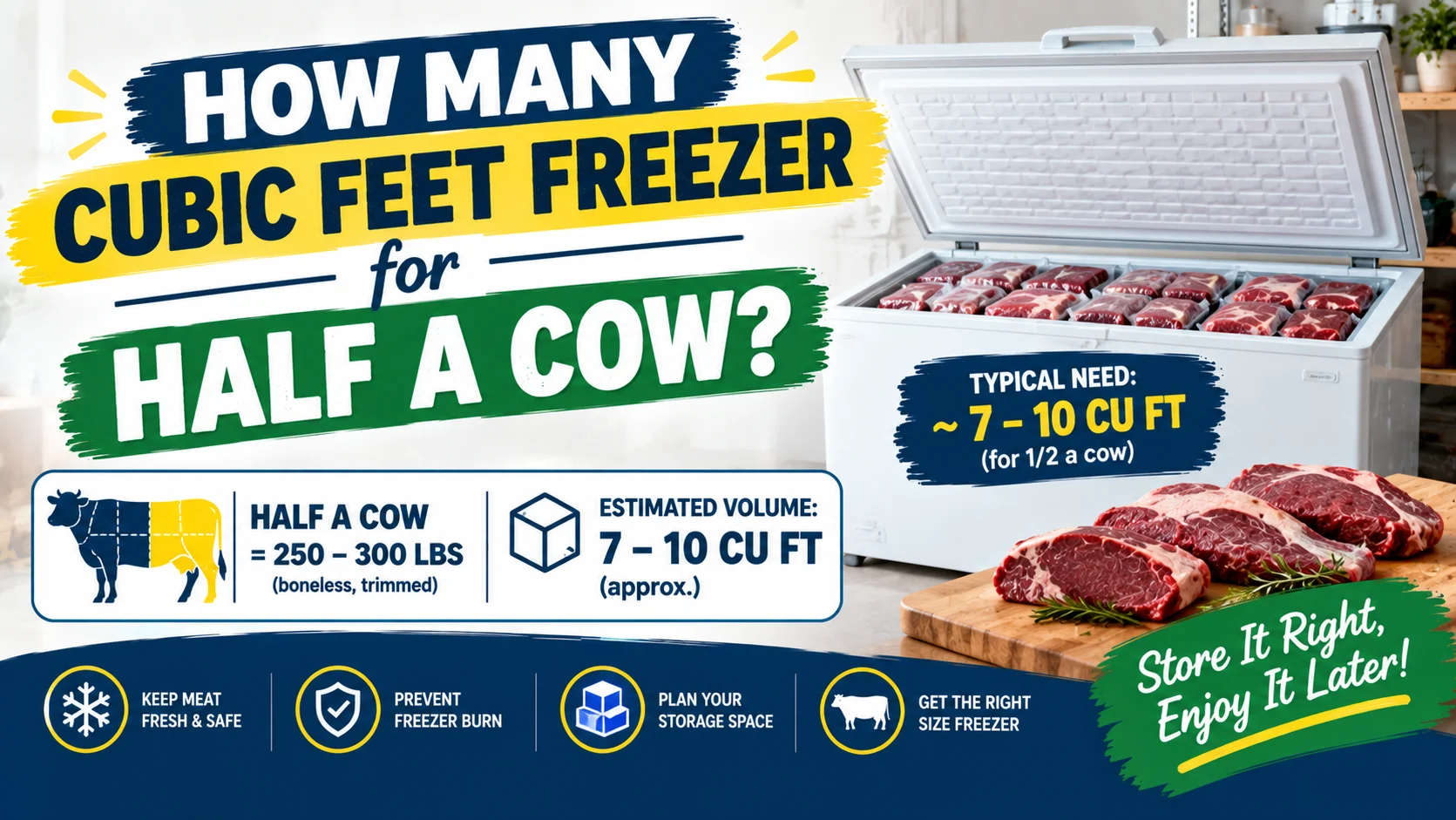
If you’re buying a half cow, one of the most important questions is how many cubic feet freezer for half a cow you will need. A typical half beef requires roughly 8 to 12 cubic feet of freezer space, although the exact amount can vary based on the animal’s hanging weight, how the meat is packaged, and the size and shape of individual cuts.
A common planning estimate is around 0.4 to 0.5 cubic feet of freezer space per 100 pounds of packaged beef. However, packaged meat does not fit into a freezer as efficiently as a solid block because boxes, irregularly shaped cuts, and air gaps take up additional space.
For many buyers, a 10 to 12 cubic-foot chest freezer is a practical starting point for a half cow, while a larger freezer may be preferable if you already have frozen food or want extra room.
Quick Answer
For a typical half cow, plan on approximately:
8–12 cubic feet of freezer space
A 10–12 cubic-foot freezer is often a reasonable size to consider if the freezer is primarily being used for the beef.
The exact requirement depends on:
- Hanging weight
- Final packaged meat weight
- Cut selection
- Packaging style
- Box dimensions
- Freezer organization
- Existing frozen food
- How tightly the packages can be stacked
Quick Freezer Size Guide
| Freezer Size | Typical Use |
|---|---|
| 5 cu ft | Usually too small for a full half cow |
| 7 cu ft | May be insufficient depending on quantity |
| 8 cu ft | Possible for a smaller, efficiently packed order |
| 10 cu ft | Good starting size for many buyers |
| 12 cu ft | More comfortable capacity |
| 14–16 cu ft | Extra room and easier organization |
| 18+ cu ft | Useful if storing other frozen foods too |
These are planning estimates rather than guarantees because beef quantities vary from animal to animal.
How Much Freezer Space Does Half a Cow Need?
The amount of freezer space required depends primarily on how much packaged meat you receive.
A half beef can have a substantial hanging weight, but the final amount of packaged meat is lower because bones, fat, moisture loss, trimming, and other processing factors affect the final yield.
For this reason, it is better to estimate freezer capacity from the expected take-home packaged weight rather than simply using the animal’s live weight.
A half cow might produce several hundred pounds of packaged beef, depending on the size of the animal and how it is processed.
As a broad planning range, many buyers should consider approximately 8 to 12 cubic feet of freezer capacity.
Understanding the Different Beef Weights
One reason freezer estimates can be confusing is that a beef animal can be described using several different weights.
Live Weight
Live weight is the animal’s weight before processing.
This is not the amount of meat that will go into your freezer.
Hanging Weight
Hanging weight, also called carcass weight, is measured after slaughter and initial processing.
It is generally lower than live weight.
Packaged or Take-Home Weight
This is the amount of meat you actually receive after aging, trimming, cutting, deboning where applicable, and packaging.
This is the number that matters most when determining freezer requirements.
Why Doesn’t All the Weight Become Packaged Beef?
A cow does not turn entirely into steaks, roasts, ground beef, and other packages.
Some weight is lost or separated through:
- Hide
- Head
- Organs
- Bones
- Excess fat
- Trimming
- Moisture loss during aging
- Processing
- Cuts you choose not to take
Therefore, using the live weight to calculate freezer capacity can significantly overestimate the amount of meat you will actually store.
How Much Beef Comes From Half a Cow?
The exact amount varies considerably.
Factors include:
- Breed
- Animal size
- Live weight
- Dressing percentage
- Aging time
- Fat level
- Cutting instructions
- Bone-in versus boneless cuts
- Amount of trimming
- Ground beef preferences
For planning purposes, a half cow can produce several hundred pounds of packaged beef.
Your butcher or farm should be able to provide a more specific estimate based on the animal’s actual hanging weight and expected yield.
How Much Freezer Space Per Pound of Beef?
There is no single universal number because packaging affects how efficiently the meat fits.
A useful planning estimate is approximately:
0.4–0.5 cubic feet per 100 pounds of packaged beef
However, you should treat this as an estimate rather than a strict conversion.
For example, if you receive 400 pounds of packaged beef:
400 ÷ 100 = 4
At 0.4 cubic feet per 100 pounds:
4 × 0.4 = 1.6 cubic feet
That mathematical result would represent the compact volume of the meat itself under a particular density assumption, but real freezer storage requires additional space for packaging, irregular shapes, air gaps, and organization.
For that reason, freezer planning should use practical freezer-capacity estimates rather than simply treating packaged meat as a perfectly compact solid.
How Big of a Chest Freezer for Half a Cow?
A chest freezer can be an excellent choice for bulk beef because its design allows large quantities of frozen food to be stored efficiently.
For a half cow, consider:
8 Cubic Feet
An 8-cubic-foot freezer may work for a smaller half beef or very efficiently packaged meat, but it can be tight.
It is also less suitable if you want to store other frozen foods.
10 Cubic Feet
A 10-cubic-foot freezer offers more flexibility and can be a reasonable choice for many half-cow purchases.
12 Cubic Feet
A 12-cubic-foot chest freezer gives you additional room and makes organizing different cuts easier.
It is a useful size to consider if you want some capacity beyond the beef itself.
14–16 Cubic Feet
A larger freezer can be helpful for:
- Larger animals
- Larger packaged yields
- Extra frozen food
- Better organization
- Future bulk purchases
The best choice ultimately depends on your expected packaged weight and the freezer’s actual usable capacity.
Can a 7 Cubic Foot Freezer Hold Half a Cow?
A 7-cubic-foot freezer may be too small for a typical half-cow purchase.
It could potentially work for a smaller quantity or a particularly efficient packaging arrangement, but it leaves little room for irregularly shaped packages.
If you’re purchasing a half cow specifically for bulk storage, choosing a freezer with more capacity provides a larger margin for variation.
Can a 10 Cubic Foot Freezer Hold Half a Cow?
A 10-cubic-foot freezer can be a reasonable size for many half-cow purchases.
However, whether it fits depends on the amount of packaged beef and how it is packaged.
If the meat arrives in large boxes or bulky packages, the usable capacity may be less than expected.
If you’re uncertain, ask the butcher approximately how many pounds of packaged beef you should expect.
Can a 12 Cubic Foot Freezer Hold Half a Cow?
A 12-cubic-foot freezer provides more capacity than a 10-cubic-foot model and can be a comfortable option for many half-cow purchases.
It also gives you more flexibility when organizing:
- Steaks
- Roasts
- Ground beef
- Ribs
- Brisket
- Stew meat
- Organ meats
- Other frozen products
A larger freezer doesn’t guarantee that every half cow will fit, but it gives you more room for variation.
Upright Freezer vs. Chest Freezer for Half a Cow
Both types can work, but they have different advantages.
Chest Freezer
Advantages include:
- Large open storage area
- Efficient use of interior volume
- Good for bulk purchases
- Generally easy to store large quantities
The main drawback is organization. Packages at the bottom can be harder to reach.
Upright Freezer
Advantages include:
- Shelves and compartments
- Easier access
- Easier organization
- Smaller footprint on the floor
However, shelves and drawers can reduce flexibility when storing large boxes and irregular packages.
For a large beef purchase, freezer organization is an important consideration regardless of the style.
How to Organize a Half Cow in a Freezer
Good organization can make a major difference.
Group Similar Cuts Together
Keep steaks, roasts, ground beef, and other categories together.
Label Everything
Clearly label each package with:
- Cut
- Weight
- Packaging date
- Quantity
Use Bins or Baskets
In a chest freezer, removable baskets can make it easier to access frequently used items.
Keep a Freezer Inventory
Create a simple list of what you have.
For example:
| Category | Example |
|---|---|
| Ground beef | 1 lb packages |
| Steaks | Ribeye, sirloin |
| Roasts | Chuck, rump |
| Ribs | Short ribs |
| Brisket | Whole or partial |
| Other | Stew meat, organs |
This prevents packages from getting buried and forgotten.
How Much Space Does Ground Beef Take?
Ground beef is often easier to store than irregularly shaped cuts because packages can be stacked.
If your butcher packages ground beef in uniform 1-pound or 2-pound packages, they can usually be arranged efficiently.
Vacuum-sealed packages can also be easier to stack than bulky packaging.
The more uniform the packaging, the easier it is to maximize freezer space.
Does Vacuum Sealing Save Freezer Space?
Vacuum sealing can make packages more compact because it removes much of the air around the meat.
This can improve organization and reduce unnecessary gaps.
However, vacuum sealing does not eliminate the need for adequate freezer capacity. Steaks, roasts, briskets, ribs, and other large cuts still have their own physical dimensions.
If freezer space is limited, ask your processor about packaging options before placing the order.
What Size Freezer for a Quarter Cow?
A quarter cow requires substantially less freezer space than a half cow.
A smaller freezer may be adequate depending on the packaged yield.
As a rough planning approach, a 5–7 cubic-foot freezer may be worth considering for a quarter beef, although the actual requirement depends on the quantity and packaging.
For an exact estimate, ask the butcher for the expected take-home weight.
What Size Freezer for a Whole Cow?
A whole cow requires roughly twice the meat-storage capacity of a half cow.
If a half cow requires approximately 8–12 cubic feet, a whole beef could require substantially more space, potentially around 16–24 cubic feet or more, depending on yield and packaging.
A large chest freezer or multiple freezers may be appropriate for a whole-animal purchase.
Factors That Affect Freezer Space Requirements
The amount of freezer space you need can vary because of several factors.
Animal Size
A larger animal generally produces more beef.
Processing Yield
Different animals and processing methods produce different final yields.
Bone-In vs. Boneless
Bone-in cuts generally occupy more physical space for the same edible meat weight.
Packaging
Vacuum-sealed packages can often be arranged more efficiently than bulky paper-wrapped packages.
Cut Selection
Large roasts and briskets can be difficult to arrange compared with flat ground-beef packages.
Existing Food
If your freezer already contains frozen food, you need additional capacity beyond the space required for the beef.
How to Calculate Your Own Freezer Requirement
The most reliable approach is to start with your expected packaged weight.
Step 1: Ask for the Expected Take-Home Weight
Ask your butcher or farm:
“Approximately how many pounds of packaged beef should I expect?”
Step 2: Consider the Packaging
Ask whether the beef will be:
- Vacuum sealed
- Paper wrapped
- Boxed
- Individually packaged
- Frozen before pickup
Step 3: Check Your Freezer’s Capacity
Look for the freezer’s listed capacity in cubic feet.
Step 4: Leave Some Extra Room
Don’t plan to fill every inch of the freezer.
Extra room makes it easier to organize the meat and retrieve individual packages.
Example Freezer Calculation
Suppose your processor estimates that your half cow will produce approximately 350 pounds of packaged beef.
You don’t want to choose a freezer based solely on the mathematical volume of the meat.
Instead, consider:
- Packaging
- Large cuts
- Air gaps
- Storage baskets
- Existing food
- Future purchases
A 10–12 cubic-foot freezer may be worth considering for this type of purchase, but you should confirm the expected packaged volume with your processor if the fit is critical.
Should You Buy a Bigger Freezer?
If you’re deciding between a freezer that will be nearly full and one with additional capacity, the larger model may provide more flexibility.
Extra capacity can be useful for:
- Other meat
- Frozen vegetables
- Prepared meals
- Bulk purchases
- Future beef purchases
- Seasonal food storage
However, larger freezers also require more floor space and may consume more electricity depending on the model.
Consider your long-term storage needs rather than buying solely for one beef order.
Common Mistakes When Buying a Freezer for Half a Cow
Choosing Based on Live Weight
Live weight is not the amount of packaged meat entering your freezer.
Buying the Exact Minimum Capacity
A freezer that technically fits the meat may be difficult to organize.
Forgetting Existing Food
If you already have frozen food, subtract the occupied capacity from the freezer’s available storage.
Ignoring Packaging
Two equal-weight beef orders can require different amounts of physical space depending on packaging.
Forgetting Large Cuts
Briskets, roasts, ribs, and other large pieces can create storage challenges.
Not Asking the Butcher
Your butcher or processor can often provide the best estimate because they know the expected yield and packaging style.
Frequently Asked Questions
How many cubic feet freezer for half a cow?
A typical planning range is approximately 8–12 cubic feet of freezer space for a half cow. A 10–12 cubic-foot freezer can provide a useful amount of capacity, but the actual requirement depends on packaged weight and packaging style.
What size freezer do I need for half a cow?
For many buyers, a 10–12 cubic-foot freezer is a practical starting point. Larger or more heavily yielding animals may require more capacity.
Will a 5 cubic foot freezer hold half a cow?
A 5-cubic-foot freezer is generally quite small for a typical half-cow purchase and may not provide enough room for the entire order.
Will a 7 cubic foot freezer hold half a cow?
It may be possible for a smaller yield with compact packaging, but 7 cubic feet can be tight for a typical half cow.
Is a 10 cubic foot freezer big enough for half a cow?
A 10-cubic-foot freezer can work for many half-cow orders, depending on the final packaged weight and packaging method.
Is a 12 cubic foot freezer big enough for half a cow?
A 12-cubic-foot freezer provides a useful amount of capacity for many half-cow purchases and leaves more room for organization than smaller models.
How many pounds of beef fit in a cubic foot freezer?
There is no universal pounds-per-cubic-foot figure because packaging, cut shape, bone content, and arrangement affect storage density. Use the processor’s expected packaged weight and freezer manufacturer’s capacity as planning references.
How much freezer space does a quarter cow need?
A quarter cow generally requires less space than a half cow. A freezer around 5–7 cubic feet may be considered depending on the final packaged yield and packaging.
How much freezer space does a whole cow need?
A whole cow may require roughly twice the freezer space of a half cow. A large freezer or multiple freezers may be needed, depending on the final packaged yield.
Does vacuum-sealed beef take less freezer space?
Vacuum-sealed packages can often be stacked more efficiently because they contain less excess air and can have a flatter shape. The actual savings depend on the cuts and packaging method.
Final Answer
So, how many cubic feet freezer for half a cow?
A useful general planning range is:
About 8–12 cubic feet of freezer space
For many buyers, a 10–12 cubic-foot freezer provides a practical amount of capacity for a half cow, especially when the meat is packaged efficiently.
However, there is no single freezer size that guarantees enough space for every half cow. The animal’s size, hanging weight, final packaged yield, bone-in versus boneless cuts, packaging method, and existing freezer contents all affect the amount of space required.
The best way to make the decision is to ask your butcher or farm for the estimated take-home packaged weight and packaging dimensions before purchasing your freezer.
If you’re buying a half cow for the first time, allowing some extra capacity can also make organization much easier than trying to pack the freezer completely full.



Pingback: How Many Square Feet in a Gallon of Paint?
Pingback: How Many Feet Between Fence Posts?