

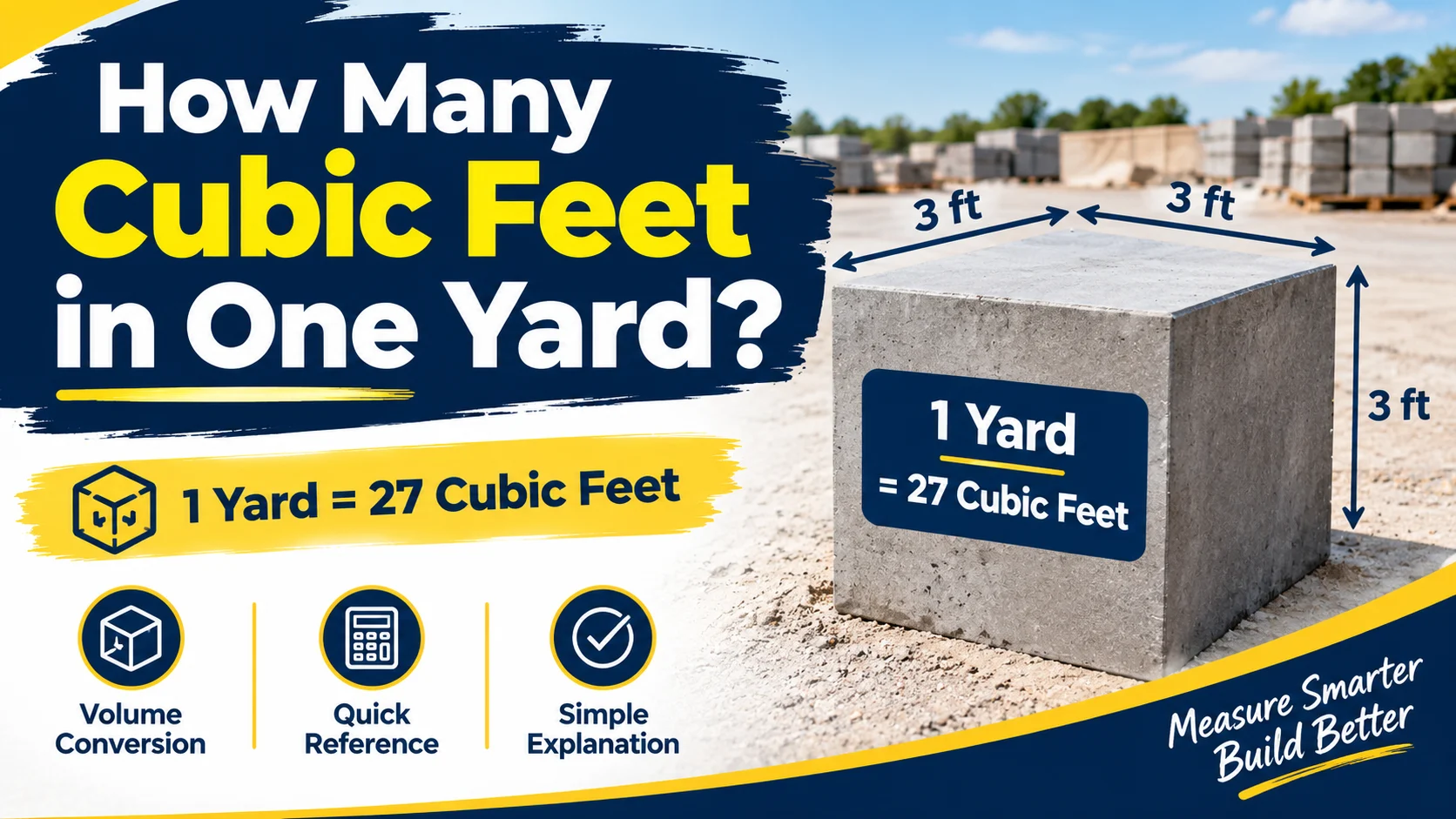
One cubic yard contains 27 cubic feet.
The basic conversion is:
1 cubic yard = 27 cubic feet
This is because one cubic yard is a cube measuring 3 feet long × 3 feet wide × 3 feet high:
3 × 3 × 3 = 27 cubic feet
So, if you are wondering how many cubic feet in one yard, the answer is 27 cubic feet.
This conversion applies to volume. It is commonly used when calculating quantities of dirt, topsoil, mulch, gravel, sand, concrete, compost, and other materials sold by the cubic yard.
What Is a Cubic Yard?
A cubic yard is a unit of volume used primarily in the United States and other places that use U.S. customary measurements.
Unlike a regular yard, which measures length, a cubic yard measures three-dimensional space.
Imagine a box that is:
- 3 feet long
- 3 feet wide
- 3 feet high
The volume of that box is:
3 ft × 3 ft × 3 ft = 27 ft³
Therefore:
1 yd³ = 27 ft³
The superscript ³ is important because it means the measurement is cubic, or three-dimensional.
How Many Cubic Feet Are in One Yard?
There are 27 cubic feet in one cubic yard.
The conversion works because:
1 yard = 3 feet
For cubic measurements, you must multiply the conversion three times:
1 yd³ = 3 ft × 3 ft × 3 ft
1 yd³ = 27 ft³
Therefore:
1 cubic yard = 27 cubic feet
It is important not to confuse this with linear measurements. One yard is only 3 feet when measuring length, while one cubic yard is 27 cubic feet when measuring volume.
Cubic Yard to Cubic Feet Formula
The formula for converting cubic yards to cubic feet is very simple:
Cubic Feet = Cubic Yards × 27
For example, if you have 4 cubic yards:
4 × 27 = 108 cubic feet
Therefore:
4 cubic yards = 108 cubic feet
More Examples
| Cubic Yards | Cubic Feet |
|---|---|
| 0.25 yd³ | 6.75 ft³ |
| 0.5 yd³ | 13.5 ft³ |
| 1 yd³ | 27 ft³ |
| 2 yd³ | 54 ft³ |
| 3 yd³ | 81 ft³ |
| 4 yd³ | 108 ft³ |
| 5 yd³ | 135 ft³ |
| 6 yd³ | 162 ft³ |
| 10 yd³ | 270 ft³ |
| 20 yd³ | 540 ft³ |
Simply multiply the number of cubic yards by 27 to get cubic feet.
How to Convert Cubic Feet to Cubic Yards
You can also convert in the opposite direction.
The formula is:
Cubic Yards = Cubic Feet ÷ 27
For example, suppose you have 81 cubic feet of soil.
81 ÷ 27 = 3 cubic yards
Therefore:
81 cubic feet = 3 cubic yards
Cubic Feet to Cubic Yards Chart
| Cubic Feet | Cubic Yards |
|---|---|
| 6.75 ft³ | 0.25 yd³ |
| 13.5 ft³ | 0.5 yd³ |
| 27 ft³ | 1 yd³ |
| 54 ft³ | 2 yd³ |
| 81 ft³ | 3 yd³ |
| 108 ft³ | 4 yd³ |
| 135 ft³ | 5 yd³ |
| 162 ft³ | 6 yd³ |
| 270 ft³ | 10 yd³ |
| 540 ft³ | 20 yd³ |
Why Is One Cubic Yard Equal to 27 Cubic Feet?
The answer comes directly from the definition of a cubic yard.
A cube that measures one yard on every side has a volume of one cubic yard.
Since:
1 yard = 3 feet
each side is 3 feet long.
Now calculate the volume:
Length × Width × Height
3 × 3 × 3 = 27
So:
1 cubic yard = 27 cubic feet
The key is that the conversion factor of 3 is used in all three dimensions.
You should not multiply by 3 only once when converting cubic yards to cubic feet.
How Many Cubic Feet Are in 2 Yards?
There are 54 cubic feet in 2 cubic yards.
Calculation:
2 × 27 = 54 cubic feet
So:
2 yd³ = 54 ft³
This might be useful when ordering two cubic yards of mulch, soil, gravel, or another bulk material.
How Many Cubic Feet Are in 3 Yards?
There are 81 cubic feet in 3 cubic yards.
Calculation:
3 × 27 = 81 cubic feet
Therefore:
3 yd³ = 81 ft³
How Many Cubic Feet Are in 5 Yards?
There are 135 cubic feet in 5 cubic yards.
Calculation:
5 × 27 = 135 cubic feet
Therefore:
5 yd³ = 135 ft³
How Many Cubic Feet Are in 10 Yards?
There are 270 cubic feet in 10 cubic yards.
Calculation:
10 × 27 = 270 cubic feet
Therefore:
10 yd³ = 270 ft³
This is a useful conversion for larger landscaping and construction projects.
How Many Cubic Feet Does One Yard of Material Cover?
The answer depends on depth.
A cubic yard always contains 27 cubic feet, but the surface area it covers changes depending on how thickly you spread the material.
For example, one cubic yard of mulch spread 2 inches deep covers more area than the same cubic yard spread 6 inches deep.
A useful formula is:
Coverage in square feet = 324 ÷ depth in inches
For one cubic yard:
| Depth | Coverage From 1 Cubic Yard |
|---|---|
| 1 inch | 324 sq ft |
| 2 inches | 162 sq ft |
| 3 inches | 108 sq ft |
| 4 inches | 81 sq ft |
| 5 inches | 64.8 sq ft |
| 6 inches | 54 sq ft |
| 8 inches | 40.5 sq ft |
| 10 inches | 32.4 sq ft |
| 12 inches | 27 sq ft |
This calculation is particularly useful for landscaping materials such as mulch, topsoil, compost, and fill dirt.
How to Calculate Cubic Yards for a Project
If you know the length, width, and depth of your project, you can calculate the amount of material needed.
Use this formula:
Cubic Feet = Length × Width × Depth
Make sure all three measurements are in feet.
Then convert cubic feet to cubic yards:
Cubic Yards = Cubic Feet ÷ 27
Example: 10 × 20 Foot Area
Suppose you need to fill an area that is:
- 10 feet long
- 20 feet wide
- 4 inches deep
First convert 4 inches to feet:
4 ÷ 12 = 0.3333 feet
Now calculate the volume:
10 × 20 × 0.3333 = 66.67 cubic feet
Convert to cubic yards:
66.67 ÷ 27 = 2.47 cubic yards
You would need approximately 2.47 cubic yards of material before accounting for settling, waste, or other project-specific considerations.
Shortcut Formula for Cubic Yards
If your project dimensions are in feet but the depth is given in inches, you can use a convenient shortcut:
Cubic Yards = Length × Width × Depth in Inches ÷ 324
For example:
10 × 20 × 4 ÷ 324 = 2.47 cubic yards
This shortcut saves you from converting the depth from inches to feet first.
Cubic Feet vs. Square Feet
One of the most common mistakes is confusing square feet with cubic feet.
Square Feet
Square feet measure area.
For example:
10 ft × 20 ft = 200 square feet
Cubic Feet
Cubic feet measure volume.
For example:
10 ft × 20 ft × 1 ft = 200 cubic feet
Square feet have two dimensions:
length × width
Cubic feet have three:
length × width × height
This distinction is especially important when purchasing landscaping or construction materials.
Cubic Yard vs. Cubic Foot
Both units measure volume, but they represent different quantities.
| Measurement | Equivalent |
|---|---|
| 1 cubic foot | 1 ft³ |
| 1 cubic yard | 27 ft³ |
| 2 cubic yards | 54 ft³ |
| 3 cubic yards | 81 ft³ |
| 5 cubic yards | 135 ft³ |
| 10 cubic yards | 270 ft³ |
The easiest rule to remember is:
Multiply cubic yards by 27 to get cubic feet.
Divide cubic feet by 27 to get cubic yards.
How Many Cubic Feet Are in a Yard of Dirt?
There are 27 cubic feet in one cubic yard of dirt.
The same volume conversion applies whether the material is:
- Topsoil
- Garden soil
- Fill dirt
- Compost
- Mulch
- Gravel
- Sand
- Concrete
However, these materials can have very different weights.
For example, a cubic yard of dry mulch may weigh much less than a cubic yard of wet soil or gravel.
Therefore, never assume that every cubic yard weighs the same.
How Many Bags Equal One Cubic Yard?
The answer depends on the volume of each bag.
Since one cubic yard equals 27 cubic feet, divide 27 by the volume of one bag.
For example:
1-Cubic-Foot Bags
27 ÷ 1 = 27 bags
So you need 27 one-cubic-foot bags to equal one cubic yard.
1.5-Cubic-Foot Bags
27 ÷ 1.5 = 18 bags
2-Cubic-Foot Bags
27 ÷ 2 = 13.5 bags
You would need 14 full 2-cubic-foot bags to provide at least one cubic yard.
3-Cubic-Foot Bags
27 ÷ 3 = 9 bags
| Bag Size | Bags Per Cubic Yard |
|---|---|
| 1 cu ft | 27 |
| 1.5 cu ft | 18 |
| 2 cu ft | 13.5 |
| 2.5 cu ft | 10.8 |
| 3 cu ft | 9 |
Always check the actual volume printed on the product packaging.
Does One Cubic Yard Always Contain 27 Cubic Feet?
Yes.
The volume conversion itself does not change:
1 cubic yard = 27 cubic feet
What can change is the weight or physical amount of material in that volume.
For example, one cubic yard of soil remains 27 cubic feet whether it is dry or wet. However, wet soil will generally weigh more than dry soil.
Similarly, loose material may settle after delivery, which can affect how much usable material you have after spreading or compacting it.
How Much Material Should You Order?
After calculating the required volume, you may need to consider waste, settling, and compaction.
For example, if your calculation gives you exactly 3 cubic yards, ordering exactly 3 yards may or may not be sufficient depending on the project.
Factors that can affect the final amount include:
- Soil settling
- Compaction
- Uneven ground
- Material loss during spreading
- Measurement errors
- Irregularly shaped areas
- Excavation conditions
For important projects, calculate the volume carefully and ask the material supplier or contractor whether an additional allowance is appropriate.
Avoid adding a large amount of extra material without reason, because that can unnecessarily increase costs.
Common Mistakes When Converting Cubic Yards to Cubic Feet
1. Confusing a Yard With a Cubic Yard
A yard measures length.
A cubic yard measures volume.
1 yard = 3 feet
but:
1 cubic yard = 27 cubic feet
2. Multiplying by 3 Instead of 27
Because one yard equals three feet, it can be tempting to multiply one cubic yard by 3.
That is incorrect.
For cubic measurements, the conversion applies in three dimensions:
3 × 3 × 3 = 27
3. Forgetting the Depth
When calculating soil, mulch, or gravel requirements, measuring only length and width gives you square feet, not cubic feet.
You also need the material depth.
4. Mixing Inches and Feet
If length and width are measured in feet but depth is measured in inches, convert the units or use the shortcut formula.
For example, don’t calculate:
20 × 30 × 4
and call the answer cubic feet.
The 4 represents inches, not feet.
5. Assuming Weight Equals Volume
A cubic yard is a volume measurement, not a weight measurement.
Different materials have different densities.
Quick Cubic Yard Conversion Chart
For easy reference:
| Cubic Yards | Cubic Feet |
|---|---|
| 0.1 | 2.7 |
| 0.25 | 6.75 |
| 0.5 | 13.5 |
| 0.75 | 20.25 |
| 1 | 27 |
| 1.5 | 40.5 |
| 2 | 54 |
| 2.5 | 67.5 |
| 3 | 81 |
| 4 | 108 |
| 5 | 135 |
| 6 | 162 |
| 8 | 216 |
| 10 | 270 |
FAQs
How many cubic feet in one yard?
There are 27 cubic feet in one cubic yard. The calculation is 3 feet × 3 feet × 3 feet = 27 cubic feet.
Is a yard the same as a cubic yard?
No. A yard is a unit of length equal to 3 feet. A cubic yard is a unit of volume equal to 27 cubic feet.
How many cubic feet are in 2 cubic yards?
There are 54 cubic feet in 2 cubic yards.
2 × 27 = 54
How many cubic feet are in 3 cubic yards?
There are 81 cubic feet in 3 cubic yards.
3 × 27 = 81
How many cubic feet are in 5 cubic yards?
There are 135 cubic feet in 5 cubic yards.
5 × 27 = 135
How do I convert cubic feet to cubic yards?
Divide the number of cubic feet by 27.
Cubic yards = cubic feet ÷ 27
For example, 108 cubic feet ÷ 27 = 4 cubic yards.
How many cubic feet are in a yard of dirt?
One cubic yard of dirt contains 27 cubic feet. The volume conversion is the same for dirt, soil, mulch, gravel, sand, and other materials.
How much area does one cubic yard cover?
Coverage depends on depth. At 2 inches deep, one cubic yard covers about 162 square feet. At 3 inches, it covers about 108 square feet, and at 4 inches, about 81 square feet.
How many 2-cubic-foot bags are in one cubic yard?
There are 13.5 two-cubic-foot bags in one cubic yard mathematically. Because you normally purchase whole bags, you would need 14 full bags to provide at least one cubic yard.
Final Answer
If you’re asking how many cubic feet in one yard, the answer is:
1 cubic yard = 27 cubic feet
The calculation is:
3 feet × 3 feet × 3 feet = 27 cubic feet
To convert cubic yards to cubic feet, multiply by 27:
Cubic feet = cubic yards × 27
To convert cubic feet back to cubic yards, divide by 27:
Cubic yards = cubic feet ÷ 27
This simple conversion is useful when buying or calculating dirt, topsoil, mulch, gravel, sand, compost, concrete, and other bulk materials. Just remember that cubic feet measure volume, while square feet measure surface area, and the amount of area a cubic yard covers depends on how deep you spread the material.


Pingback: How Many Yards Are in 27 Feet? Complete Guide