
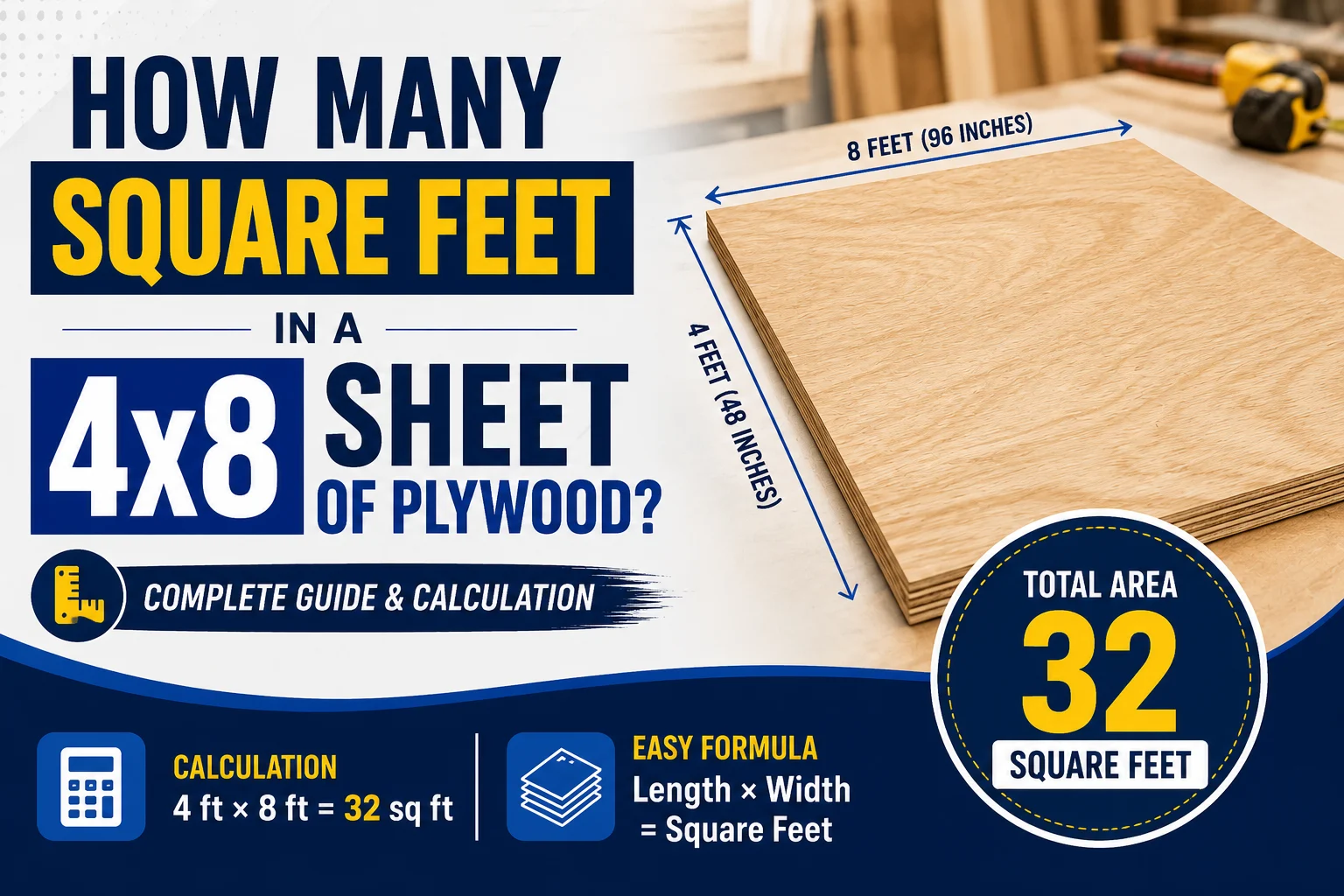
If you are wondering how many square feet are in a 4×8 sheet of plywood, the answer is:
4 feet×8 feet=32 square feet
A standard 4×8 plywood sheet covers:
32 square feet
This is one of the most common building material sizes used in:
- Construction
- Flooring
- Roofing
- Furniture building
- Home renovation
Understanding plywood square footage helps you:
- Estimate materials accurately
- Reduce waste
- Budget properly
- Plan projects efficiently
In this guide, you will learn how plywood square footage is calculated, common uses for 4×8 sheets, and practical tips for estimating plywood needs.
Quick Answer
A standard 4×8 plywood sheet contains:
32 square feet
Exact Square Footage
The calculation is simple:
4×8=32
Basic Formula
To calculate square footage:
Length×Width=Square Feet
Understanding Plywood Dimensions
Plywood sheets come in standard sizes for construction efficiency.
What Does 4×8 Mean?
A 4×8 sheet measures:
- 4 feet wide
- 8 feet long
This size is standard across many construction industries.
Standard Plywood Sizes
While 4×8 is most common, other sizes exist:
- 2×4
- 4×10
- 5×5
However, 4×8 sheets dominate most residential projects.
How to Calculate Square Feet in Plywood
Square footage calculations are straightforward.
Formula Explained
Use this formula:
Length×Width=Area
Step-by-Step Example
For a standard plywood sheet:
Length:
8 feet
Width:
4 feet
Multiply them:
8×4=32 square feet
Final result:
32 square feet
Plywood Coverage Chart
Here are common plywood sheet sizes and coverage:
| Plywood Size | Square Footage |
|---|---|
| 2×4 | 8 sq ft |
| 4×4 | 16 sq ft |
| 4×8 | 32 sq ft |
| 4×10 | 40 sq ft |
| 5×5 | 25 sq ft |
This chart helps estimate project material needs quickly.
Common Uses for 4×8 Plywood Sheets
The 4×8 sheet is widely used in construction and woodworking.
Flooring
Subfloors often use:
- 4×8 plywood sheets
because they cover large areas efficiently.
Roofing
Roof decking commonly relies on:
- Plywood sheathing
for structural support.
Wall Sheathing
Exterior wall framing often uses:
- 4×8 sheets
to simplify installation.
Why Plywood Square Footage Matters
Knowing plywood coverage helps improve:
- Planning
- Cost estimation
- Material efficiency
Accurate Budgeting
Understanding sheet coverage prevents:
- Overbuying
- Underbuying
Reduced Waste
Precise measurements minimize:
- Scrap material
- Extra cuts
Faster Construction
Correct material estimates improve:
- Workflow
- Labor efficiency
How Many Sheets of Plywood Do You Need?
To estimate plywood requirements:
Step 1: Measure Total Area
Suppose a room measures:
12 feet×16 feet=192 square feet
Step 2: Divide by Sheet Coverage
Each sheet covers:
32 square feet
Now divide:
192÷32=6
You would need:
- Approximately 6 sheets
before accounting for waste.
Common Plywood Estimation Mistakes
Forgetting Waste Factor
Always allow extra plywood for:
- Cuts
- Damage
- Mistakes
Professionals often add:
- 10% extra
Ignoring Sheet Orientation
Improper layout can increase:
- Waste
- Material costs
Measuring Incorrectly
Double-check:
- Length
- Width
- Openings
before ordering materials.
Tips for Buying Plywood
Choose the Correct Thickness
Different projects require different thicknesses:
- Flooring
- Roofing
- Furniture
- Cabinets
Inspect Sheet Quality
Check for:
- Warping
- Cracks
- Delamination
Store Plywood Properly
Keep sheets:
- Flat
- Dry
- Protected from moisture
Common Plywood Thicknesses
Popular plywood thicknesses include:
- 1/4 inch
- 1/2 inch
- 5/8 inch
- 3/4 inch
Thicker plywood offers:
- Greater strength
- Better load support
Fun Facts About Plywood
Plywood Is Made From Thin Wood Layers
These layers are glued together in alternating grain directions for added strength.
Plywood Is Stronger Than Many Solid Boards
Cross-grain construction improves:
- Durability
- Stability
Modern Plywood Is Used Worldwide
Plywood is one of the most versatile construction materials available today.
FAQs
How many square feet are in a 4×8 sheet of plywood?
A standard 4×8 sheet contains:
32 square feet
What formula calculates plywood square footage?
Use:
Length×Width=Square Feet
How many 4×8 plywood sheets cover 100 square feet?
Since each sheet covers 32 square feet, you need about:
- 4 sheets
after accounting for waste.
What is the most common plywood size?
The most common plywood sheet size is:
- 4 feet by 8 feet
Why is plywood sold in 4×8 sheets?
This standardized size works efficiently with:
- Stud spacing
- Framing systems
- Construction layouts
Conclusion
So, how many square feet are in a 4×8 sheet of plywood? The exact coverage is:
32 square feet
Understanding plywood square footage helps homeowners, contractors, and DIY builders estimate materials accurately, reduce waste, and improve project planning.
Whether you are building floors, walls, roofs, or furniture, knowing how much area a plywood sheet covers makes construction projects faster, easier, and more cost-effective.