

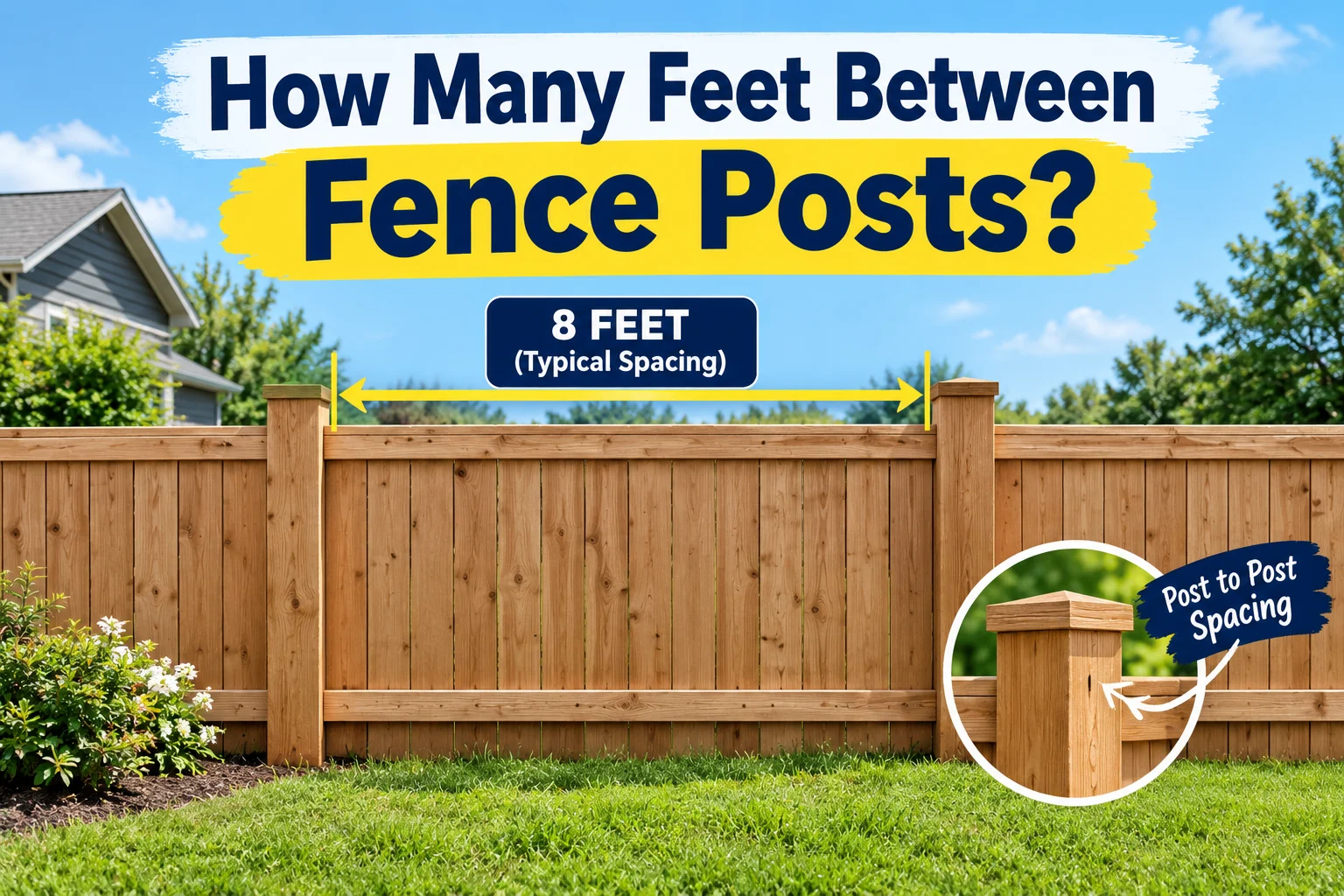
If you are building a fence, one of the most important measurements to get right is how many feet should be between fence posts. The spacing affects the fence’s strength, appearance, cost, and ability to withstand wind, weather, and everyday use.
For most residential fences, 6 to 8 feet between fence posts is a common range. A 6-foot spacing generally provides more support, while 8-foot spacing can reduce the number of posts and installation costs.
The ideal distance depends on the type of fence, the material, fence height, local weather conditions, and the weight of the panels. A lightweight fence may allow wider spacing, while a tall, heavy, or high-wind fence may require posts closer together.
In this guide, you’ll learn how far apart fence posts should be, how to calculate the number of posts you need, and how spacing changes for wood, vinyl, chain-link, and other common fences.
Quick Answer: How Many Feet Should Be Between Fence Posts?
For many residential fences, posts are installed approximately 6 to 8 feet apart.
Here are common spacing ranges:
| Fence Type | Typical Post Spacing |
|---|---|
| Wood privacy fence | 6–8 feet |
| Wood picket fence | 6–8 feet |
| Vinyl fence | 6–8 feet |
| Chain-link fence | 6–10 feet |
| Agricultural fence | 8–12+ feet |
| Heavy or high-wind fence | Often 6 feet or less |
These are general planning ranges. The manufacturer’s specifications and local building requirements should take priority.
Why Does Fence Post Spacing Matter?
Fence posts are the structural support for the entire fence.
If posts are spaced too far apart, the fence can become weak or unstable. Rails may sag, panels can flex, and wind can place excessive stress on the posts.
If posts are placed too close together, the fence may be stronger than necessary, but you will need more posts, more concrete, and more labor.
Good spacing balances:
- Strength
- Stability
- Material cost
- Installation time
- Fence appearance
- Local conditions
For this reason, choosing post spacing before buying materials can make the entire project easier.
Is 6 Feet or 8 Feet Better for Fence Posts?
Both 6-foot and 8-foot spacing are common, but they have different advantages.
6-Foot Post Spacing
With posts every 6 feet, each section of fencing has more structural support.
This can be useful for:
- Privacy fences
- Heavy wood panels
- Tall fences
- Windy locations
- Areas where additional rigidity is desired
The tradeoff is that you will need more posts.
8-Foot Post Spacing
Eight-foot spacing can reduce the number of posts required.
For example, a 100-foot straight fence could require approximately:
- 6-foot spacing: about 17 intervals
- 8-foot spacing: about 13 intervals
The exact number depends on how the fence begins and ends and whether gates or corners require additional posts.
Eight-foot spacing is common for many standard wood fence installations, but the fence design and material specifications should determine the final spacing.
How Far Apart Should Wood Fence Posts Be?
For a typical wood fence, 6 to 8 feet apart is a common starting point.
For example, if you are installing an 8-foot-wide fence panel, placing a post at each end creates an approximately 8-foot post-to-post span.
However, the actual layout can depend on whether the stated panel width includes the posts or only the panel itself.
Wood Privacy Fence
Privacy fences are exposed to considerable wind because they have relatively few gaps.
For this reason, many installations use approximately 6 to 8 feet between posts.
A shorter spacing can provide additional support in areas with strong winds or for taller fences.
Wood Picket Fence
Picket fences may be lighter and more open than privacy fences.
Post spacing of approximately 6 to 8 feet is common, depending on the rails and overall design.
How Far Apart Should Vinyl Fence Posts Be?
Vinyl fencing is often designed around specific panel dimensions.
Many vinyl systems use approximately 6- to 8-foot sections, but the manufacturer’s installation instructions should be followed.
Unlike a simple wood fence, vinyl fencing may use posts, rails, brackets, and panels designed to work together.
Installing posts at an arbitrary distance can result in panels that do not fit correctly.
Before digging, check:
- Panel width
- Post dimensions
- Manufacturer’s instructions
- Gate dimensions
- Corner-post requirements
- End-post requirements
How Far Apart Should Chain-Link Fence Posts Be?
Chain-link fencing can have wider spacing than some privacy fences, although the exact distance varies according to the fence height, mesh, framework, and design.
A common planning range for line posts is approximately 6 to 10 feet apart.
For many residential applications, spacing around 8 feet can be a useful starting point.
Terminal posts—such as corner, end, and gate posts are structurally different from ordinary line posts and require special attention.
How Far Apart Should Fence Posts Be for a 6-Foot Fence?
A 6-foot fence often uses posts spaced approximately 6 to 8 feet apart.
For a wood privacy fence, 6-foot spacing can provide additional support, while 8-foot spacing may be suitable when the fence design and materials are engineered for that span.
The taller the fence, the more important structural support becomes.
A 6-foot solid privacy fence catches substantially more wind than a short decorative picket fence, so the fence design should not be based on post spacing alone.
How Far Apart Should Fence Posts Be for an 8-Foot Fence?
An 8-foot fence is taller and can experience greater wind loads than a shorter fence.
Because of this, many designs use closer post spacing than a low decorative fence.
A common planning approach is approximately 6 feet between posts, but the correct spacing depends on the fence material, post size, rails, footing, soil, and local requirements.
For a tall privacy fence, don’t automatically use 8-foot spacing simply because standard fence panels are often 8 feet wide.
How Many Fence Posts Do I Need?
You can estimate the number of fence posts using the total fence length and your planned post spacing.
A simple calculation is:
Number of Intervals = Fence Length ÷ Post Spacing
Then account for the fence layout and endpoints.
For example, suppose you have a 100-foot straight fence and want posts approximately 8 feet apart:
100 ÷ 8 = 12.5
Since you cannot have half an interval, you would need to adjust the layout.
If you divide the fence into 13 equal spaces:
100 ÷ 13 = 7.69 feet
The posts would be approximately 7.7 feet apart.
This is often better than simply placing one post every 8 feet and leaving an uneven section at the end.
Fence Post Spacing Calculator
Use this basic formula when planning a straight fence:
Approximate Number of Spaces = Fence Length ÷ Desired Spacing
For example:
120 feet ÷ 8 feet = 15 spaces
A straight 120-foot fence with 15 equal 8-foot spaces would have 16 posts if there is a post at both ends.
This distinction is important:
Number of posts = Number of spaces + 1
For a straight fence with no gates or corners:
| Fence Length | Approx. Spacing | Spaces | Posts |
|---|---|---|---|
| 24 ft | 6 ft | 4 | 5 |
| 30 ft | 6 ft | 5 | 6 |
| 40 ft | 8 ft | 5 | 6 |
| 48 ft | 8 ft | 6 | 7 |
| 60 ft | 6 ft | 10 | 11 |
| 80 ft | 8 ft | 10 | 11 |
| 100 ft | 8 ft* | 13 | 14 |
| 120 ft | 8 ft | 15 | 16 |
*For 100 feet, 13 equal spaces would actually produce about 7.69 feet between posts.
How Many Fence Posts for 100 Feet?
For a 100-foot fence, the number of posts depends on the spacing.
At 6-Foot Spacing
100 ÷ 6 = 16.67
You would need approximately 17 intervals, resulting in about 18 posts for a straight run.
The actual spacing would be:
100 ÷ 17 = 5.88 feet
At 8-Foot Spacing
100 ÷ 8 = 12.5
You would need to use approximately 13 intervals.
That means:
13 + 1 = 14 posts
The resulting spacing would be:
100 ÷ 13 = 7.69 feet
Therefore, a 100-foot fence could use approximately 14 posts when targeting an 8-foot maximum spacing.
How Many Fence Posts for 200 Feet?
For a 200-foot fence:
At 6-Foot Spacing
200 ÷ 6 = 33.33
You would need 34 intervals, or approximately 35 posts.
Actual spacing:
200 ÷ 34 = 5.88 feet
At 8-Foot Spacing
200 ÷ 8 = 25
You would need 25 spaces and 26 posts.
So, a straight 200-foot fence with 8-foot spacing would require approximately 26 posts.
How Many Fence Posts for 300 Feet?
At 8-foot spacing:
300 ÷ 8 = 37.5
You would need 38 intervals.
Therefore:
38 + 1 = 39 posts
The actual spacing would be:
300 ÷ 38 ≈ 7.89 feet
At 6-foot spacing:
300 ÷ 6 = 50
You would need:
50 + 1 = 51 posts
This illustrates how much the number of posts can change when you reduce the spacing from 8 feet to 6 feet.
How Far Apart Should Fence Posts Be for a Gate?
Gate posts require special consideration.
A gate is heavier and moves repeatedly, placing additional stress on the supporting posts.
Gate posts may need to be:
- Larger
- Deeper
- More heavily reinforced
- Set in stronger footings
- Positioned according to the gate manufacturer’s specifications
Do not treat a gate post exactly like an ordinary line post.
The opening between gate posts should also be based on the actual gate size, hardware, and clearance requirements.
How Far Apart Should Corner Fence Posts Be?
Corners are another important structural point.
A corner post changes the direction of the fence and may carry tension from both directions.
For this reason, corners should be treated as structural posts rather than simply continuing the normal spacing pattern.
A typical layout may include:
- End posts
- Corner posts
- Gate posts
- Line posts
The line posts support the fence between these major structural points.
How Deep Should Fence Posts Be?
Post spacing is only one part of a stable fence.
The depth of the post depends on fence height, soil conditions, frost conditions, local building requirements, and fence design.
A commonly used rule of thumb for many wood fence installations is to bury approximately one-third of the post length, with additional consideration for the required above-ground height.
For example, a 6-foot fence may require posts significantly longer than 6 feet because part of the post needs to be below ground.
However, this is not a universal engineering rule. Local frost depth, soil conditions, wind exposure, and building codes can change the required footing depth.
Does Soil Type Affect Fence Post Spacing?
Yes.
The soil around the fence can affect stability.
Examples include:
- Firm clay
- Sandy soil
- Loose fill
- Gravelly soil
- Rocky ground
- Wet soil
Soft or unstable soil may require stronger or deeper footings.
A fence in a high-wind area with poor soil may require a different design from the same fence installed in firm ground.
Does Wind Affect Fence Post Spacing?
Wind can have a major effect on fence design.
A solid privacy fence behaves differently from an open picket or chain-link fence because a solid fence presents a larger surface area to the wind.
If your property experiences strong winds, you may need:
- Closer post spacing
- Larger posts
- Deeper footings
- Stronger concrete footings
- Stronger rails
- Additional bracing
For tall or solid fences, following an engineered design or local requirements is especially important.
What Happens If Fence Posts Are Too Far Apart?
Posts installed too far apart can contribute to several problems.
Sagging Rails
Longer spans can place more stress on horizontal rails.
Flexible Panels
Fence panels may move more easily between widely spaced posts.
Wind Damage
Strong winds can place substantial force on a fence.
Uneven Appearance
Excessive spacing can cause sections to look less stable or properly supported.
Premature Repairs
A poorly supported fence may require repairs sooner than a properly designed installation.
What Happens If Fence Posts Are Too Close Together?
Closer spacing generally provides more support, but it also increases material and labor requirements.
You may need:
- More fence posts
- More concrete
- More digging
- More labor
- More time
For this reason, closer spacing is not automatically necessary or better for every fence.
The goal is to use spacing appropriate for the fence design and conditions.
Fence Post Spacing for Different Materials
Different fencing materials have different structural requirements.
Wood
Wood fences commonly use approximately 6 to 8 feet between posts.
Vinyl
Vinyl fence systems often use approximately 6 to 8 feet, but manufacturer specifications are especially important.
Chain Link
Chain-link line posts may commonly be spaced around 6 to 10 feet apart, depending on the installation.
Farm Fencing
Agricultural fencing can use wider spacing, sometimes 8 to 12 feet or more, depending on the type of fence and terrain.
Metal Fencing
Ornamental metal fencing may have post spacing determined by the panel dimensions and manufacturer’s design.
How to Plan Fence Posts Before Digging
Before you start digging, mark the entire fence layout.
1. Measure the Fence Line
Determine the total length.
2. Identify Corners
Mark every change in direction.
3. Mark Gates
Gate locations should be established before calculating line posts.
4. Determine Maximum Spacing
Choose spacing based on the fence design and manufacturer’s requirements.
5. Divide Each Run
Calculate how many equal spaces fit between structural posts.
6. Mark Post Locations
Use stakes, string, or marking paint to identify each location.
7. Check Utilities
Before digging, make sure underground utility locations have been identified according to local procedures.
8. Confirm Local Requirements
Fence height, setbacks, permits, and footing requirements can vary by location.
FAQs
What is the standard distance between fence posts?
For many residential fences, 6 to 8 feet is a common spacing range. The correct distance depends on the fence material, height, panel design, and local conditions.
Is 8 feet too far between fence posts?
Not necessarily. Eight feet is common for many fence designs, but whether it is appropriate depends on the fence system and structural requirements.
Is 6 feet between fence posts better than 8 feet?
Six-foot spacing provides more frequent structural support, while 8-foot spacing reduces the number of posts. Neither spacing is universally appropriate for every fence.
How far apart should posts be for a 6-foot privacy fence?
Approximately 6 to 8 feet is a common planning range, although taller solid fences and windy locations may require closer spacing or stronger construction.
How far apart should posts be for an 8-foot fence?
An 8-foot fence may require closer spacing and stronger construction than a shorter fence. Approximately 6 feet can be used as a planning starting point for some designs, but the manufacturer’s or engineer’s specifications should determine the final spacing.
How many fence posts do I need for 100 feet?
At approximately 8-foot spacing, a 100-foot straight run would require about 14 posts, creating 13 spaces of approximately 7.69 feet each.
At approximately 6-foot spacing, it would require about 18 posts, creating 17 spaces of approximately 5.88 feet each.
How far apart should chain-link fence posts be?
A common planning range is approximately 6 to 10 feet, although exact spacing depends on fence height, mesh, framework, and manufacturer specifications.
Do corner posts need to be stronger?
Yes. Corner and end posts often carry additional forces and should be designed accordingly.
Do gate posts need to be closer together?
Gate posts are determined by the gate opening rather than ordinary line-post spacing. They also typically require stronger support because they carry the gate’s weight and movement.
Final Answer: How Many Feet Between Fence Posts?
For many residential fences, 6 to 8 feet between fence posts is a common starting range.
An 8-foot spacing can reduce the number of posts and is commonly used with some standard fence systems. Six-foot spacing provides more frequent support and can be useful for heavier, taller, or more wind-exposed fences.
The exact spacing should be based on the fence material, panel dimensions, height, soil, wind conditions, gates, corners, and manufacturer instructions.
For a quick estimate:
Fence Length ÷ Post Spacing = Approximate Number of Spaces
Then:
Number of Posts = Number of Spaces + 1
For example, a 120-foot straight fence using 8-foot spacing requires 15 spaces and therefore 16 posts.
Before purchasing materials or digging, confirm the required spacing for your specific fence system and check applicable local requirements.



Pingback: How Many Feet Between Cornhole Boards?