

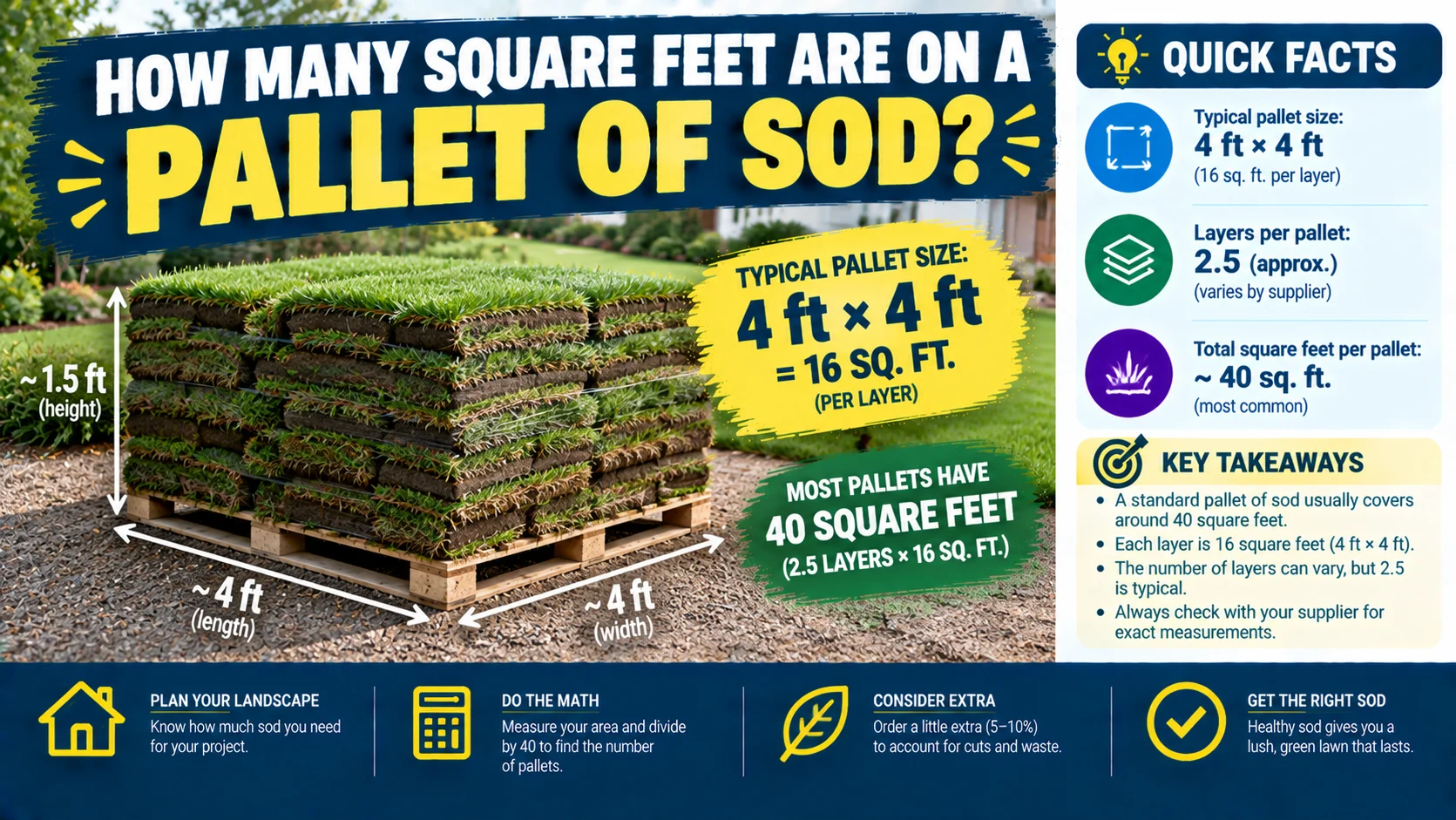
If you are planning to install a new lawn, one of the first questions you may have is how many square feet are on a pallet of sod. A standard pallet of sod typically covers about 450 to 500 square feet, although the exact amount can vary by sod variety, supplier, slab size, and region.
For example, if a supplier sells pallets that cover 500 square feet, you would need one pallet for a 500-square-foot lawn. A 1,000-square-foot lawn would require approximately two pallets.
Before ordering, it is important to check the supplier’s stated coverage because pallet sizes are not completely standardized. Some pallets may cover 400 square feet, while others can cover 600 square feet or more.
This guide explains how much sod comes on a pallet, how to calculate the number of pallets you need, common pallet sizes, and how much extra sod to order for cutting and installation waste.
Quick Answer: How Many Square Feet Are on a Pallet of Sod?
A typical pallet of sod covers approximately 450 to 500 square feet.
However, the actual coverage depends on the sod supplier and the dimensions of each piece.
| Pallet Coverage | Approximate Lawn Coverage |
|---|---|
| Small pallet | 400 sq ft |
| Common pallet | 450 sq ft |
| Standard example | 500 sq ft |
| Large pallet | 600 sq ft |
| Specialty pallet | Varies |
The safest approach is to check the coverage listed by your local sod supplier before placing an order.
How Much Sod Is on One Pallet?
A pallet of sod is made up of many individual rolls or slabs of grass. The number of pieces can vary considerably because different suppliers use different slab dimensions.
For example, one supplier might sell sod in pieces that measure approximately 2 feet by 5 feet, while another may use different dimensions.
What matters most when ordering is the total square-foot coverage, rather than the number of pieces.
If one pallet contains enough sod to cover 500 square feet, it doesn’t matter whether that coverage comes from 50 large pieces or 100 smaller pieces.
Why Pallet Coverage Varies
Several factors can affect how much sod is included on a pallet:
- Sod variety
- Slab or roll dimensions
- Thickness of the sod
- Supplier packaging
- Regional growing and harvesting practices
- Weight restrictions for transportation
- Moisture content
- Local supplier standards
Because of these differences, you should not assume that every pallet covers exactly 500 square feet.
How Many Rolls of Sod Are on a Pallet?
There is no universal number of rolls or slabs per pallet.
The number depends on the dimensions of each piece and the total coverage supplied by the sod farm.
For example, suppose each piece covers 10 square feet and the pallet provides 500 square feet:
500 ÷ 10 = 50 pieces
In that example, the pallet would contain approximately 50 pieces.
If each piece covers 5 square feet:
500 ÷ 5 = 100 pieces
So, the same 500-square-foot pallet could contain a different number of pieces depending on the size of each piece.
How Many Square Feet Does 1 Pallet of Sod Cover?
For estimating purposes, you can use 500 square feet per pallet when your supplier confirms that coverage.
Here are some common examples:
| Number of Pallets | Coverage at 500 sq ft/Pallet |
|---|---|
| 1 pallet | 500 sq ft |
| 2 pallets | 1,000 sq ft |
| 3 pallets | 1,500 sq ft |
| 4 pallets | 2,000 sq ft |
| 5 pallets | 2,500 sq ft |
| 6 pallets | 3,000 sq ft |
| 8 pallets | 4,000 sq ft |
| 10 pallets | 5,000 sq ft |
This table is useful for a quick estimate, but always use your supplier’s actual coverage when calculating an order.
How to Calculate How Many Pallets of Sod You Need
The calculation is straightforward.
Step 1: Measure Your Lawn
Measure the length and width of each rectangular section.
For a simple rectangular lawn:
Length × Width = Square Feet
For example, if your lawn is 40 feet long and 25 feet wide:
40 × 25 = 1,000 square feet
Your lawn has 1,000 square feet of area.
Step 2: Determine Pallet Coverage
Suppose your supplier says one pallet covers 500 square feet.
Now divide the total lawn area by the coverage per pallet:
1,000 ÷ 500 = 2 pallets
You would need two pallets before accounting for extra material.
Step 3: Add Extra Sod
It is generally wise to account for some additional sod when installing a lawn, particularly when the area contains curves, irregular edges, trees, planting beds, or other obstacles.
For a 1,000-square-foot lawn, ordering around 5% to 10% extra would mean approximately:
1,000 × 1.05 = 1,050 square feet
or:
1,000 × 1.10 = 1,100 square feet
At 500 square feet per pallet, you would still need to purchase 3 pallets, because two pallets provide only 1,000 square feet.
Whether you need that much extra depends on the shape of your lawn and your supplier’s minimum order requirements.
How Many Pallets of Sod Do I Need for Different Lawn Sizes?
If one pallet covers 500 square feet, you can estimate your order as follows:
| Lawn Size | Pallets Needed* |
|---|---|
| 250 sq ft | 1 |
| 500 sq ft | 1 |
| 750 sq ft | 2 |
| 1,000 sq ft | 2 |
| 1,250 sq ft | 3 |
| 1,500 sq ft | 3 |
| 2,000 sq ft | 4 |
| 2,500 sq ft | 5 |
| 3,000 sq ft | 6 |
| 4,000 sq ft | 8 |
| 5,000 sq ft | 10 |
*This assumes 500 square feet of coverage per pallet and rounds up to a whole pallet.
If your supplier’s pallet covers 450 square feet, the number of pallets can be different.
How Many Square Feet Does a Pallet of Sod Cover by Pallet Size?
Because suppliers can package sod differently, it helps to compare possible coverage amounts.
400-Square-Foot Pallet
If one pallet covers 400 square feet:
1 pallet = 400 sq ft
A 1,000-square-foot lawn would require:
1,000 ÷ 400 = 2.5
Since you cannot normally order half a pallet, you would need 3 pallets.
450-Square-Foot Pallet
If a pallet covers 450 square feet:
1,000 ÷ 450 = 2.22
You would need 3 pallets.
500-Square-Foot Pallet
If a pallet covers 500 square feet:
1,000 ÷ 500 = 2
You would need 2 pallets.
600-Square-Foot Pallet
If one pallet covers 600 square feet:
1,000 ÷ 600 = 1.67
You would need 2 pallets.
This demonstrates why checking the actual coverage per pallet is important.
How Much Does a Pallet of Sod Weigh?
The weight of a pallet of sod can vary substantially.
Freshly harvested sod contains a considerable amount of moisture, so the weight can be much higher than you might expect from looking at the grass.
Weight depends on:
- Sod variety
- Soil attached to the roots
- Moisture content
- Thickness
- Pallet size
- Harvesting conditions
- Time between harvesting and delivery
Because of this variation, homeowners should ask the supplier about pallet weight if they are planning to transport the sod themselves.
A heavy pallet may require a suitable trailer, truck, loading equipment, or delivery service.
How Much Area Can 2 Pallets of Sod Cover?
If one pallet covers 500 square feet, two pallets cover:
500 × 2 = 1,000 square feet
Therefore:
2 pallets = approximately 1,000 square feet
If your supplier’s pallets cover only 450 square feet each:
450 × 2 = 900 square feet
This is why the supplier’s actual coverage specification matters.
How Much Area Can 3 Pallets of Sod Cover?
Using a 500-square-foot pallet:
500 × 3 = 1,500 square feet
So, three pallets would cover approximately 1,500 square feet.
At 450 square feet per pallet:
450 × 3 = 1,350 square feet
At 400 square feet per pallet:
400 × 3 = 1,200 square feet
How Many Pallets of Sod for 1,000 Square Feet?
For a supplier offering 500 square feet per pallet:
1,000 ÷ 500 = 2 pallets
Therefore, you would need 2 pallets of sod to cover 1,000 square feet exactly.
However, if your lawn has a complicated shape or many obstacles, you may want additional material to account for cutting and waste.
If the supplier’s pallet covers 450 square feet:
1,000 ÷ 450 = 2.22
You would need 3 pallets.
How Many Pallets of Sod for 2,000 Square Feet?
At 500 square feet per pallet:
2,000 ÷ 500 = 4 pallets
So, four pallets cover approximately 2,000 square feet.
At 450 square feet per pallet:
2,000 ÷ 450 = 4.44
You would need 5 pallets.
How Many Pallets of Sod for 5,000 Square Feet?
At 500 square feet per pallet:
5,000 ÷ 500 = 10 pallets
Therefore, a 5,000-square-foot lawn would require approximately 10 pallets.
If each pallet covers 450 square feet:
5,000 ÷ 450 = 11.11
You would need 12 pallets.
Should You Buy Extra Sod?
Buying a small amount of extra sod can be helpful, particularly for lawns that are not simple rectangles.
You may need extra material because of:
- Curved lawn edges
- Irregularly shaped areas
- Trees
- Garden beds
- Walkways
- Driveways
- Landscaping features
- Cutting around structures
- Damaged pieces
- Measurement errors
A simple rectangular lawn generally produces less waste than a lawn with many curves and small sections.
A Simple Extra-Sod Calculation
Suppose your lawn measures 1,200 square feet and you want 5% extra.
1,200 × 0.05 = 60 square feet
Add that to your original measurement:
1,200 + 60 = 1,260 square feet
You would therefore plan for approximately 1,260 square feet of sod.
If each pallet covers 500 square feet:
1,260 ÷ 500 = 2.52
You would need 3 pallets.
How to Measure an Irregular Lawn for Sod
Not every lawn is a perfect rectangle.
One easy method is to divide the lawn into smaller rectangles.
For example:
- Section A = 600 sq ft
- Section B = 400 sq ft
- Section C = 200 sq ft
Total:
600 + 400 + 200 = 1,200 square feet
You can then calculate how many pallets are needed based on your supplier’s coverage.
For complicated landscapes, drawing the lawn on paper and labeling each section can make the calculation much easier.
Can You Buy Half a Pallet of Sod?
Whether you can buy a partial pallet depends on the supplier.
Some sod farms sell by:
- Full pallet
- Half pallet
- Individual rolls
- Individual slabs
- Square feet
Others have minimum order quantities.
If your project requires 600 square feet and a pallet covers 500 square feet, ask whether the supplier sells individual pieces or partial pallets. You may be able to avoid purchasing significantly more sod than necessary.
What Is the Difference Between Sod and Grass Seed?
Sod and grass seed are two different ways to establish a lawn.
Sod is mature grass with roots and soil attached. It is installed over prepared soil and can create an established-looking lawn much faster.
Grass seed is planted directly into the soil and requires time to germinate and develop.
Sod generally has a higher upfront material cost, but it can provide quicker lawn coverage.
Seed may be more flexible for filling small areas or establishing a lawn from scratch, depending on the grass variety, climate, soil, and maintenance conditions.
How Long Does Sod Stay Good on a Pallet?
Fresh sod is perishable and should generally be installed as soon as possible after delivery or harvesting.
Leaving sod stacked on a pallet for too long can cause the grass to heat up and deteriorate, particularly during warm weather.
For that reason, it is best to:
- Prepare the soil before the sod arrives.
- Schedule delivery when you can install it promptly.
- Keep the sod protected from excessive heat.
- Follow the supplier’s handling and installation instructions.
- Water the newly installed sod appropriately.
The exact handling window can vary with temperature, weather, sod type, and supplier recommendations.
How Much Does a Pallet of Sod Cost?
The price of a pallet of sod varies significantly depending on location and grass variety.
Factors that influence cost include:
- Type of grass
- Local climate
- Season
- Sod farm
- Delivery distance
- Quantity purchased
- Installation charges
- Soil preparation
- Local labor rates
For an accurate estimate, request a quote from a local sod supplier based on the exact grass variety and square footage you need.
Remember that the cost of the sod itself is only part of the project. Delivery, soil preparation, fertilizer, topsoil, irrigation, and installation may add to the overall cost.
Common Mistakes When Ordering Sod
Assuming Every Pallet Covers 500 Square Feet
A 500-square-foot pallet is a useful estimating example, but it is not a universal standard.
Always verify the coverage with the supplier.
Measuring the Lawn Incorrectly
A small measurement error can become significant when multiplied across a large lawn.
Measure each section carefully and add the areas together.
Forgetting Waste
Cutting around trees, walkways, flower beds, and curved edges can create additional waste.
Ordering Too Late
Fresh sod should be installed promptly. Avoid ordering it before the site is ready.
Ignoring Delivery Requirements
Sod pallets can be heavy. Make sure the delivery location can accommodate the truck and that the unloading area is accessible.
FAQs
How many square feet are on a standard pallet of sod?
A typical pallet is often estimated at around 450 to 500 square feet, but coverage varies by supplier and sod type. Always confirm the exact square-foot coverage before ordering.
Is 500 square feet of sod one pallet?
Often, yes. Many suppliers offer pallets around 500 square feet, but this is not universal.
How many pallets of sod do I need for 500 square feet?
If one pallet covers 500 square feet, you need 1 pallet.
How many pallets of sod do I need for 1,000 square feet?
If one pallet covers 500 square feet, you need 2 pallets. If the pallet covers less than 500 square feet, you may need 3 pallets.
How many pallets of sod do I need for 1,500 square feet?
At 500 square feet per pallet, you need 3 pallets.
How many pallets of sod do I need for 2,000 square feet?
At 500 square feet per pallet, you need 4 pallets.
How many square feet does a pallet of Bermuda sod cover?
The coverage depends on the supplier’s packaging. Check the specific pallet coverage for the Bermuda sod you are purchasing rather than assuming a universal amount.
How many square feet does a pallet of St. Augustine sod cover?
Coverage varies by supplier and packaging. A common estimating range is around 450–500 square feet per pallet, but confirm the actual coverage before ordering.
Should I order extra sod?
Extra sod can be useful for irregular lawns, cutting around obstacles, and accounting for installation waste. A small percentage above the measured area is often considered when planning an order.
Can I install sod myself?
Yes. Homeowners can install sod themselves if the soil is properly prepared and the sod is handled and installed correctly. Large or complicated properties may benefit from professional installation.
Final Answer: How Many Square Feet Are on a Pallet of Sod?
So, how many square feet are on a pallet of sod?
The typical answer is about 450 to 500 square feet per pallet, with 500 square feet being a convenient figure for estimating.
However, pallet coverage is not completely standardized. The actual amount can vary by sod variety, supplier, slab size, and packaging.
To calculate how many pallets you need:
Number of Pallets = Total Lawn Area ÷ Square Feet per Pallet
For example, if your lawn is 2,000 square feet and each pallet covers 500 square feet:
2,000 ÷ 500 = 4 pallets
Before ordering, confirm the supplier’s exact coverage and consider whether your lawn requires additional sod for cutting and installation waste. Accurate measurements and proper planning can help you order enough sod without purchasing significantly more than your project requires.



Pingback: How Many Square Feet Are in 3 Acres?