

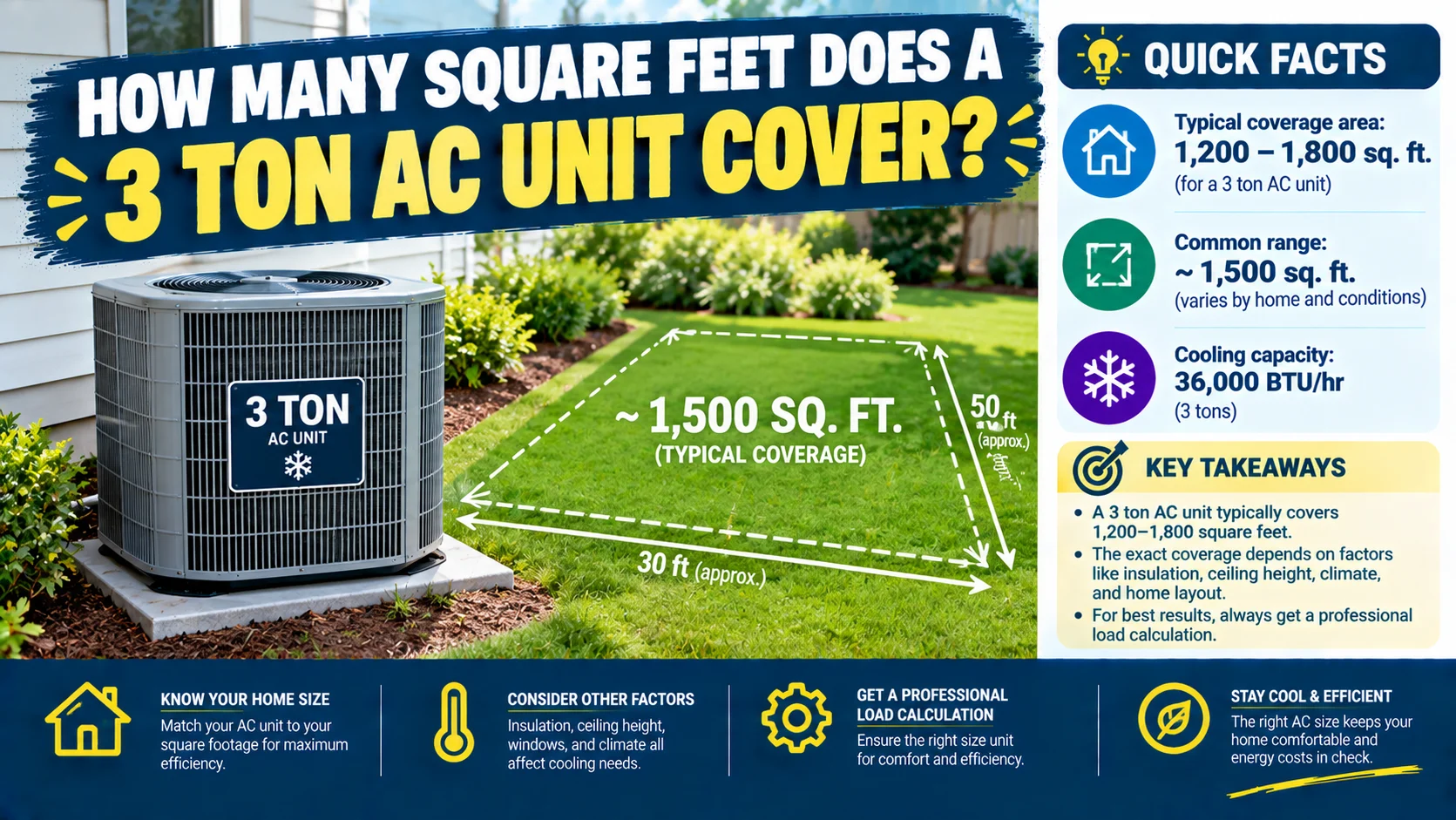
A 3-ton AC unit typically covers about 1,500 to 1,800 square feet in a standard residential setting. However, the exact amount of space a 3-ton air conditioner can cool depends on climate, insulation, ceiling height, windows, sunlight, home layout, and other factors.
A 3-ton air conditioner has a cooling capacity of 36,000 BTUs per hour because one ton of air conditioning capacity equals approximately 12,000 BTUs.
So:
3 tons × 12,000 BTUs = 36,000 BTUs
For a basic estimate, many homeowners use approximately 1,500–1,800 square feet as a starting range for a 3-ton AC unit. In a well-insulated home in a moderate climate, it may potentially serve a larger area, while a poorly insulated home in a hot climate may require more capacity for the same square footage.
Quick Answer: How Many Square Feet Does a 3 Ton AC Cover?
A 3-ton AC unit generally covers approximately:
1,500–1,800 square feet
This is only a general estimate. HVAC sizing should ideally be based on a proper load calculation rather than square footage alone.
| AC Size | Cooling Capacity | Approximate Residential Area* |
|---|---|---|
| 1 ton | 12,000 BTU | 400–600 sq ft |
| 1.5 ton | 18,000 BTU | 600–900 sq ft |
| 2 ton | 24,000 BTU | 900–1,200 sq ft |
| 2.5 ton | 30,000 BTU | 1,200–1,500 sq ft |
| 3 ton | 36,000 BTU | 1,500–1,800 sq ft |
| 3.5 ton | 42,000 BTU | 1,800–2,100 sq ft |
| 4 ton | 48,000 BTU | 2,000–2,400 sq ft |
| 5 ton | 60,000 BTU | 2,500–3,000 sq ft |
*These are broad planning estimates, not a substitute for an HVAC load calculation.
What Does a 3 Ton AC Unit Mean?
The word ton in air conditioning does not refer to the physical weight of the air conditioner.
Instead, it describes the unit’s cooling capacity.
One ton of cooling equals approximately:
12,000 BTUs per hour
Therefore:
3 × 12,000 = 36,000 BTUs per hour
A 3-ton AC unit is therefore rated at approximately 36,000 BTU/h of cooling capacity.
Why Is It Called a “Ton” of AC?
The term comes from the historical cooling capacity associated with melting ice.
One ton of refrigeration represents approximately 12,000 BTUs per hour of cooling capacity.
Modern air conditioners do not use ice to provide cooling, but the traditional unit of measurement remains widely used in HVAC.
How Many BTUs Is a 3 Ton AC?
A 3-ton air conditioner has a nominal capacity of:
36,000 BTUs
The calculation is:
3 tons × 12,000 BTU = 36,000 BTU
This makes it possible to compare AC capacity using either tons or BTUs.
For example:
- 1 ton = 12,000 BTU
- 2 tons = 24,000 BTU
- 2.5 tons = 30,000 BTU
- 3 tons = 36,000 BTU
- 3.5 tons = 42,000 BTU
- 4 tons = 48,000 BTU
- 5 tons = 60,000 BTU
How Much Square Footage Can 36,000 BTUs Cool?
A 36,000-BTU air conditioner can often serve around 1,500–1,800 square feet under common residential assumptions.
However, square footage is only one part of determining cooling requirements.
A 1,600-square-foot house with excellent insulation and moderate outdoor temperatures may have very different cooling requirements from a 1,600-square-foot house with poor insulation in a very hot climate.
This is why two homes with the same floor area can require different AC capacities.
Factors That Affect How Much Area a 3 Ton AC Can Cool
Climate
Outdoor temperature has a major effect on cooling demand.
Homes in hotter climates generally require more cooling capacity than similarly sized homes in milder climates.
Insulation
Good insulation reduces heat entering the home.
Poor insulation can increase the cooling load and make an AC unit work harder.
Ceiling Height
A home with 8-foot ceilings has less air volume than a home with 10- or 12-foot ceilings.
Higher ceilings can therefore increase the amount of air that needs to be conditioned.
Windows
Large windows can allow significant solar heat into a building, especially when they receive direct sunlight.
Window quality, orientation, shading, and glazing all affect cooling requirements.
Number of Occupants
People generate heat. A home with many occupants may have a higher cooling load than an otherwise identical home with fewer occupants.
Appliances
Ovens, refrigerators, computers, televisions, lighting, and other equipment generate heat.
Home Layout
An open floor plan may distribute conditioned air differently from a house divided into many separate rooms.
Air Leakage
Gaps around doors, windows, ductwork, and other building components can allow conditioned air to escape and outdoor air to enter.
Is a 3 Ton AC Good for 1,500 Square Feet?
A 3-ton AC may be suitable for a 1,500-square-foot home, depending on the home’s cooling load.
For example, a well-insulated 1,500-square-foot house in a moderate climate may have different requirements from a poorly insulated house in a hot climate.
Square footage alone should not be used to automatically select a 3-ton system.
Is a 3 Ton AC Good for 1,600 Square Feet?
A 3-ton unit can potentially be appropriate for a 1,600-square-foot home.
Since 1,600 square feet falls within the common planning range for a 3-ton system, it may be a reasonable size to investigate.
However, an HVAC professional should calculate the home’s actual cooling load before installation.
Is a 3 Ton AC Good for 1,800 Square Feet?
A 3-ton AC may be suitable for an 1,800-square-foot home under favorable conditions.
The upper end of the typical planning range depends heavily on factors such as insulation, climate, ceiling height, windows, and solar exposure.
A load calculation provides a more reliable answer than using a square-footage rule alone.
Is a 3 Ton AC Good for 2,000 Square Feet?
A 3-ton system may be undersized for some 2,000-square-foot homes, particularly in hot climates or homes with high heat gain.
However, a highly efficient and well-insulated home may have a lower cooling load than expected from its floor area.
Rather than automatically moving to a larger unit, calculate the home’s actual cooling requirements.
Can a 3 Ton AC Cool a 2,500 Square Foot House?
A 3-ton AC may not provide enough capacity for many 2,500-square-foot homes, particularly in hotter climates or homes with poor insulation.
But there is no universal answer based only on square footage.
Factors such as building envelope, climate, windows, ceiling height, and internal heat gains should be considered.
What Size House Does a 3 Ton AC Usually Cool?
As a general planning range, a 3-ton system is commonly associated with approximately:
1,500–1,800 square feet
But this should not be interpreted as a fixed rule.
The correct capacity can be smaller or larger depending on the home’s characteristics.
3 Ton AC Coverage by Climate
Climate is one of the most important reasons AC sizing varies.
Mild Climate
A 3-ton system may potentially cool a larger area in a mild climate because the temperature difference between indoor and outdoor conditions is smaller.
Moderate Climate
The commonly quoted 1,500–1,800 square-foot range can be a useful starting point for discussion.
Hot Climate
A home may require more cooling capacity per square foot because of higher outdoor temperatures and increased heat gain.
This means a 3-ton system may serve a smaller area than the general rule suggests.
Does Insulation Affect 3 Ton AC Coverage?
Yes.
Insulation reduces the transfer of heat through walls, ceilings, and other parts of the building envelope.
A well-insulated home generally loses less conditioned air and gains less heat from outside.
For example, two 1,800-square-foot houses can have different cooling requirements if one has:
- Better attic insulation
- Better windows
- Fewer air leaks
- More effective shading
- Better-insulated walls
Therefore, square footage alone doesn’t determine the correct AC size.
Does Ceiling Height Affect AC Sizing?
Yes.
A home’s square footage describes floor area, but cooling equipment also conditions the volume of air inside the building.
For example, compare:
1,600 sq ft × 8 ft ceilings = 12,800 cubic feet
with:
1,600 sq ft × 10 ft ceilings = 16,000 cubic feet
The second space contains substantially more air volume.
Higher ceilings can therefore affect the cooling load, although a proper load calculation considers more than just air volume.
3 Ton AC vs. 2.5 Ton AC
A 2.5-ton AC has approximately:
2.5 × 12,000 = 30,000 BTUs
A 3-ton AC has:
3 × 12,000 = 36,000 BTUs
The difference is:
36,000 − 30,000 = 6,000 BTUs
So a 3-ton unit has approximately 20% more nominal cooling capacity than a 2.5-ton unit.
3 Ton AC vs. 3.5 Ton AC
A 3-ton unit provides approximately:
36,000 BTUs
A 3.5-ton unit provides:
42,000 BTUs
The difference is:
42,000 − 36,000 = 6,000 BTUs
A 3.5-ton system therefore has approximately 16.7% more nominal capacity than a 3-ton system.
3 Ton AC vs. 4 Ton AC
A 4-ton unit provides:
4 × 12,000 = 48,000 BTUs
Compared with a 3-ton unit:
48,000 − 36,000 = 12,000 BTUs
A 4-ton AC has approximately 33% more nominal cooling capacity than a 3-ton unit.
More capacity isn’t automatically better, however. Oversizing can create comfort and humidity-control issues because the system may satisfy the thermostat too quickly and cycle more frequently.
What Happens if an AC Unit Is Too Large?
An oversized air conditioner can cool the space quickly but may not run long enough to provide effective dehumidification.
Potential issues can include:
- Short cycling
- Uneven temperatures
- Reduced humidity control
- Increased wear
- Less consistent comfort
This is one reason simply choosing the largest available AC unit is not necessarily the correct approach.
What Happens if an AC Unit Is Too Small?
An undersized system may struggle to maintain the desired indoor temperature during periods of high outdoor heat.
It may:
- Run for long periods
- Struggle during peak temperatures
- Fail to maintain the thermostat setting
- Experience additional operating stress
Again, correct sizing is the goal rather than simply choosing a larger or smaller unit.
How to Know if You Need a 3 Ton AC
Several factors can help determine whether a 3-ton system is worth considering.
Start with:
- Home square footage
- Climate
- Insulation
- Ceiling height
- Window size and orientation
- Number of occupants
- Building orientation
- Air leakage
- Ductwork
- Existing HVAC performance
Then have a qualified HVAC professional perform a load calculation.
What Is a Manual J Load Calculation?
A Manual J load calculation is an HVAC sizing method used to determine the heating and cooling loads of a building.
Instead of relying only on square footage, it considers factors such as:
- Outdoor design conditions
- Building dimensions
- Insulation
- Windows
- Doors
- Orientation
- Occupancy
- Internal heat gains
- Air infiltration
This provides a more detailed basis for selecting HVAC capacity.
Does AC Efficiency Affect Coverage?
The efficiency rating of an AC affects how efficiently the equipment operates, but efficiency does not mean you can simply assume a higher-rated unit will cool a specific number of additional square feet.
Capacity and efficiency are different characteristics.
A 3-ton unit remains approximately a 36,000-BTU nominal system regardless of whether it has a higher or lower efficiency rating, although actual performance and ratings depend on the matched equipment and operating conditions.
Does Ductwork Affect a 3 Ton AC?
Yes.
Even if the AC itself has adequate capacity, poorly designed or leaky ductwork can reduce system performance.
Potential ductwork problems include:
- Air leakage
- Poor insulation
- Incorrect sizing
- Restricted airflow
- Imbalanced distribution
A properly designed distribution system helps deliver conditioned air effectively throughout the home.
How Many BTUs Per Square Foot Do You Need?
A commonly repeated rule of thumb is to estimate roughly 20–30 BTUs per square foot, but this is only a rough starting point.
For example:
1,500 × 24 = 36,000 BTUs
That calculation corresponds to a 3-ton system.
But using a fixed BTU-per-square-foot value can produce inaccurate results because cooling loads vary significantly between buildings.
A professional load calculation is more appropriate when selecting HVAC equipment.
3 Ton AC Coverage Calculator
You can use the following table as a general planning reference:
| Home Size | 3 Ton AC Suitability |
|---|---|
| 1,200 sq ft | Potentially oversized in some homes |
| 1,400 sq ft | May be suitable depending on load |
| 1,500 sq ft | Within common planning range |
| 1,600 sq ft | Within common planning range |
| 1,700 sq ft | Within common planning range |
| 1,800 sq ft | Within common planning range |
| 2,000 sq ft | Depends strongly on building characteristics |
| 2,200 sq ft | May require additional capacity |
| 2,500 sq ft | Often requires a detailed load assessment |
This table should be treated as a planning guide rather than an equipment-sizing recommendation.
How Much Electricity Does a 3 Ton AC Use?
A 3-ton AC has a cooling capacity of approximately 36,000 BTUs per hour, but that does not mean it consumes 36,000 BTUs of electricity per hour.
Air conditioners move heat using electrical energy.
Actual electricity consumption depends on:
- Efficiency rating
- Outdoor temperature
- Indoor temperature
- Compressor type
- Runtime
- Fan operation
- Duct losses
- Equipment condition
To estimate electricity cost, you need the unit’s electrical input rating and the local electricity rate.
FAQs
How many square feet does a 3 ton AC unit cover?
A 3-ton AC unit commonly serves approximately 1,500–1,800 square feet as a broad residential planning estimate. Actual sizing depends on climate, insulation, windows, ceiling height, and other factors.
How many BTUs is a 3 ton AC?
A 3-ton AC has approximately 36,000 BTUs per hour of nominal cooling capacity.
Is a 3 ton AC enough for 1,500 square feet?
It may be. A 3-ton system falls within a common planning range for a 1,500-square-foot home, but the actual cooling load should be calculated.
Is a 3 ton AC enough for 1,800 square feet?
It may be suitable depending on the home’s insulation, climate, windows, ceiling height, and other heat-gain factors.
Is a 3 ton AC enough for 2,000 square feet?
It depends on the home’s actual cooling load. A 3-ton system may be insufficient in some homes but appropriate in others.
How many square feet will 36,000 BTUs cool?
36,000 BTUs is equivalent to a 3-ton AC. A broad residential estimate is approximately 1,500–1,800 square feet, but actual coverage varies.
What size AC do I need for 1,500 square feet?
A 3-ton unit may be considered for a 1,500-square-foot home, but the correct size depends on the building’s calculated cooling load.
What size AC do I need for 2,000 square feet?
There is no universal answer based only on square footage. A Manual J load calculation should be used to determine the appropriate capacity.
Is a bigger AC always better?
No. An oversized system can cycle too frequently and may provide poorer humidity control. Correct sizing is more important than simply choosing a larger unit.
How many tons of AC do I need for 1,800 square feet?
A 3-ton system is often considered within the general planning range for 1,800 square feet, but the actual requirement depends on the home’s cooling load.
Final Answer: How Many Square Feet Does a 3 Ton AC Unit Cover?
A 3-ton AC unit provides approximately 36,000 BTUs of cooling capacity and is commonly associated with approximately 1,500 to 1,800 square feet of residential space.
The basic conversion is:
3 tons × 12,000 BTUs = 36,000 BTUs
However, there is no universal square-footage limit for a 3-ton air conditioner. Climate, insulation, windows, ceiling height, air leakage, occupancy, solar exposure, and ductwork can all change the home’s cooling requirements.
For a rough estimate, 1,500–1,800 square feet is a useful starting range. For an actual installation or replacement, a professional HVAC load calculation is the more reliable way to determine whether a 3-ton system is appropriately sized.



Pingback: How Many Feet Between Fence Posts?