

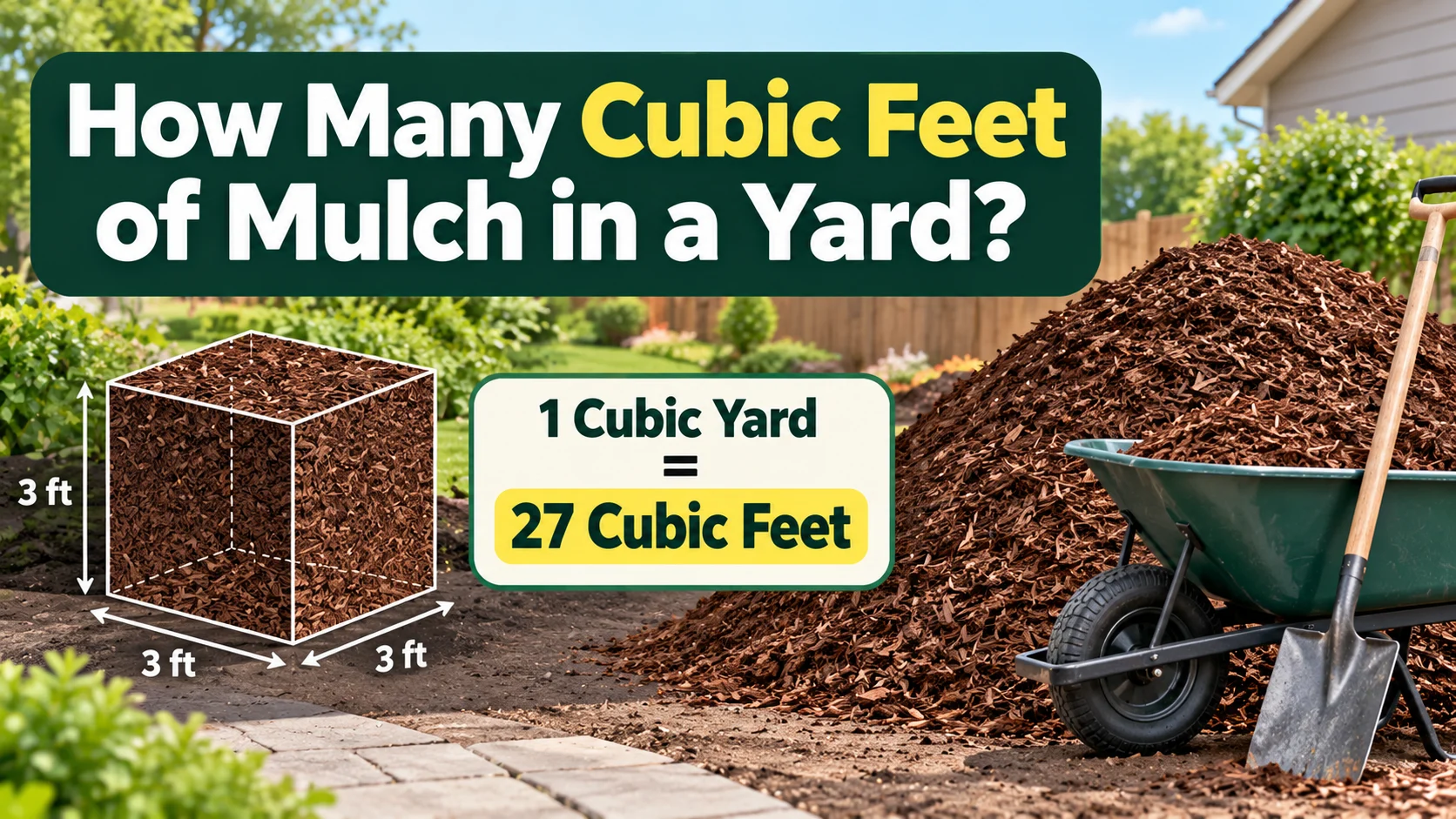
If you’re wondering how many cubic feet of mulch in a yard, the answer is:
1 cubic yard of mulch = 27 cubic feet
A cubic yard is a volume measurement measuring:
3 feet × 3 feet × 3 feet = 27 cubic feet
So, one yard of mulch contains exactly 27 cubic feet of mulch.
However, the amount of ground that one cubic yard covers depends on the depth at which you spread the mulch.
For example:
| Mulch Depth | Coverage From 1 Cubic Yard |
|---|---|
| 1 inch | 324 sq ft |
| 2 inches | 162 sq ft |
| 3 inches | 108 sq ft |
| 4 inches | 81 sq ft |
| 5 inches | 64.8 sq ft |
| 6 inches | 54 sq ft |
| 8 inches | 40.5 sq ft |
| 10 inches | 32.4 sq ft |
| 12 inches | 27 sq ft |
For most landscaping applications, mulch is commonly spread around 2 to 4 inches deep, depending on the material and purpose.
How Many Cubic Feet of Mulch Are in a Yard?
There are exactly 27 cubic feet of mulch in one cubic yard.
The calculation is based on the definition of a cubic yard.
One yard equals 3 feet:
1 yard = 3 feet
For a cubic measurement, multiply the three dimensions:
3 × 3 × 3 = 27
Therefore:
1 cubic yard = 27 cubic feet
This means that whether you’re buying hardwood mulch, bark mulch, shredded mulch, wood chips, or another bulk mulch product, a supplier selling 1 cubic yard is selling a volume of 27 cubic feet.
The weight can vary considerably depending on the type of mulch, moisture content, and density, but the volume remains 27 cubic feet.
What Is a Cubic Yard of Mulch?
A cubic yard of mulch is the amount of mulch that would fill a box measuring:
- 3 feet long
- 3 feet wide
- 3 feet high
The volume is:
3 ft × 3 ft × 3 ft = 27 ft³
So, a cubic yard is not simply a pile that is exactly 3 feet long. It represents three-dimensional volume.
This distinction is important when purchasing landscaping materials.
A regular yard measures length, while a cubic yard measures volume.
Remember:
1 yard = 3 feet
but:
1 cubic yard = 27 cubic feet
How Much Area Does 1 Cubic Yard of Mulch Cover?
One cubic yard contains 27 cubic feet, but its surface coverage depends on how thickly you spread it.
The deeper the mulch layer, the smaller the area one cubic yard will cover.
For example, spreading one cubic yard 2 inches deep covers approximately 162 square feet.
At 4 inches deep, that same cubic yard covers only about 81 square feet.
The formula is:
Coverage = 324 ÷ mulch depth in inches
For example, at 3 inches:
324 ÷ 3 = 108 square feet
Therefore, one cubic yard of mulch covers approximately 108 square feet at a 3-inch depth.
Mulch Coverage Chart
Here is a quick reference chart for one cubic yard of mulch:
| Depth | Coverage |
|---|---|
| 1 inch | 324 sq ft |
| 1.5 inches | 216 sq ft |
| 2 inches | 162 sq ft |
| 2.5 inches | 129.6 sq ft |
| 3 inches | 108 sq ft |
| 3.5 inches | 92.6 sq ft |
| 4 inches | 81 sq ft |
| 5 inches | 64.8 sq ft |
| 6 inches | 54 sq ft |
| 8 inches | 40.5 sq ft |
| 10 inches | 32.4 sq ft |
| 12 inches | 27 sq ft |
This chart can help you estimate how much mulch to order before starting your landscaping project.
How to Calculate How Much Mulch You Need
Calculating the amount of mulch required is relatively simple if you know:
- The length of the area
- The width of the area
- The desired mulch depth
First calculate the area in square feet:
Length × Width = Square Feet
Then determine the required volume.
If the depth is given in inches, use:
Cubic Yards = Length × Width × Depth ÷ 324
All length and width measurements should be in feet, while depth is in inches.
Example: 10 × 20 Foot Mulch Bed
Suppose you have a garden bed that is:
- 10 feet long
- 20 feet wide
- 3 inches deep
First calculate the area:
10 × 20 = 200 square feet
Now calculate the required cubic yards:
10 × 20 × 3 ÷ 324
600 ÷ 324 = 1.85 cubic yards
You need approximately:
1.85 cubic yards of mulch
Since mulch is generally sold in whole or fractional cubic-yard quantities, you would typically need to purchase enough material to meet or exceed that requirement.
Example: 500 Square Feet of Mulch
Suppose you have 500 square feet and want to spread mulch 3 inches deep.
Use:
500 × 3 ÷ 324 = 4.63 cubic yards
So you need approximately 4.63 cubic yards of mulch.
If the area is uneven or you expect settling or material loss, your final order may need to be slightly higher.
How Many Cubic Feet of Mulch Do You Need for 100 Square Feet?
The answer depends on the desired depth.
At 2 inches:
100 × 2 ÷ 12 = 16.67 cubic feet
At 3 inches:
100 × 3 ÷ 12 = 25 cubic feet
At 4 inches:
100 × 4 ÷ 12 = 33.33 cubic feet
Since one cubic yard equals 27 cubic feet:
| Area | Depth | Cubic Feet Needed | Cubic Yards |
|---|---|---|---|
| 100 sq ft | 2 in | 16.67 ft³ | 0.62 yd³ |
| 100 sq ft | 3 in | 25 ft³ | 0.93 yd³ |
| 100 sq ft | 4 in | 33.33 ft³ | 1.23 yd³ |
This makes it easy to estimate mulch requirements for smaller landscaping beds.
How Many Cubic Feet of Mulch Are in 2 Yards?
If one cubic yard contains 27 cubic feet, then two cubic yards contain:
2 × 27 = 54 cubic feet
Therefore:
2 cubic yards = 54 cubic feet
How Many Cubic Feet of Mulch Are in 3 Yards?
Three cubic yards contain:
3 × 27 = 81 cubic feet
Therefore:
3 cubic yards = 81 cubic feet
How Many Cubic Feet of Mulch Are in 5 Yards?
Five cubic yards contain:
5 × 27 = 135 cubic feet
Therefore:
5 cubic yards = 135 cubic feet
How Many Cubic Feet of Mulch Are in 10 Yards?
Ten cubic yards contain:
10 × 27 = 270 cubic feet
Therefore:
10 cubic yards = 270 cubic feet
For a large landscaping project, this is a substantial quantity of mulch.
Cubic Yards to Cubic Feet Mulch Conversion Chart
Use this chart for quick calculations:
| Cubic Yards of Mulch | Cubic Feet |
|---|---|
| 0.25 yd³ | 6.75 ft³ |
| 0.5 yd³ | 13.5 ft³ |
| 0.75 yd³ | 20.25 ft³ |
| 1 yd³ | 27 ft³ |
| 1.5 yd³ | 40.5 ft³ |
| 2 yd³ | 54 ft³ |
| 2.5 yd³ | 67.5 ft³ |
| 3 yd³ | 81 ft³ |
| 4 yd³ | 108 ft³ |
| 5 yd³ | 135 ft³ |
| 6 yd³ | 162 ft³ |
| 8 yd³ | 216 ft³ |
| 10 yd³ | 270 ft³ |
The formula is always:
Cubic Feet = Cubic Yards × 27
How Deep Should Mulch Be?
The appropriate mulch depth depends on the purpose and type of mulch.
For many landscape beds, a layer around 2 to 4 inches is commonly used.
A thinner layer may provide less effective coverage, while an excessively thick layer can create problems around plants and trees.
When applying mulch:
- Spread it evenly.
- Keep it away from building siding.
- Avoid piling mulch directly against tree trunks.
- Don’t bury plant stems.
- Check the recommended depth for the specific mulch material.
The goal is to provide useful ground coverage without creating unnecessarily deep layers.
Does Mulch Type Affect Cubic Feet?
The volume conversion does not change.
One cubic yard remains:
27 cubic feet
regardless of the mulch type.
However, different types of mulch can have different physical characteristics.
For example:
- Bark mulch may have a different density than shredded wood.
- Fresh wood chips may contain different moisture levels.
- Rubber mulch is much denser than many wood-based mulches.
- Decorative stone mulch can weigh substantially more than wood mulch.
Therefore, don’t use the volume conversion to estimate the weight of a delivery.
If you need to know how much a cubic yard weighs, check the supplier’s specifications for the specific product.
How Many Bags of Mulch Equal One Cubic Yard?
Bag sizes vary, so you need to check the volume printed on each bag.
The basic formula is:
Number of Bags = 27 ÷ Bag Volume in Cubic Feet
1-Cubic-Foot Bags
27 ÷ 1 = 27 bags
So 27 one-cubic-foot bags equal one cubic yard.
1.5-Cubic-Foot Bags
27 ÷ 1.5 = 18 bags
2-Cubic-Foot Bags
27 ÷ 2 = 13.5 bags
Because you cannot normally buy half a bag, you would need 14 two-cubic-foot bags to provide at least one cubic yard.
3-Cubic-Foot Bags
27 ÷ 3 = 9 bags
| Bag Size | Bags Per Cubic Yard |
|---|---|
| 1 cu ft | 27 bags |
| 1.5 cu ft | 18 bags |
| 2 cu ft | 13.5 bags |
| 2.5 cu ft | 10.8 bags |
| 3 cu ft | 9 bags |
Always use the actual bag volume listed by the manufacturer.
Bulk Mulch vs. Bagged Mulch
When deciding how to buy mulch, consider the size of your project.
Bulk Mulch
Bulk mulch is usually purchased by the cubic yard.
It can be convenient for:
- Large garden beds
- Large yards
- Commercial landscaping
- Multiple planting areas
Bagged Mulch
Bagged mulch is sold by individual bags, usually with the volume printed on the packaging.
It can be convenient for:
- Small garden beds
- Small landscaping projects
- Areas where bulk delivery is inconvenient
- Projects requiring several different mulch types
For larger projects, comparing the price per cubic foot can help you determine which option offers better value.
How Much Does a Yard of Mulch Weigh?
There is no single universal weight for a cubic yard of mulch.
The weight depends on:
- Mulch type
- Moisture content
- Particle size
- Density
- Age
- How tightly the material is packed
Dry wood mulch can weigh considerably less than wet mulch.
This is why suppliers may provide different weight estimates for different products.
If you’re concerned about trailer capacity, truck payload, delivery requirements, or handling, ask the supplier for the estimated weight of the exact mulch product you are purchasing.
Should You Buy Extra Mulch?
Your calculated requirement is a useful starting point, but the exact amount you should order can depend on your project.
You may need to account for:
- Uneven ground
- Irregular-shaped beds
- Material loss during installation
- Existing mulch
- Settling
- Inaccurate measurements
- Slight differences in application depth
However, buying substantially more than necessary can waste money.
A good approach is to measure carefully, calculate the volume, and discuss the quantity with your mulch supplier if you’re unsure.
Common Mistakes When Buying Mulch
1. Confusing Cubic Feet With Square Feet
Cubic feet measure volume, while square feet measure area.
One cubic yard contains 27 cubic feet, but the area covered by that yard depends on depth.
2. Ignoring Mulch Depth
A 3-inch layer covers a different area than a 6-inch layer.
Always include depth when calculating the amount required.
3. Assuming Every Bag Has the Same Volume
Bag sizes vary by manufacturer and product.
Check the label before calculating how many bags you need.
4. Confusing Linear Yards With Cubic Yards
A linear yard measures length.
A cubic yard measures volume.
For bulk mulch, you generally need cubic yards.
5. Assuming All Mulch Weighs the Same
Different materials and moisture levels can produce significantly different weights.
FAQs
How many cubic feet of mulch are in a yard?
There are exactly 27 cubic feet of mulch in one cubic yard.
The calculation is:
3 × 3 × 3 = 27 cubic feet
How many cubic feet are in 2 yards of mulch?
Two cubic yards contain 54 cubic feet.
2 × 27 = 54
How many cubic feet are in 3 yards of mulch?
Three cubic yards contain 81 cubic feet.
3 × 27 = 81
How many square feet does a yard of mulch cover?
It depends on the depth. One cubic yard covers approximately 162 square feet at 2 inches deep, 108 square feet at 3 inches, and 81 square feet at 4 inches.
How much mulch do I need for 100 square feet?
At 2 inches deep, you need about 0.62 cubic yards. At 3 inches, about 0.93 cubic yards. At 4 inches, about 1.23 cubic yards.
How many bags of mulch are in a yard?
It depends on the bag size. A 1-cubic-foot bag requires 27 bags per cubic yard, while a 2-cubic-foot bag requires 13.5 bags mathematically, meaning 14 full bags.
Is a cubic yard of mulch the same as 27 cubic feet?
Yes. 1 cubic yard always equals 27 cubic feet because a cubic yard is 3 feet × 3 feet × 3 feet.
Does wet mulch have more cubic feet than dry mulch?
No. The volume conversion stays the same. One cubic yard is still 27 cubic feet. However, wet mulch generally weighs more because of its additional moisture.
How do I calculate cubic yards of mulch?
Multiply the length in feet by the width in feet and the depth in inches, then divide by 324:
Cubic Yards = Length × Width × Depth ÷ 324
Final Answer: How Many Cubic Feet of Mulch in a Yard?
If you’re asking how many cubic feet of mulch in a yard, the exact answer is:
1 cubic yard of mulch = 27 cubic feet
The conversion is:
1 yd³ = 27 ft³
To calculate how much area one yard of mulch covers, you also need to know the desired depth. For example:
- 1 inch deep: about 324 sq ft
- 2 inches deep: about 162 sq ft
- 3 inches deep: about 108 sq ft
- 4 inches deep: about 81 sq ft
- 6 inches deep: about 54 sq ft
For most landscaping calculations, use:
Cubic Yards = Length × Width × Depth in Inches ÷ 324
Understanding both the volume conversion and coverage depth makes it much easier to order the right amount of mulch without buying significantly too much or too little.


Pingback: How Many Cubic Feet in One Yard? Complete Guide