

Your feet are remarkable structures that support your entire body, help you maintain balance, absorb shock, and allow you to walk, run, jump, and stand. Although each foot looks relatively small compared with the rest of the body, it contains a surprisingly large number of bones.
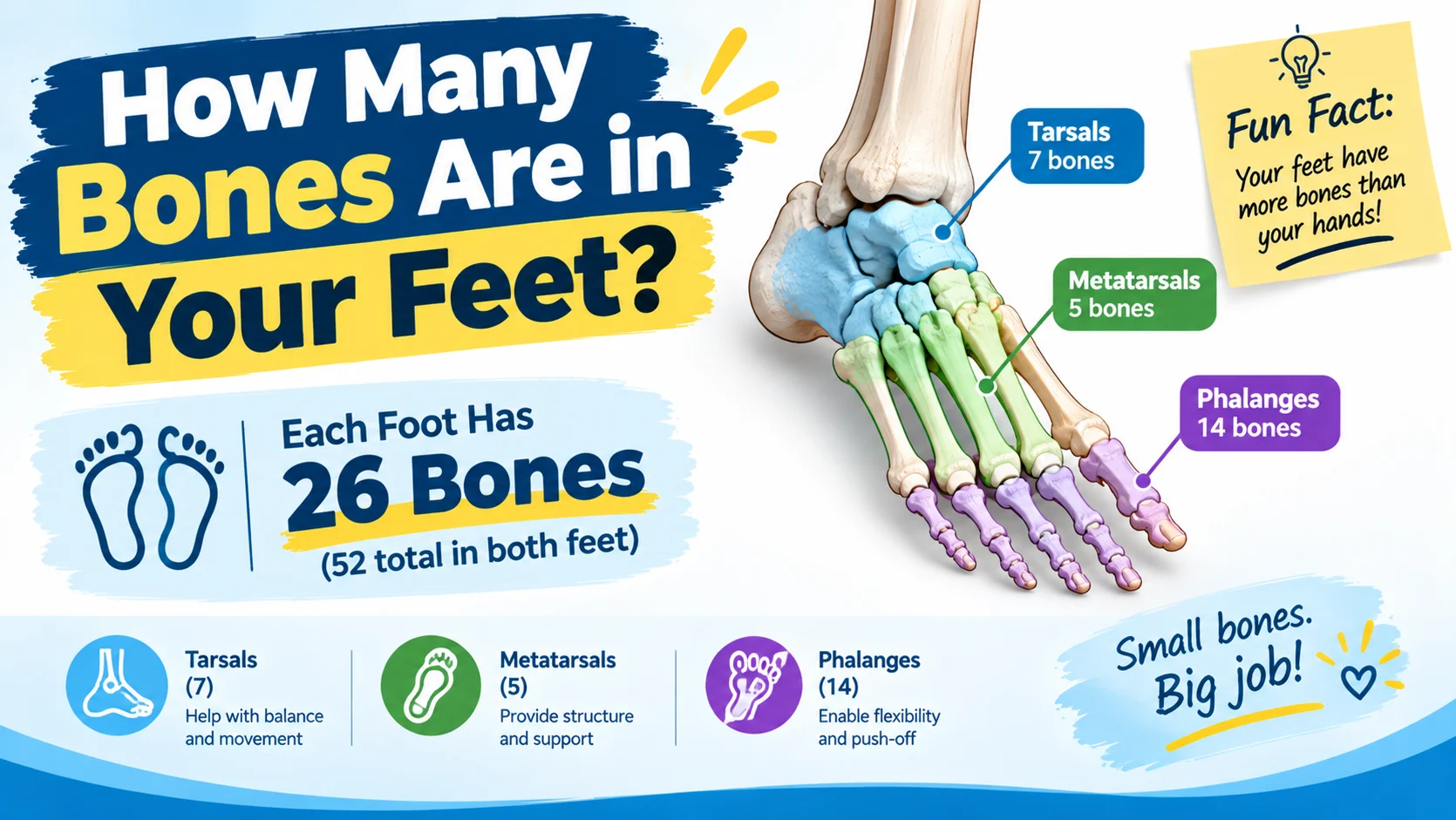
The human foot has 26 bones. Since you have two feet, there are 52 bones in both feet combined. These bones work together with joints, muscles, tendons, ligaments, nerves, and blood vessels to provide stability and movement.
In this guide, we’ll explain exactly how the 26 bones in each foot are arranged, what each group does, and how they work together.
Quick Answer: How Many Bones Are in a Foot?
There are 26 bones in one human foot.
| Part of the Foot | Number of Bones |
|---|---|
| Tarsal bones | 7 |
| Metatarsal bones | 5 |
| Phalanges (toe bones) | 14 |
| Total in one foot | 26 |
| Total in both feet | 52 |
The 26 bones are divided into three main groups: tarsals, metatarsals, and phalanges.
How Are the 26 Bones in the Foot Organized?
The bones of the foot can be understood from the heel toward the toes.
1. Tarsal Bones — 7 Bones
The tarsal bones make up the rear and middle portions of the foot. There are seven tarsal bones in each foot.
They include:
- Talus
- Calcaneus
- Navicular
- Cuboid
- Medial cuneiform
- Intermediate cuneiform
- Lateral cuneiform
These bones are important for supporting body weight and connecting the foot to the lower leg.
Talus
The talus sits near the top of the foot and connects with the tibia and fibula of the lower leg. It plays an important role in the ankle joint.
Unlike many other bones, the talus has no muscle directly attached to it. It transfers forces between the leg and foot and helps with ankle movement.
Calcaneus
The calcaneus is commonly known as the heel bone. It is the largest bone in the foot.
When you stand or walk, the calcaneus helps carry and distribute your body weight. It also provides an attachment point for the Achilles tendon.
Navicular
The navicular is located toward the inner side of the foot, between the talus and cuneiform bones. It contributes to the structure of the foot’s arch.
Cuboid
The cuboid is located on the outer side of the foot. It connects with several surrounding bones and helps provide stability to the lateral portion of the foot.
Cuneiform Bones
There are three cuneiform bones:
- Medial cuneiform
- Intermediate cuneiform
- Lateral cuneiform
They sit between the navicular and metatarsal bones and help form the middle portion of the foot.
2. Metatarsal Bones — 5 Bones
Each foot contains five metatarsal bones.
They are numbered from the big-toe side toward the little-toe side:
- First metatarsal
- Second metatarsal
- Third metatarsal
- Fourth metatarsal
- Fifth metatarsal
The metatarsals form much of the middle and front portion of the foot.
The first metatarsal connects to the big toe, while the fifth metatarsal connects to the little toe.
Metatarsal bones help distribute weight when you stand and play an important role when your foot pushes off the ground during walking or running.
3. Phalanges — 14 Bones
The toes contain 14 bones, known as phalanges.
Most toes have three phalanges:
- Proximal phalanx
- Middle phalanx
- Distal phalanx
However, the big toe has only two:
- Proximal phalanx
- Distal phalanx
Here’s the calculation:
4 smaller toes × 3 bones = 12 bones
Big toe = 2 bones
12 + 2 = 14 phalanges
Together with the seven tarsals and five metatarsals:
7 + 5 + 14 = 26 bones per foot.
How Many Bones Are in Both Feet?
If one foot has 26 bones, two feet contain:
26 × 2 = 52 bones
Therefore, a typical adult human has 52 bones in both feet combined.
This means the feet alone contain a substantial number of the body’s bones.
Foot Bones at a Glance
The structure becomes easier to understand when divided into sections:
| Foot Section | Bones | Main Function |
|---|---|---|
| Tarsals | 7 | Support, stability, ankle and rear-foot movement |
| Metatarsals | 5 | Weight distribution and propulsion |
| Phalanges | 14 | Toe movement and balance |
| Total | 26 | Walking, balance, support, and movement |
Do Toes Have Bones?
Yes. Toes contain bones called phalanges.
There are 14 toe bones in one foot.
The four smaller toes generally contain three bones each, while the big toe contains two.
The joints between these bones allow the toes to bend and move. Toe movement helps with balance and contributes to the push-off phase of walking.
Why Does the Foot Have So Many Bones?
Having many smaller bones rather than one large solid bone gives the foot flexibility while maintaining strength.
The arrangement of the bones allows the foot to:
- Support body weight
- Absorb some impact
- Adapt to different surfaces
- Maintain balance
- Help with walking
- Help with running and jumping
- Create a strong push-off during movement
The bones also work together with ligaments and muscles to maintain the foot’s arches.
The Three Arches of the Foot
The bones of the foot help create its characteristic arches. These arches are important for weight distribution and shock absorption.
The main structural arches include the medial longitudinal arch, lateral longitudinal arch, and transverse arch.
Medial Longitudinal Arch
This is the most noticeable arch and runs along the inner side of the foot.
It involves several bones, including the calcaneus, talus, navicular, cuneiforms, and metatarsals.
Lateral Longitudinal Arch
This arch runs along the outside of the foot and is generally flatter than the medial arch.
The calcaneus, cuboid, and lateral metatarsal bones contribute to this structure.
Transverse Arch
The transverse arch runs across the foot and helps provide stability and distribute pressure.
Together, these arches allow the foot to act as a flexible yet strong platform.
Are the Bones in Your Feet Different From the Bones in Your Legs?
Yes. The foot and lower leg contain different groups of bones.
The lower leg has two main bones:
- Tibia
- Fibula
The foot begins below the ankle and contains 26 bones.
The talus connects the foot with the bones of the lower leg at the ankle joint. This connection allows forces from the body to pass into the foot.
How Foot Bones Help You Walk
Walking requires coordinated movement between the bones and soft tissues of the foot.
During a normal walking cycle, the foot first contacts the ground, accepts your body weight, supports you as you move forward, and then pushes off.
The bones provide the framework for this process.
The heel and rear-foot bones help absorb and transfer forces. The metatarsals help distribute pressure through the front of the foot, while the toes help complete the push-off.
This combination allows the foot to function as both a relatively flexible structure and a stable lever.
Common Problems Affecting Foot Bones
Because your feet carry your body weight and experience repeated stress, their bones can be affected by injuries and other conditions.
Stress Fractures
A stress fracture is a small crack in a bone that can develop from repeated loading.
Stress fractures can occur in the metatarsals, especially in people who suddenly increase running, jumping, or other high-impact activities.
Broken Toe
Toe fractures can occur after an impact, such as hitting a toe against furniture or dropping something on the foot.
Symptoms may include pain, swelling, bruising, and difficulty walking.
Metatarsal Fractures
The metatarsals can fracture because of direct trauma or excessive repetitive stress.
The fifth metatarsal is particularly important clinically because fractures can occur in different areas of this bone.
Bunions
A bunion involves changes around the joint at the base of the big toe. Although it is not simply a problem with one bone, the position of the bones and surrounding tissues can contribute to the characteristic bump and toe alignment.
Can the Number of Bones in a Foot Vary?
The standard anatomical answer is 26 bones per foot, but some people may have additional small bones called accessory bones.
These are extra bones that develop in some individuals and are not present in everyone.
For example, an accessory bone can occur near the navicular. These anatomical variations do not change the standard answer used in basic anatomy:
One foot = 26 bones.
Are Foot Bones Fully Developed at Birth?
No. The skeleton develops and changes throughout childhood.
Some bones begin as cartilage and gradually harden through a process called ossification. Different bones and areas of bones mature at different times.
This is one reason the bones of a child’s foot are not exactly the same as those of a fully developed adult.
FAQs
How many bones are in one foot?
There are 26 bones in one adult human foot.
How many bones are in both feet?
There are normally 52 bones in both feet combined, because each foot has 26 bones.
How many bones are in the toes?
There are 14 phalanges in each foot. The big toe has two phalanges, while each of the other four toes usually has three.
How many bones are in the heel?
The heel region includes the calcaneus, which is the main heel bone. The talus is positioned above it and is also part of the rear-foot and ankle structure.
Are there 26 bones in every foot?
The standard anatomical count is 26 bones per foot. However, some people have small accessory bones that create anatomical variations.
What are the three main groups of foot bones?
The three main groups are tarsals, metatarsals, and phalanges.
Which is the largest bone in the foot?
The calcaneus, or heel bone, is the largest bone in the foot.
Final Answer: How Many Bones Are in Your Feet?
So, how many bones are in your feet?
The answer is 26 bones in each foot and 52 bones in both feet.
Each foot contains 7 tarsal bones, 5 metatarsal bones, and 14 phalanges. These bones form a complex structure that supports your body, distributes weight, maintains balance, absorbs forces, and helps you move efficiently.
Although the number may seem surprising, the 26 bones in each foot work as a coordinated system. Along with muscles, tendons, ligaments, joints, and connective tissues, they make it possible to perform everyday activities such as walking, standing, running, and jumping.



Pingback: How Many Square Feet in a 12 x 12 Room?