
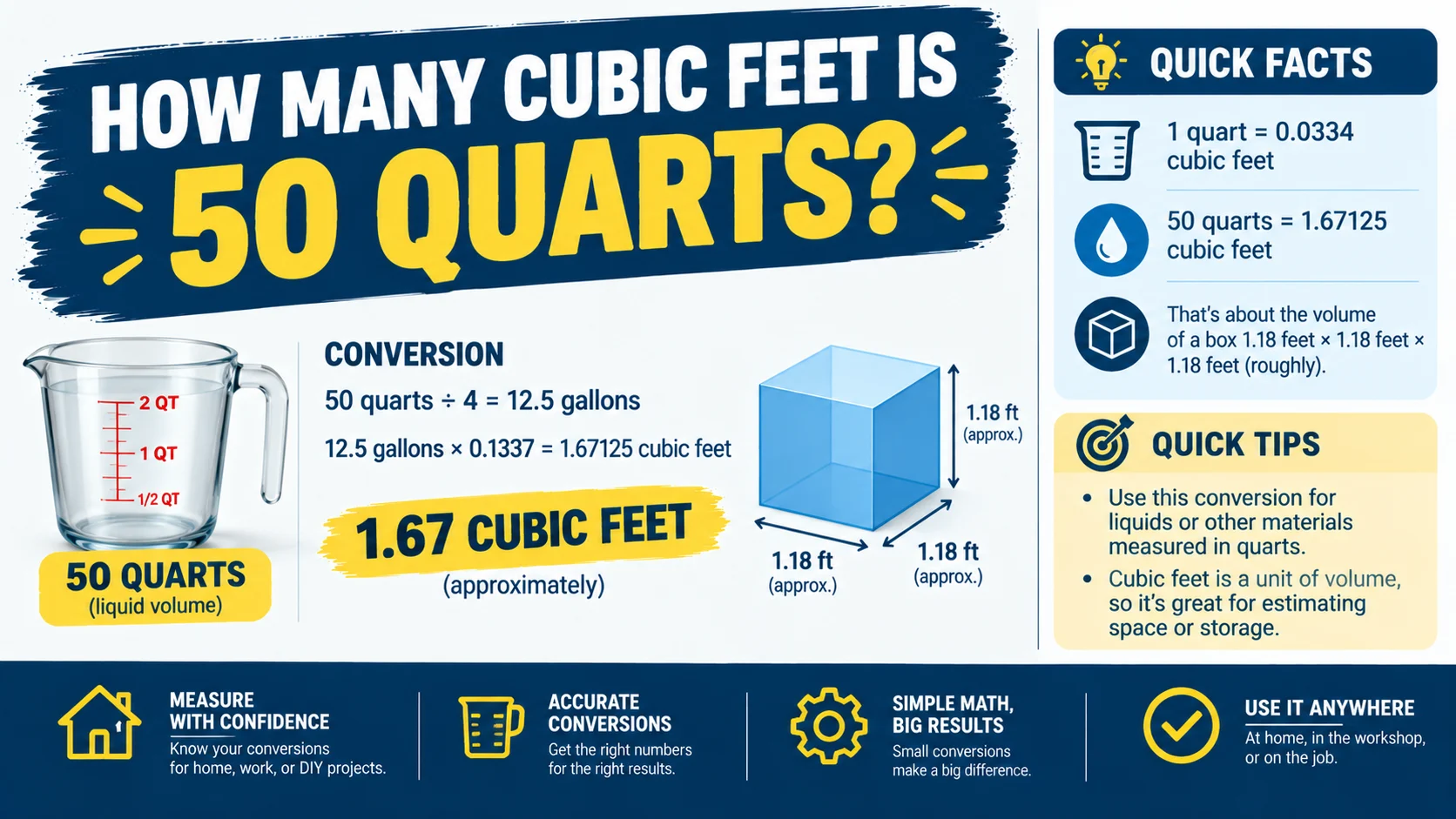
If you are wondering how many cubic feet is 50 quarts, the answer depends on which type of quart you are using. In the United States, the standard U.S. liquid quart is most commonly intended for this type of conversion.
Using U.S. liquid quarts:
50 quarts = 1.671875 cubic feet
Rounded to two decimal places:
50 quarts ≈ 1.67 cubic feet
This conversion can be useful when buying soil, mulch, potting mix, storage materials, liquids, or other products sold in quarts while you need to know the equivalent volume in cubic feet.
Quick Answer
50 U.S. liquid quarts = 1.671875 cubic feet
For everyday calculations, you can round this to:
50 quarts ≈ 1.67 cubic feet
The calculation is based on:
1 cubic foot = 29.922077 quarts
Therefore:
50 ÷ 29.922077 = 1.671875 cubic feet
How Do You Convert 50 Quarts to Cubic Feet?
The easiest way to convert quarts to cubic feet is to divide the number of U.S. liquid quarts by the number of quarts in one cubic foot.
Conversion formula
Cubic feet = Quarts ÷ 29.922077
For 50 quarts:
50 ÷ 29.922077 = 1.671875
Therefore:
50 quarts = 1.671875 cubic feet
Rounded:
50 quarts ≈ 1.67 cubic feet
This is the most useful answer when you are dealing with U.S. liquid quarts.
Why Are There About 29.92 Quarts in a Cubic Foot?
A cubic foot is a three-dimensional volume measuring:
1 foot × 1 foot × 1 foot
Since:
1 cubic foot = 1,728 cubic inches
and one U.S. liquid quart equals approximately:
57.75 cubic inches
you can divide:
1,728 ÷ 57.75 ≈ 29.92 quarts
So:
1 cubic foot ≈ 29.92 U.S. liquid quarts
This relationship makes it possible to convert between quarts and cubic feet.
50 Quarts to Cubic Feet Calculation
Let’s break the calculation down step by step.
Step 1: Start with 50 quarts
You have:
50 quarts
Step 2: Use the conversion factor
One cubic foot contains approximately:
29.922077 quarts
Step 3: Divide
50 ÷ 29.922077 = 1.671875
Step 4: Round the answer
For most practical applications:
1.671875 ≈ 1.67
Therefore:
50 quarts = approximately 1.67 cubic feet
50 Quarts in Cubic Feet, Cubic Inches, and Gallons
Here is a quick comparison of 50 quarts in several volume units:
| Unit | 50 Quarts |
|---|---|
| Cubic feet | 1.671875 ft³ |
| Cubic feet, rounded | 1.67 ft³ |
| U.S. gallons | 12.5 gal |
| Cubic inches | 2,887.5 in³ |
| Liters | 47.3176 L |
| Cubic meters | 0.0473 m³ |
These conversions are based on U.S. liquid quarts.
How Many Gallons Are in 50 Quarts?
Since:
4 quarts = 1 U.S. gallon
you can divide 50 by 4:
50 ÷ 4 = 12.5 gallons
Therefore:
50 quarts = 12.5 gallons
This is another useful way to understand the volume.
For example, if you have a container holding 50 quarts, it can hold the equivalent of 12.5 U.S. gallons.
How Many Liters Are in 50 Quarts?
One U.S. liquid quart is approximately:
0.946353 liters
Therefore:
50 × 0.946353 = 47.31765 liters
So:
50 U.S. liquid quarts ≈ 47.32 liters
This means 50 quarts is slightly less than 50 liters.
How Many Cubic Inches Are in 50 Quarts?
One U.S. liquid quart contains approximately 57.75 cubic inches.
Therefore:
50 × 57.75 = 2,887.5 cubic inches
So:
50 quarts = approximately 2,887.5 cubic inches
Since one cubic foot contains 1,728 cubic inches:
2,887.5 ÷ 1,728 = 1.671875 cubic feet
This gives us the same answer.
50 Quarts of Soil Is How Many Cubic Feet?
This is one of the most common reasons people search for this conversion.
If a bag of soil contains 50 quarts, its stated volume is approximately:
1.67 cubic feet
So, if you are purchasing soil in 50-quart bags, you can use approximately 1.67 cubic feet per bag when estimating how much material you need.
For example:
| Number of 50-Quart Bags | Approx. Cubic Feet |
|---|---|
| 1 bag | 1.67 ft³ |
| 2 bags | 3.34 ft³ |
| 3 bags | 5.02 ft³ |
| 4 bags | 6.69 ft³ |
| 5 bags | 8.36 ft³ |
| 6 bags | 10.03 ft³ |
| 10 bags | 16.72 ft³ |
Actual fill volume can vary slightly for bagged materials because of compression and packaging, but the stated volume conversion remains the same.
How Much Area Does 50 Quarts Cover?
Cubic feet measure volume, not surface area. Therefore, you cannot determine coverage from 50 quarts alone without knowing the desired depth.
However, once you know that 50 quarts is approximately 1.67 cubic feet, you can calculate the coverage area.
Coverage formula
Area = Volume ÷ Depth
For example, suppose you want to spread 50 quarts of soil at a depth of 2 inches.
First convert 2 inches to feet:
2 ÷ 12 = 0.1667 feet
Then:
1.671875 ÷ 0.1667 ≈ 10.03 square feet
So 50 quarts would cover approximately 10 square feet at a 2-inch depth.
At a depth of 1 inch:
1.671875 ÷ 0.0833 ≈ 20.06 square feet
At a depth of 4 inches:
1.671875 ÷ 0.3333 ≈ 5.02 square feet
Approximate coverage
| Depth | Coverage from 50 Quarts |
|---|---|
| 1 inch | 20.1 sq ft |
| 2 inches | 10.0 sq ft |
| 3 inches | 6.7 sq ft |
| 4 inches | 5.0 sq ft |
| 6 inches | 3.3 sq ft |
This assumes the entire 1.67 cubic feet is usable material and does not account for settling.
How Many 50-Quart Bags Make One Cubic Foot?
Since one 50-quart bag contains approximately 1.67 cubic feet, you need less than one bag to equal one cubic foot.
The calculation is:
1 ÷ 1.671875 ≈ 0.598 bags
Therefore, approximately 0.60 of a 50-quart bag equals one cubic foot.
In practical terms, one 50-quart bag contains considerably more than one cubic foot.
How Many 50-Quart Bags Make 2 Cubic Feet?
To determine how many 50-quart bags are needed for 2 cubic feet:
2 ÷ 1.671875 ≈ 1.20 bags
Therefore, you need approximately:
1.2 bags of 50 quarts
Since you generally cannot purchase a fraction of a bag, you would need to purchase 2 bags to have enough material.
How Many 50-Quart Bags Make 10 Cubic Feet?
For a larger landscaping or gardening project:
10 ÷ 1.671875 ≈ 5.98 bags
So you would need approximately 6 bags of 50 quarts to provide 10 cubic feet of material.
Six bags contain:
6 × 1.671875 = 10.03125 cubic feet
Therefore, six 50-quart bags provide just over 10 cubic feet.
50 Quarts vs. 2 Cubic Feet
These two package sizes are often compared when shopping for soil, mulch, compost, or potting mix.
A 50-quart bag contains:
1.671875 cubic feet
A 2-cubic-foot bag contains:
2 cubic feet
The difference is:
2 − 1.671875 = 0.328125 cubic feet
So a 2-cubic-foot bag contains about 19.6% more volume than a 50-quart bag.
This can help when comparing products sold in different package sizes.
What Is the Difference Between Quarts and Cubic Feet?
Quarts and cubic feet both measure volume, but they are very different-sized units.
A quart is a relatively small unit commonly used for liquids and packaged materials. A cubic foot is a larger volume measurement commonly used for soil, mulch, storage containers, appliances, construction materials, and other bulk items.
The key relationship is:
1 cubic foot ≈ 29.92 U.S. liquid quarts
Therefore:
50 quarts ≈ 1.67 cubic feet
U.S. Liquid Quarts vs. Imperial Quarts
It is important to know that not all quarts are the same.
The conversion in this article uses the U.S. liquid quart.
A U.S. liquid quart is approximately:
0.946353 liters
An Imperial quart is approximately:
1.136523 liters
Because the Imperial quart is larger, converting Imperial quarts to cubic feet produces a different result.
If a product label simply says “quarts,” check whether it is using U.S. quarts or another measurement standard.
For most U.S. gardening and household products, the U.S. measurement is the relevant one.
Common Uses for a 50-Quart Volume
A 50-quart volume is commonly encountered when purchasing:
- Potting soil
- Garden soil
- Compost
- Mulch
- Peat moss
- Planting mix
- Storage containers
- Animal bedding
- Gardening materials
- Certain liquid products
When a product is sold in quarts but your project is calculated in cubic feet, converting the package size makes it much easier to estimate how many bags or containers you need.
Common Mistakes When Converting Quarts to Cubic Feet
Mistake 1: Assuming 50 quarts equals 50 cubic feet
A quart and a cubic foot are different volume units. Fifty quarts is only about 1.67 cubic feet, not 50 cubic feet.
Mistake 2: Using the wrong quart
Make sure you know whether the measurement is a U.S. liquid quart or an Imperial quart.
Mistake 3: Confusing cubic feet with square feet
Cubic feet measure volume. Square feet measure area.
If you are calculating how much soil is required for a garden bed, you need length, width, and depth.
Mistake 4: Ignoring material settling
Bagged soil, compost, and similar materials can settle during transportation and storage. The labeled volume is the appropriate starting point, but the material may not occupy exactly the same apparent space after handling.
FAQs
How many cubic feet is 50 quarts?
50 U.S. liquid quarts equals 1.671875 cubic feet, or approximately 1.67 cubic feet.
Is 50 quarts the same as 2 cubic feet?
No. 50 quarts is approximately 1.67 cubic feet, while 2 cubic feet is larger.
How many gallons are 50 quarts?
Since 4 U.S. quarts equal 1 gallon:
50 quarts = 12.5 gallons.
How many liters are 50 quarts?
50 U.S. liquid quarts equals approximately 47.32 liters.
How many cubic inches are 50 quarts?
50 U.S. liquid quarts equal approximately 2,887.5 cubic inches.
How many cubic feet are in one quart?
One U.S. liquid quart is approximately:
0.0334375 cubic feet
How many 50-quart bags do I need for 10 cubic feet?
One 50-quart bag contains approximately 1.67 cubic feet.
10 ÷ 1.671875 ≈ 5.98
Therefore, you would need approximately 6 bags to provide 10 cubic feet.
Final Answer: How Many Cubic Feet Is 50 Quarts?
The answer is:
50 U.S. liquid quarts = 1.671875 cubic feet
Rounded to a practical number:
50 quarts ≈ 1.67 cubic feet
If you are comparing bags of soil, compost, mulch, or potting mix, a 50-quart bag contains approximately 1.67 cubic feet of material.
For quick calculations, remember:
Cubic feet = Quarts ÷ 29.922077
So:
50 ÷ 29.922077 = 1.671875 cubic feet
That conversion can make it much easier to compare products sold in quarts with materials sold by the cubic foot.