
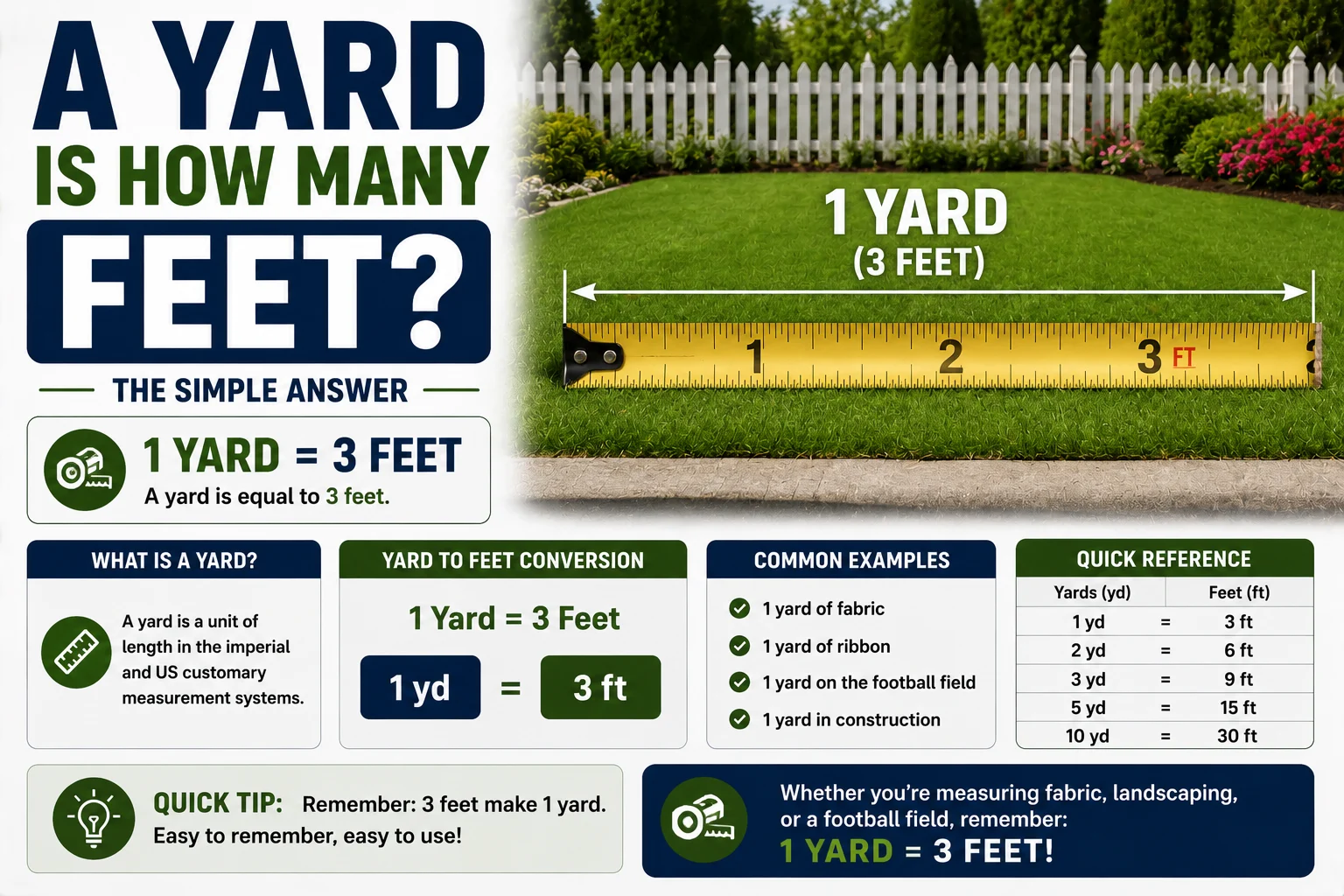
If you are wondering “a yard is how many feet,” the answer is simple:
1 yard=3 feet
The yard is a standard unit of length used in:
- The United States
- Sports
- Construction
- Fabric measurement
- Landscaping
Understanding yard-to-feet conversions is useful for:
- Measuring distances
- Home improvement projects
- Buying materials
- Sports field calculations
- School math
In this guide, you will learn exactly how many feet are in a yard, how to convert yards into feet, and real-world examples of yard measurements.
Quick Answer
One yard equals:
3 feet
Exact Conversion
The official measurement is:
1 yard=36 inches=3 feet
Basic Formula
To convert yards into feet:
Yards×3=Feet
What Is a Yard?
A yard is a unit of length in the imperial and US customary systems.
Definition
One yard equals:
- 3 feet
- 36 inches
It is commonly used to measure:
- Distance
- Fabric
- Landscaping materials
- Sports fields
History of the Yard
The yard has ancient origins.
Historically, it was based on:
- Human body measurements
Modern yard measurements are now standardized internationally.
Yard to Feet Conversion Explained
Converting yards into feet is easy.
Conversion Formula
Use this formula:
Feet=Yards×3
Easy Examples
Example 1
Convert 2 yards into feet:
2×3=6 feet
Example 2
Convert 5 yards into feet:
5×3=15 feet
Example 3
Convert 10 yards into feet:
10×3=30 feet
Yard Conversion Chart
Quick charts make conversions easier.
Yards to Feet
| Yards | Feet |
|---|---|
| 1 yard | 3 feet |
| 2 yards | 6 feet |
| 5 yards | 15 feet |
| 10 yards | 30 feet |
| 20 yards | 60 feet |
Yards to Inches
| Yards | Inches |
|---|---|
| 1 yard | 36 inches |
| 2 yards | 72 inches |
| 3 yards | 108 inches |
Real-World Examples of a Yard
Understanding practical examples makes measurements easier to visualize.
Football Field
Football field markings use:
- Yard lines
For example:
- 10 yards = 30 feet
Household Measurements
Some rugs, curtains, and flooring materials are sold by:
- The yard
Fabric Measurements
Fabric stores commonly measure cloth using:
- Yards
This helps customers estimate sewing materials.
Why Yard Measurements Matter
Yards remain useful for many industries and activities.
Construction and Landscaping
Builders often use yards for:
- Concrete
- Soil
- Gravel
- Mulch
Sports
American football relies heavily on:
- Yard measurements
Retail and Fabric
Textiles and carpeting are frequently sold by:
- Linear yard
Common Yard Conversion Mistakes
Forgetting the Conversion Factor
Remember:
1 yard=3 feet
Confusing Feet With Inches
One yard equals:
- 3 feet
- 36 inches
not:
- 12 inches
Mixing Measurement Systems
Avoid mixing:
- Imperial units
- Metric units
without proper conversion.
Tips for Measuring Accurately
Use Proper Measuring Tools
Tape measures and rulers improve:
- Accuracy
- Efficiency
Double-Check Calculations
Always confirm:
- Multiplication
- Unit conversions
before purchasing materials.
Learn Common Conversions
Knowing basic conversions helps with:
- DIY projects
- Schoolwork
- Construction estimates
Common Uses for Yard Measurements
Yards are commonly used for:
- Sports fields
- Landscaping
- Fabric sales
- Construction projects
- Outdoor measurements
Many homeowners use yard conversions when estimating:
- Fencing
- Sod
- Concrete
- Flooring
Fun Facts About Yards
Football Fields Use Yard Markers
Every line on an American football field is measured in:
- Yards
The Yard Is Older Than the Metric System
The yard has been used for centuries in England and America.
Some Countries Prefer Metric Units
Many countries now use:
- Meters
- Centimeters
instead of yards and feet.
FAQs
A yard is how many feet?
One yard equals 3 feet.
How many inches are in a yard?
One yard equals 36 inches.
What formula converts yards into feet?
Use:
Yards×3=Feet
Why are yards used in sports?
Sports like football measure field distances using yards.
Are yards part of the metric system?
No. Yards belong to the imperial and US customary systems.
Conclusion
So, a yard is how many feet? The exact conversion is:
1 yard=3 feet
This simple conversion is widely used in sports, construction, landscaping, fabric measurement, and everyday distance calculations.
Understanding yard-to-feet conversions makes it easier to estimate materials, measure spaces, and solve practical measurement problems accurately.