

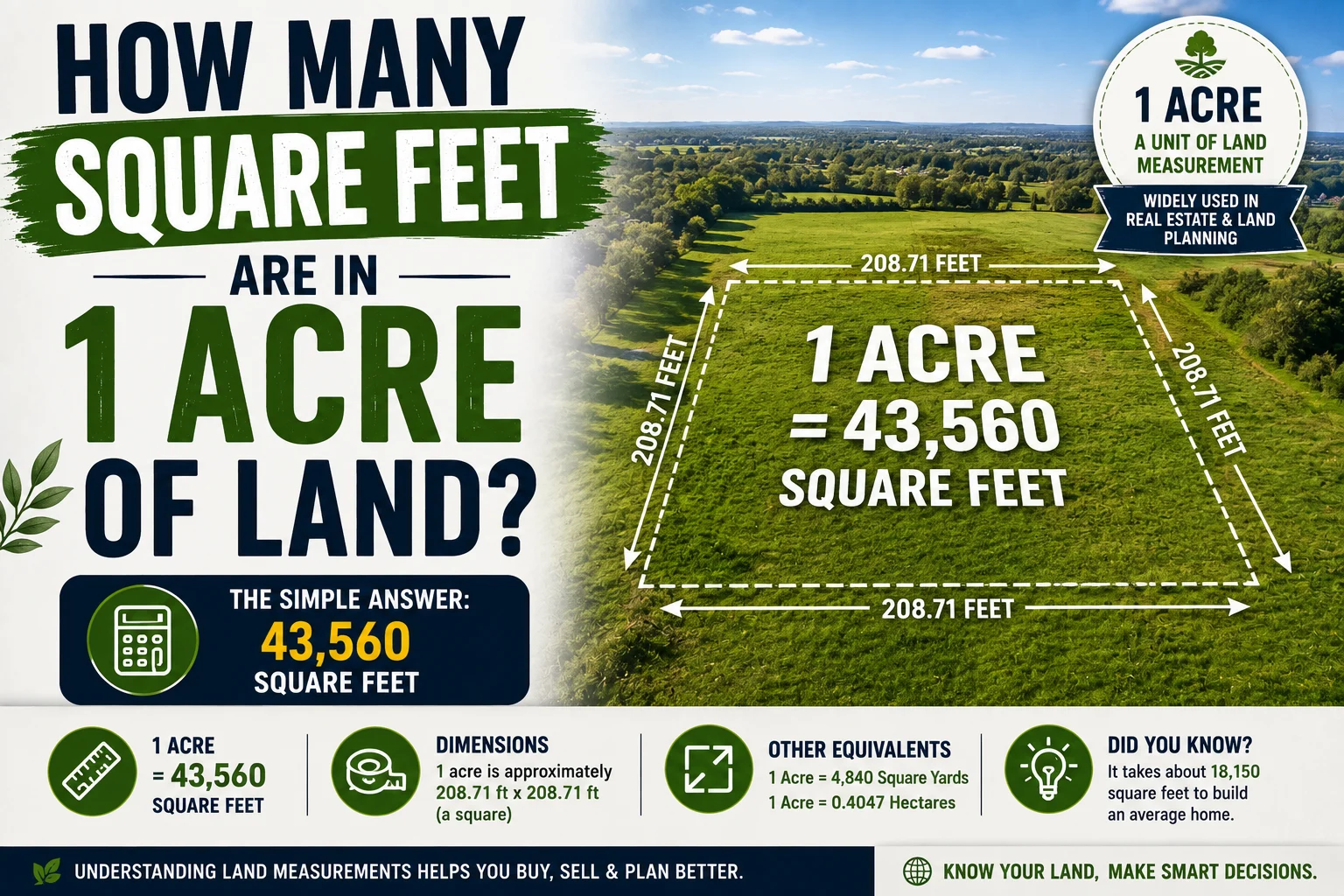
If you are wondering how many square feet in 1 acre of land, the exact answer is:
1 acre=43,560 square feet
An acre is one of the most widely used land measurements in:
- Real estate
- Farming
- Construction
- Landscaping
- Property development
Understanding acreage is important because it helps people:
- Compare property sizes
- Estimate land value
- Plan building projects
- Understand lot dimensions
- Calculate development costs
Whether you are buying land, selling property, planning a farm, or simply curious about measurements, knowing how large an acre is can help you make smarter decisions.
In this guide, you will learn exactly how many square feet are in an acre, what one acre looks like, common land comparisons, conversion formulas, and practical examples for real-world property planning.
Quick Answer
One acre contains exactly:
43,560 square feet
This is the official standardized measurement used in:
- The United States
- Real estate industries
- Agricultural land calculations
Exact Acre Conversion
The acre is a unit of area, not length.
That means:
- It measures surface space
- Not distance or perimeter
An acre can have many shapes as long as the total area equals:
43,560 square feet
Why Acre Measurements Matter
Understanding acreage helps with:
- Property purchases
- Construction estimates
- Zoning compliance
- Land development
- Agricultural planning
Acreage also affects:
- Property taxes
- Land value
- Building restrictions
What Is an Acre?
An acre is a standard land measurement unit.
Acre Definition
One acre equals:
43,560 square feet
It is commonly used for:
- Residential land
- Farms
- Ranches
- Vacant lots
- Commercial property
History of the Acre
The acre has ancient origins.
Historically, it referred to the amount of land a farmer could plow in one day using oxen.
Over time, the measurement became standardized into the modern acre used today.
How Many Square Feet in 1 Acre of Land?
The acre-to-square-feet conversion is fixed.
Standard Conversion Formula
The basic formula is:
1 acre=43,560 square feet
To convert acres into square feet:
Acres×43,560=Square Feet
Easy Calculation Example
Suppose you own:
2 acres
Multiply by 43,560:
2×43,560=87,120 square feet
So:
- 2 acres = 87,120 square feet
What Does 1 Acre Look Like?
Many people understand land better through comparisons.
Football Field Comparison
One acre is slightly smaller than:
- A full American football field without end zones
A football field measures approximately:
- 48,000 square feet including end zones
while one acre equals:
- 43,560 square feet
Residential Lot Comparison
Typical suburban home lots may range from:
- 5,000 to 12,000 square feet
That means one acre could hold:
- Several average residential lots
depending on zoning laws.
Walking Visualization
Imagine a square measuring approximately:
208.7 feet×208.7 feet
That square equals roughly one acre.
Acre Conversion Chart
Here are common acreage conversions.
Acres to Square Feet
| Acres | Square Feet |
|---|---|
| 0.25 acre | 10,890 sq ft |
| 0.5 acre | 21,780 sq ft |
| 1 acre | 43,560 sq ft |
| 2 acres | 87,120 sq ft |
| 5 acres | 217,800 sq ft |
Acres to Other Measurements
| Measurement | Equivalent to 1 Acre |
|---|---|
| Square feet | 43,560 |
| Square yards | 4,840 |
| Hectares | 0.4047 |
| Square meters | 4,046.86 |
These conversions are commonly used in:
- Real estate
- Surveying
- Construction
- Agriculture
Common Uses for Acre Measurements
Acres are used across many industries.
Real Estate
Real estate listings often describe:
- Property size
- Lot dimensions
- Development land
using acres.
Larger acreage can increase:
- Property value
- Privacy
- Development potential
Farming
Farmers use acreage to estimate:
- Crop production
- Irrigation needs
- Livestock capacity
- Equipment planning
Agricultural land is often measured entirely in acres.
Construction and Development
Builders use acreage to plan:
- Housing developments
- Commercial buildings
- Parking lots
- Roads
- Utility systems
Why Understanding Acreage Matters
Knowing land size helps avoid expensive mistakes.
Better Property Decisions
Understanding acreage helps buyers:
- Compare listings accurately
- Estimate usable land
- Understand future expansion options
Improved Budget Planning
Land size affects:
- Purchase price
- Maintenance costs
- Landscaping expenses
- Construction budgets
Smarter Land Use
Acreage calculations help determine:
- Building placement
- Driveway size
- Garden areas
- Recreational space
Common Acre Measurement Mistakes
Land calculations can become confusing.
Confusing Area With Dimensions
An acre measures:
- Total area
not:
- Shape
- Width
- Length
Different property shapes can still equal one acre.
Forgetting Irregular Shapes
Some lots include:
- Curves
- Angles
- Easements
which may reduce usable land.
Using Incorrect Units
Always verify whether measurements use:
- Square feet
- Acres
- Hectares
- Square meters
Tips for Measuring Land Accurately
Use Professional Surveys
Property surveys provide:
- Legal boundaries
- Accurate dimensions
- Easement information
Double-Check Property Listings
Real estate listings occasionally contain:
- Approximate measurements
Always verify official records.
Learn Basic Conversion Formulas
Knowing formulas helps estimate:
- Lot size
- Building area
- Land value
For example:
Acres×43,560=Square Feet
Real-World Examples of One Acre
Understanding practical examples makes acreage easier to visualize.
Small Farm
A one-acre farm can support:
- Vegetable gardens
- Chickens
- Fruit trees
- Small livestock
Residential Development
One acre may fit:
- Multiple homes
depending on zoning regulations.
Recreation Space
An acre provides enough room for:
- Outdoor sports
- Large gardens
- Swimming pools
- Workshops
Fun Facts About Acres
Acres Are Still Widely Used Today
Even with metric systems becoming common, acres remain standard in:
- US real estate
- Farming
- Land development
Some Ranches Measure Thousands of Acres
Large ranches may contain:
- Tens of thousands of acres
Acreage Influences Property Taxes
In many locations, land size directly impacts:
- Tax assessments
- Property valuation
FAQs
How many square feet are in 1 acre of land?
One acre contains exactly:
43,560 square feet
What does 1 acre look like?
An acre is slightly smaller than a football field without end zones.
How do you convert acres into square feet?
Use this formula:
Acres×43,560=Square Feet
Is one acre a large lot?
Yes. One acre is much larger than most suburban residential lots.
How many houses can fit on one acre?
It depends on:
- Local zoning laws
- House size
- Road access
- Utility requirements
Conclusion
So, how many square feet in 1 acre of land? The official conversion is:
1 acre=43,560 square feet
Understanding acreage is important for property buyers, landowners, builders, farmers, and investors because it affects everything from land value to construction planning.
Whether you are comparing lots, estimating building space, planning agricultural use, or evaluating real estate opportunities, knowing how to visualize and calculate one acre can help you make more informed decisions.


Pingback: How Many Cubic Feet Are in a Cubic Yard?
Pingback: How Many Square Feet Is 30x30? Complete Guide