

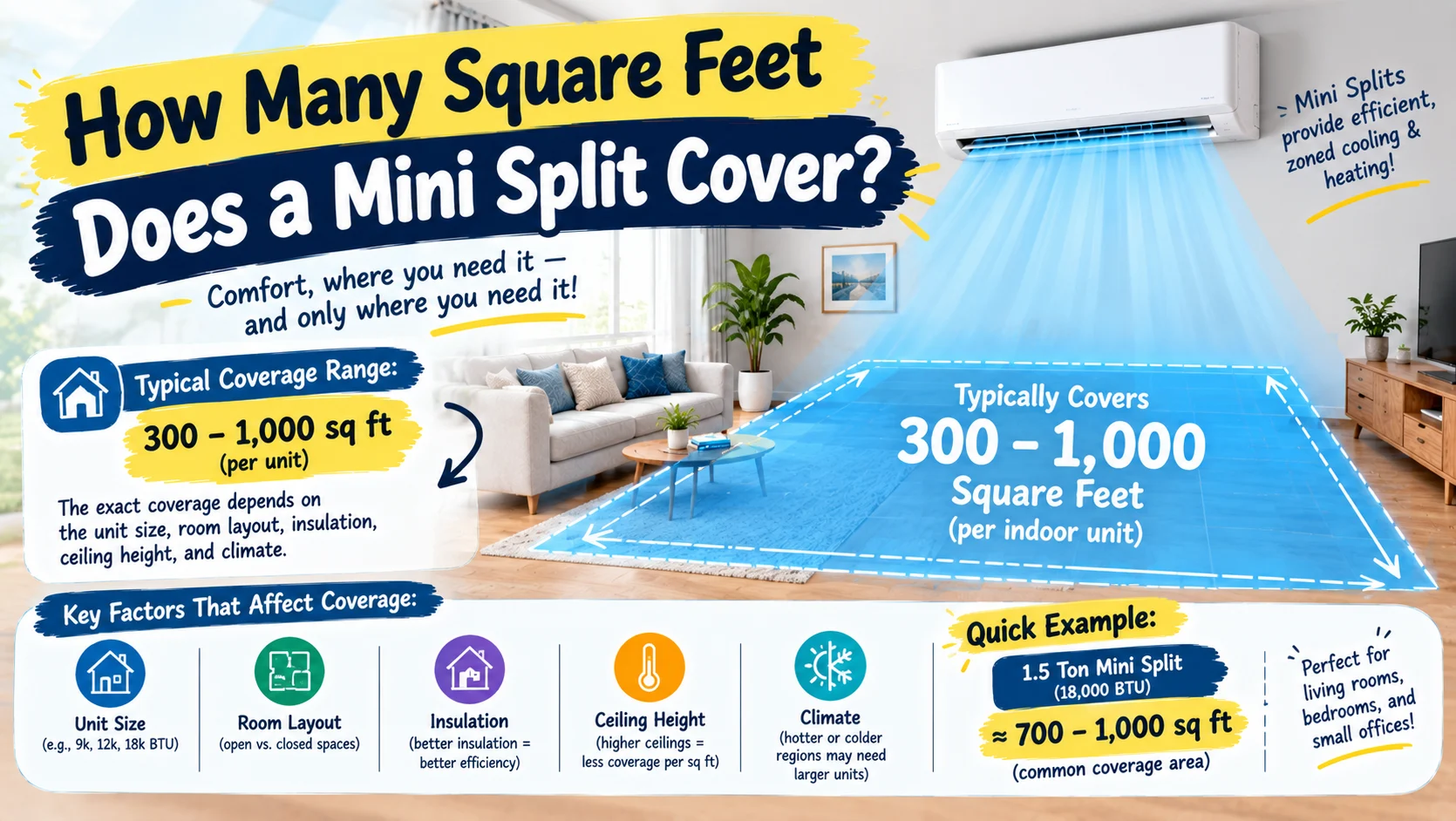
A mini split can typically cover about 300 to 1,500 square feet per indoor unit, depending on its BTU capacity, insulation, ceiling height, climate, windows, and the layout of the space. Smaller mini splits may cool a single bedroom or office, while larger systems can handle open living areas or multiple zones.
For a quick estimate, a 12,000 BTU mini split often covers around 450–600 square feet, while an 18,000 BTU system may cover approximately 700–1,000 square feet. A 24,000 BTU mini split may cover around 1,000–1,500 square feet under suitable conditions.
However, these are general estimates rather than fixed coverage limits. Proper mini-split sizing should account for the actual cooling and heating load of the space.
Quick Answer: How Many Square Feet Does a Mini Split Cover?
The coverage of a mini split depends primarily on its BTU rating.
| Mini Split Size | BTU Capacity | Approximate Coverage |
|---|---|---|
| 6,000 BTU | 6,000 | 150–300 sq ft |
| 9,000 BTU | 9,000 | 300–450 sq ft |
| 12,000 BTU | 12,000 | 450–600 sq ft |
| 15,000 BTU | 15,000 | 600–750 sq ft |
| 18,000 BTU | 18,000 | 700–1,000 sq ft |
| 24,000 BTU | 24,000 | 1,000–1,500 sq ft |
| 30,000 BTU | 30,000 | 1,250–1,800 sq ft |
| 36,000 BTU | 36,000 | 1,500–2,000+ sq ft |
These ranges are general planning estimates. Actual coverage can be significantly different depending on the building and climate.
What Is a Mini Split?
A mini split is a heating and cooling system that generally consists of an outdoor condenser unit connected to one or more indoor air-handling units.
Unlike a traditional central HVAC system, a ductless mini split does not require a network of conventional air ducts to distribute conditioned air.
A typical single-zone system includes:
- Outdoor compressor/condenser
- Indoor air handler
- Refrigerant lines
- Electrical connections
- Drain line
- Remote control or thermostat
Because mini splits can operate without traditional ductwork, they are commonly used for rooms, additions, garages, workshops, apartments, and homes where installing ducts is difficult.
How Does Mini Split Coverage Work?
Mini-split coverage is primarily determined by the system’s BTU capacity.
BTU stands for British thermal unit and is a measurement of heat energy.
In general, a higher-BTU mini split can handle a larger cooling load.
For example:
9,000 BTU → smaller room
12,000 BTU → medium-sized room
18,000 BTU → larger room or open area
24,000 BTU → larger open space
However, BTU capacity alone doesn’t determine the exact square footage a system can serve.
How Many Square Feet Does a 6,000 BTU Mini Split Cover?
A 6,000 BTU mini split may cover approximately 150–300 square feet under typical conditions.
It can be appropriate for spaces such as:
- Small bedrooms
- Home offices
- Small studios
- Guest rooms
- Compact workshops
If the room has poor insulation, large windows, high ceilings, or substantial sun exposure, the required capacity may be higher.
How Many Square Feet Does a 9,000 BTU Mini Split Cover?
A 9,000 BTU mini split may cover approximately 300–450 square feet.
This size can be useful for:
- Bedrooms
- Small living rooms
- Offices
- Studio apartments
- Small additions
A well-insulated room in a mild climate may require less capacity than a poorly insulated room in a hot climate.
How Many Square Feet Does a 12,000 BTU Mini Split Cover?
A 12,000 BTU mini split commonly covers approximately 450–600 square feet.
This is one of the popular sizes for individual rooms and smaller living areas.
For example, a 12 × 40-foot space has:
12 × 40 = 480 square feet
A 12,000 BTU mini split could potentially be considered for a space of this size, depending on the building’s cooling load.
How Many Square Feet Does an 18,000 BTU Mini Split Cover?
An 18,000 BTU mini split may cover approximately 700–1,000 square feet under suitable conditions.
It can be useful for:
- Large living rooms
- Open-concept spaces
- Larger bedrooms
- Apartments
- Small homes
- Garages and workshops
The shape and openness of the space are important. An 18,000 BTU unit may condition an open 900-square-foot area more effectively than a similarly sized space divided into several closed rooms.
How Many Square Feet Does a 24,000 BTU Mini Split Cover?
A 24,000 BTU mini split can commonly cover approximately 1,000–1,500 square feet, depending on the building.
This size may be appropriate for:
- Large open living areas
- Apartments
- Small homes
- Garages
- Workshops
- Large additions
If the area contains multiple closed rooms, one indoor unit may not distribute air evenly throughout the entire space.
How Many Square Feet Does a 30,000 BTU Mini Split Cover?
A 30,000 BTU mini split may cover approximately 1,250–1,800 square feet under favorable conditions.
Larger systems are often used for open floor plans or multi-zone applications.
A professional load calculation is particularly useful when considering a larger mini split because the system’s capacity needs to match the building’s actual heating and cooling requirements.
How Many Square Feet Does a 36,000 BTU Mini Split Cover?
A 36,000 BTU mini split may serve approximately 1,500–2,000 square feet or more, depending on the structure.
A 36,000 BTU system is equivalent to:
3 tons × 12,000 BTUs = 36,000 BTUs
However, a single 36,000 BTU indoor head does not necessarily distribute conditioned air evenly throughout a large house.
A multi-zone system with multiple indoor units may be a better configuration for a home with several separate rooms.
Mini Split Coverage by BTU
The following table provides a quick reference:
| BTU | Approximate Square Feet |
|---|---|
| 6,000 | 150–300 |
| 9,000 | 300–450 |
| 12,000 | 450–600 |
| 18,000 | 700–1,000 |
| 24,000 | 1,000–1,500 |
| 30,000 | 1,250–1,800 |
| 36,000 | 1,500–2,000+ |
Remember that these numbers are estimates. Manufacturer specifications and a proper load calculation should take priority.
What Factors Affect Mini Split Coverage?
Square footage is only one part of mini-split sizing.
Climate
The outdoor climate can dramatically affect the amount of cooling or heating required.
A room in a very hot climate may need more capacity than an identical room in a mild climate.
Insulation
Well-insulated walls, ceilings, floors, and windows reduce heat transfer.
Poor insulation increases the amount of heating or cooling required.
Ceiling Height
A room with 8-foot ceilings contains less air volume than the same floor area with 12-foot ceilings.
Higher ceilings can therefore increase the heating and cooling load.
Windows
Large windows can increase heat gain from sunlight.
Window orientation, glazing, shading, and quality all affect the cooling load.
Sun Exposure
A room exposed to direct afternoon sunlight can become considerably warmer than a shaded room.
Number of Occupants
People generate heat, so heavily occupied spaces may require more cooling.
Appliances
Computers, televisions, refrigerators, ovens, lighting, and other equipment can contribute to internal heat gain.
Air Leakage
Gaps around windows, doors, and other building components allow conditioned air to escape and outdoor air to enter.
Does a Mini Split Cool the Entire House?
A mini split can cool an entire house, but the configuration matters.
A single-zone mini split has one indoor unit and is generally designed to condition one primary area.
A multi-zone mini-split system can connect multiple indoor units to one outdoor unit.
For example, a home could have:
- One indoor unit in the living room
- One in the master bedroom
- One in another bedroom
- One in a finished basement
This allows different areas to receive conditioned air more directly.
Single-Zone vs. Multi-Zone Mini Splits
Single-Zone Mini Split
A single-zone system typically has one indoor unit connected to one outdoor unit.
It is useful for:
- One room
- One apartment
- A garage
- A home addition
- A workshop
- A detached space
Multi-Zone Mini Split
A multi-zone system can connect multiple indoor units to one outdoor unit.
It may be useful for:
- Larger homes
- Homes without ductwork
- Multiple bedrooms
- Separate living areas
- Homes with different temperature preferences
Multi-zone systems can provide more targeted temperature control.
Can One Mini Split Cool 1,000 Square Feet?
Yes, depending on the mini split’s capacity and the characteristics of the space.
An 18,000–24,000 BTU system may be considered for approximately 1,000 square feet under some conditions.
However, a 1,000-square-foot open area is very different from a 1,000-square-foot home divided into several rooms.
Airflow distribution becomes especially important in larger spaces.
Can One Mini Split Cool 1,500 Square Feet?
A sufficiently sized mini split may be capable of conditioning approximately 1,500 square feet.
A 24,000–30,000 BTU system might be considered depending on the building’s cooling load.
For a home with several rooms, a multi-zone system may provide more even temperature distribution than a single indoor head.
Can One Mini Split Cool 2,000 Square Feet?
A mini-split system can potentially cool a 2,000-square-foot property, but a single indoor unit may not provide even cooling throughout the entire building.
A multi-zone configuration may be more appropriate for spaces with multiple rooms.
The correct system should be based on the property’s actual heating and cooling load.
Can a Mini Split Cool Multiple Rooms?
It depends on the system design.
A single indoor unit primarily conditions the area around that unit. Air can travel through open doorways, but closed rooms can remain warmer or cooler than the main area.
A multi-zone system allows separate indoor units to be installed in different rooms.
This can provide better temperature control throughout the property.
How to Calculate Mini Split BTU Requirements
A simple planning calculation can provide a starting point.
One rough approach is:
Square feet × BTUs per square foot = estimated BTU requirement
For example, if you use a rough estimate of 20 BTUs per square foot for a 600-square-foot space:
600 × 20 = 12,000 BTUs
This suggests a 12,000 BTU system as a preliminary estimate.
However, fixed BTU-per-square-foot calculations are not a substitute for a detailed load calculation because building conditions vary.
Mini Split Size Calculator
Here’s a simple planning table:
| Room/Area | Possible Mini Split Size |
|---|---|
| 150–300 sq ft | 6,000 BTU |
| 300–450 sq ft | 9,000 BTU |
| 450–600 sq ft | 12,000 BTU |
| 600–750 sq ft | 15,000 BTU |
| 700–1,000 sq ft | 18,000 BTU |
| 1,000–1,500 sq ft | 24,000 BTU |
| 1,250–1,800 sq ft | 30,000 BTU |
| 1,500–2,000+ sq ft | 36,000 BTU |
These figures should be used as preliminary estimates rather than final equipment specifications.
Does a Higher BTU Mini Split Always Work Better?
No.
A larger system is not automatically better.
An oversized system may reach the thermostat setting too quickly and cycle off before effectively removing enough humidity from the space.
An undersized system may run continuously and struggle to maintain the desired temperature.
The goal is to choose a system that appropriately matches the building’s load.
What Happens If a Mini Split Is Too Small?
An undersized mini split may:
- Run continuously
- Struggle during extreme weather
- Fail to reach the desired temperature
- Consume more energy because of extended operation
- Experience increased operating stress
If the system cannot meet the building’s peak load, comfort can suffer.
What Happens If a Mini Split Is Too Large?
An oversized mini split may:
- Cycle frequently
- Provide less consistent humidity control
- Create temperature fluctuations
- Operate less efficiently under some conditions
Correct sizing is therefore more important than simply choosing the largest system.
Mini Split vs. Central AC for Square Footage
Mini splits and central air conditioners can both cool large spaces, but their distribution methods differ.
Mini Split
Advantages include:
- No traditional ductwork required
- Individual zone control
- Flexible installation
- Useful for additions and rooms
- Can be efficient in many applications
Central AC
Advantages include:
- Designed to distribute air through ductwork
- One thermostat can control the system
- Can provide whole-house conditioning
- Works well with existing duct systems
The best system depends on the building, existing infrastructure, desired zoning, installation requirements, and operating goals.
Does Insulation Matter for Mini Split Sizing?
Yes.
A well-insulated building generally requires less heating and cooling capacity than a poorly insulated building of the same size.
For example, two 800-square-foot spaces could require different mini-split capacities if one has:
- Modern insulated windows
- Well-insulated walls
- A properly insulated attic
- Minimal air leakage
while the other has:
- Single-pane windows
- Poor attic insulation
- Air leaks
- High solar exposure
Does a Mini Split Need Ductwork?
One of the major advantages of a ductless mini split is that it generally does not require traditional central-air ductwork.
The indoor and outdoor units are connected through refrigerant lines and other necessary connections.
This makes mini splits useful for spaces where installing ducts would be expensive, difficult, or impractical.
How Efficient Are Mini Splits?
Many mini splits use inverter-driven compressors that can adjust their output based on demand.
This can allow the system to operate at lower capacity rather than repeatedly switching fully on and off.
Actual efficiency depends on:
- Equipment model
- Outdoor temperature
- Indoor temperature
- Installation
- Maintenance
- Operating conditions
- Heating or cooling mode
When comparing systems, look at the manufacturer’s efficiency ratings rather than assuming every mini split has the same performance.
How Many Mini Splits Do You Need for a House?
There is no universal number.
A small open-plan home might be served by one appropriately sized system.
A larger house with multiple bedrooms may benefit from several indoor units.
For example, a 1,800-square-foot house might use:
- One large indoor unit for an open living area, or
- Multiple smaller indoor units for separate zones
The second approach may provide more even temperature control when rooms are separated.
How Much Does Mini Split Placement Matter?
Placement is important because an indoor unit needs to distribute conditioned air effectively.
Consider:
- Room shape
- Furniture
- Doorways
- Ceiling height
- Windows
- Exterior walls
- Airflow direction
A poorly positioned indoor unit can result in uneven temperatures even when the system has sufficient capacity.
How to Choose the Right Mini Split Size
Follow these basic steps:
Measure the Space
Determine the length and width of the room.
Length × width = square footage
Consider Ceiling Height
Higher ceilings can increase the heating and cooling requirement.
Evaluate Insulation
Consider walls, windows, attic insulation, and air leakage.
Consider Climate
Hot climates generally require greater cooling capacity.
Look at Windows and Sunlight
Large or highly exposed windows can increase heat gain.
Determine Whether You Need One or Multiple Zones
A single open room may work well with one indoor unit.
Multiple closed rooms may benefit from multiple indoor units.
Confirm With a Load Calculation
For a permanent installation, professional HVAC sizing is preferable to relying on square footage alone.
FAQs
How many square feet does a mini split cover?
A mini split can cover approximately 150 to 2,000+ square feet, depending on its BTU capacity. Common sizes range from 6,000 to 36,000 BTUs.
How many square feet does a 12,000 BTU mini split cover?
A 12,000 BTU mini split may cover approximately 450–600 square feet, depending on climate, insulation, windows, ceiling height, and other factors.
How many square feet does an 18,000 BTU mini split cover?
An 18,000 BTU mini split may cover approximately 700–1,000 square feet under suitable conditions.
How many square feet does a 24,000 BTU mini split cover?
A 24,000 BTU mini split may cover approximately 1,000–1,500 square feet, depending on the building.
How many square feet does a 36,000 BTU mini split cover?
A 36,000 BTU system may cover approximately 1,500–2,000+ square feet, but actual coverage depends on the building’s heating and cooling load.
Can a mini split cool a 1,000-square-foot house?
Yes. A properly sized mini-split system can cool a 1,000-square-foot home. Depending on the layout, one or more indoor units may be needed.
Can a mini split cool a 1,500-square-foot house?
Yes. A sufficiently sized mini-split system can potentially cool 1,500 square feet. Multiple indoor units may provide better distribution in a house with separate rooms.
Can one mini split cool multiple rooms?
It can cool connected or open areas, but one indoor unit may not distribute conditioned air evenly into closed rooms. A multi-zone system can provide separate indoor units for different rooms.
Is a 12,000 BTU mini split enough for 600 square feet?
It may be suitable under favorable conditions. The actual requirement depends on insulation, climate, ceiling height, windows, and other heat-load factors.
Is a bigger mini split better?
Not necessarily. Oversizing can lead to frequent cycling and potentially poorer humidity control. Proper sizing is more important than maximum capacity.
Do mini splits work for whole-house cooling?
Yes. Whole-house mini-split systems can use multiple indoor units connected to one or more outdoor units. This allows different areas of the home to be conditioned independently.
Final Answer: How Many Square Feet Does a Mini Split Cover?
A mini split can cover anywhere from about 150 to more than 2,000 square feet, depending on its capacity and the characteristics of the building.
For common residential systems:
- 6,000 BTU: about 150–300 sq ft
- 9,000 BTU: about 300–450 sq ft
- 12,000 BTU: about 450–600 sq ft
- 18,000 BTU: about 700–1,000 sq ft
- 24,000 BTU: about 1,000–1,500 sq ft
- 30,000 BTU: about 1,250–1,800 sq ft
- 36,000 BTU: about 1,500–2,000+ sq ft
These are general estimates, not guaranteed coverage limits. Climate, insulation, windows, ceiling height, sunlight, occupancy, air leakage, and room layout can all change the amount of cooling required.
For the most accurate mini-split size, calculate the actual heating and cooling load of the space rather than choosing a system based only on square footage.



Pingback: How Many Square Feet Are in 0.5 Acres?