

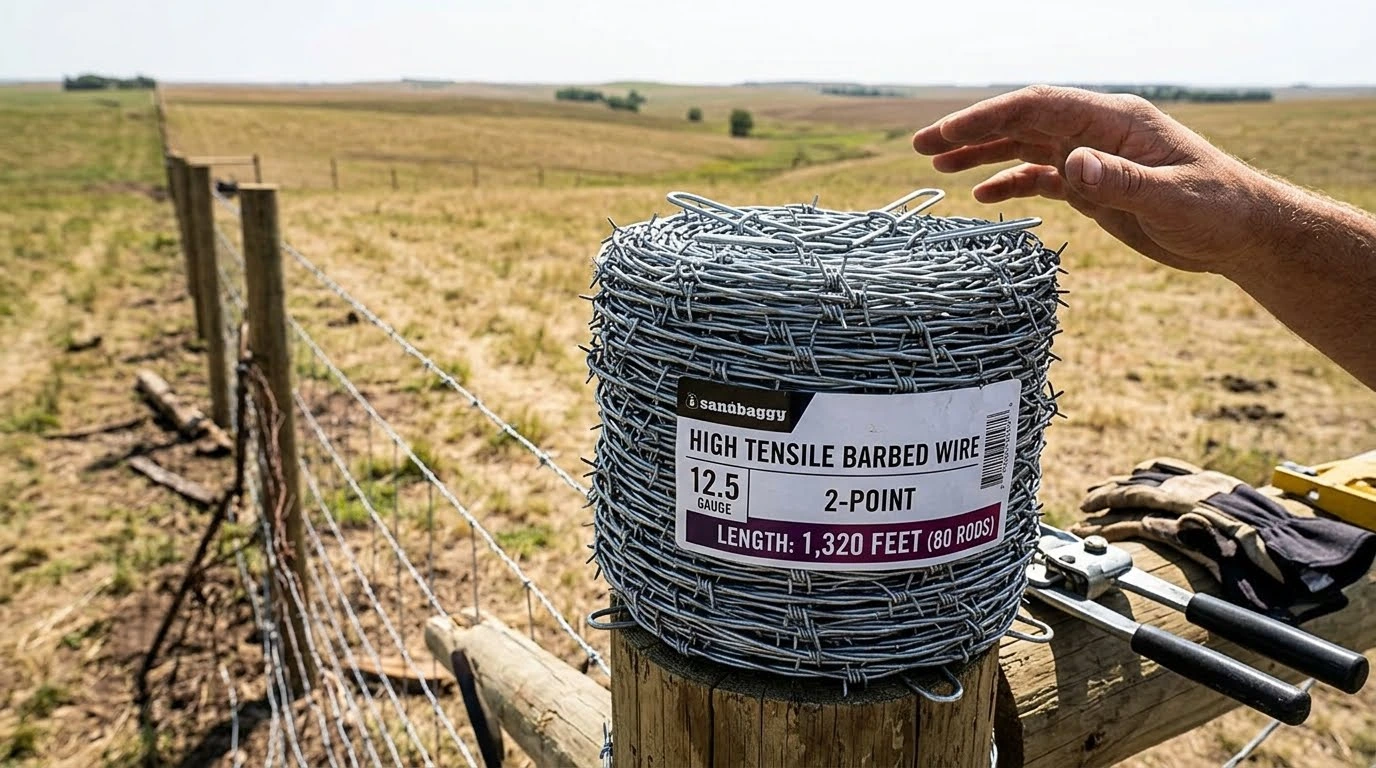
A standard roll of barbed wire typically contains 1,320 feet of wire, which is equivalent to 440 yards or approximately 402 meters. However, not every roll has the same length. Depending on the manufacturer, wire gauge, packaging, and intended use, you may find rolls containing 660 feet, 1,000 feet, 1,320 feet, or other lengths.
If you are planning to fence a farm, secure a property boundary, enclose livestock, or estimate fencing materials, knowing the length of a roll helps you calculate how many rolls you need and how much the project may cost.
In this guide, you will learn the standard lengths of barbed wire rolls, how to convert feet into yards and meters, how to estimate the number of rolls required for a fence, and which factors to consider before purchasing barbed wire.
How Many Feet Are in a Standard Roll of Barbed Wire?
A common standard roll of barbed wire contains 1,320 linear feet. This length is widely used for agricultural and livestock fencing, particularly in the United States.
However, the actual length depends on the product. Some rolls are shorter or longer, so always check the manufacturer’s label or product specifications before buying.
Here is a quick comparison of common roll lengths:
| Barbed wire roll length | Equivalent in yards | Approximate meters |
|---|---|---|
| 330 feet | 110 yards | 100.6 m |
| 660 feet | 220 yards | 201.2 m |
| 1,000 feet | 333.3 yards | 304.8 m |
| 1,320 feet | 440 yards | 402.3 m |
| 1,640 feet | 546.7 yards | 499.9 m |
These are example lengths for comparison, not a guarantee that every size is available from every manufacturer. Confirm the exact length before purchasing.
What Is Barbed Wire?
Barbed wire is a type of fencing wire designed with sharp points, or barbs, attached at regular intervals along the wire. It is commonly used to mark property boundaries, contain livestock, and discourage animals or people from crossing a fence.
Barbed wire is often made from galvanized steel to help resist rust and corrosion. Some products have additional coatings or are designed for particular agricultural or industrial applications.
The length of a roll refers to the linear length of the wire, not the width or diameter of the rolled coil. A roll containing 1,320 feet of wire provides 1,320 feet of linear fencing for one strand, before allowing for installation losses and the wire needed for fastening or tensioning.
How to Calculate the Length of Barbed Wire You Need
Before buying barbed wire, measure the boundary you intend to fence. Your required wire length depends on the perimeter of the area and the number of horizontal strands you plan to install.
Use this formula:
Total wire needed = Fence perimeter × Number of strands
For example, suppose you have a rectangular field measuring 200 feet long and 150 feet wide.
First, calculate the perimeter:
Perimeter = 2 × (Length + Width)
Perimeter = 2 × (200 + 150)
Perimeter = 700 feet
If you install four strands of barbed wire, the calculation is:
700 × 4 = 2,800 linear feet
You would need 2,800 feet of wire before adding any extra allowance for corners, gates, splices, and installation.
If each roll contains 1,320 feet:
2,800 ÷ 1,320 = 2.12 rolls
Because you cannot purchase 2.12 complete rolls, you would need 3 rolls of 1,320-foot barbed wire for this example.
The actual amount needed may vary with your fence layout and installation method.
How Many Rolls of Barbed Wire Do You Need for an Acre?
One acre contains 43,560 square feet, but the number of barbed wire rolls required depends on the shape of the land and how many strands you install.
For an example, imagine a square acre of land.
The length of each side is approximately:
√43,560 = 208.7 feet
Its perimeter is approximately:
4 × 208.7 = 834.8 feet
If you install four strands around the perimeter:
834.8 × 4 = 3,339.2 feet
Using rolls of 1,320 feet each:
3,339.2 ÷ 1,320 = 2.53 rolls
You would need 3 rolls of 1,320-foot wire for this square-acre example, before adding extra wire for gates, corners, connections, or waste.
Keep in mind that not every acre is square. A long, narrow acre can have a larger perimeter and therefore require more wire than a square acre of the same area.
How Many Feet of Barbed Wire Are Needed for Different Fence Lengths?
The following table shows estimated wire requirements for different fence perimeters using three, four, or five strands.
| Fence perimeter | 3 strands | 4 strands | 5 strands |
|---|---|---|---|
| 100 feet | 300 feet | 400 feet | 500 feet |
| 250 feet | 750 feet | 1,000 feet | 1,250 feet |
| 500 feet | 1,500 feet | 2,000 feet | 2,500 feet |
| 700 feet | 2,100 feet | 2,800 feet | 3,500 feet |
| 1,000 feet | 3,000 feet | 4,000 feet | 5,000 feet |
| 2,000 feet | 6,000 feet | 8,000 feet | 10,000 feet |
These calculations cover the horizontal wire strands only. They do not include additional material for bracing, gates, connections, or installation losses.
For example, a 1,000-foot fence with four strands requires 4,000 feet of wire. With 1,320 feet per roll, you would need four rolls because 4,000 ÷ 1,320 is approximately 3.03.
How Many Yards Are in a Roll of Barbed Wire?
A common 1,320-foot roll contains 440 yards of barbed wire.
To convert feet into yards, divide the number of feet by three.
Formula:
Yards = Feet ÷ 3
For example:
1,320 ÷ 3 = 440 yards
Here are a few additional conversions:
- 330 feet = 110 yards
- 660 feet = 220 yards
- 1,000 feet = approximately 333.3 yards
- 1,320 feet = 440 yards
- 2,640 feet = 880 yards
Remember that these conversions describe the length of the wire itself. They do not indicate how many yards of fence you can construct when you use multiple strands.
How Many Meters Are in a Roll of Barbed Wire?
If you use metric measurements, you can convert feet into meters by multiplying the length in feet by 0.3048.
Formula:
Meters = Feet × 0.3048
For a 1,320-foot roll:
1,320 × 0.3048 = 402.336 meters
Therefore, a 1,320-foot roll contains approximately 402.3 meters of barbed wire.
Other examples include:
- 330 feet = approximately 100.6 meters
- 660 feet = approximately 201.2 meters
- 1,000 feet = approximately 304.8 meters
- 1,320 feet = approximately 402.3 meters
This conversion is particularly helpful when comparing products sold in different countries or when planning fencing with metric measurements.
What Factors Affect the Length of a Barbed Wire Roll?
Although 1,320 feet is a common roll length, several factors can affect which product you should purchase.
1. Manufacturer and Packaging
Different manufacturers package barbed wire in different lengths. One company may offer a 660-foot roll, while another sells a 1,320-foot roll.
Always check the stated linear footage rather than estimating the length from the coil’s appearance.
2. Wire Gauge and Thickness
Barbed wire is available in different wire gauges and thicknesses. Thicker wire may be heavier and more difficult to handle, while thinner wire may be intended for different fencing requirements.
Wire thickness does not determine the roll length by itself. Two products with different gauges can contain the same number of feet, so check both specifications.
3. Barb Spacing and Wire Design
The spacing between barbs varies by product. Some wires have barbs positioned closer together, while others use wider spacing.
Barb spacing affects the number of barbs along the wire, but it does not necessarily change the advertised linear footage of the roll.
4. Intended Use
Barbed wire used for livestock fencing, agricultural boundaries, and other applications may come in different specifications and packaging.
Choose a product suited to the intended animals, terrain, local requirements, and fencing design rather than selecting a roll based on length alone.
5. Installation Allowance
The full advertised length may not be usable as a straight, uninterrupted fence line. You may need extra wire for fastening, tensioning, corners, and connections.
Measure carefully and allow for these requirements when estimating how many rolls to buy.
How Much Area Can One Roll of Barbed Wire Cover?
A roll does not cover a fixed area because barbed wire is measured by length rather than square footage. The area enclosed depends on the shape of the land, the perimeter, and the number of strands.
For instance, a 1,320-foot roll can provide approximately 1,320 feet of fencing with one strand. If you use four strands, it provides:
1,320 ÷ 4 = 330 feet of fence perimeter
This means one roll could supply four horizontal strands along a 330-foot perimeter, assuming no additional wire is needed for connections, tensioning, or waste.
A smaller, compact plot may have a shorter perimeter than a long, narrow plot of the same area. That is why calculating the perimeter is more useful than estimating fence needs from acreage alone.
Tips for Buying Barbed Wire
Before purchasing a roll, consider these practical tips:
- Check the label: Confirm the exact number of feet or meters included.
- Measure the boundary: Calculate the total perimeter before estimating the quantity.
- Count the strands: Multiply the perimeter by the number of horizontal wires.
- Include extra material: Allow for corners, gates, splices, and tensioning.
- Compare specifications: Check wire gauge, coating, barb spacing, and intended use.
- Inspect local requirements: Follow applicable fencing, property-boundary, and animal-safety rules.
- Use suitable protective equipment: Barbed wire has sharp points that can cause serious injuries. Wear appropriate gloves, eye protection, and protective clothing during handling and installation.
If you are fencing livestock, also consider whether barbed wire is suitable for the particular animals. Some animals may be injured if they push against or become entangled in the wire.
Frequently Asked Questions
1. How many feet are in a standard roll of barbed wire?
A common standard roll contains 1,320 feet of barbed wire, equivalent to 440 yards or approximately 402.3 meters. However, roll lengths vary by manufacturer and product.
2. Is a roll of barbed wire always 1,320 feet?
No. Although 1,320 feet is a common length, barbed wire is also sold in other lengths, including 660 feet and 1,000 feet. Check the product specifications before purchasing.
3. How many yards are in 1,320 feet of barbed wire?
There are 440 yards in 1,320 feet because one yard equals three feet.
4. How many meters are in a 1,320-foot roll?
A 1,320-foot roll contains approximately 402.3 meters of wire.
5. How many rolls do I need for 1,000 feet of fencing?
For a single strand, one 1,320-foot roll would generally provide enough wire for a 1,000-foot fence line, subject to installation allowances. For four strands, you need 4,000 feet, which requires four rolls of 1,320 feet each.
6. How many feet of barbed wire do I need for one acre?
It depends on the shape of the acre and the number of strands. A square acre has a perimeter of approximately 835 feet. Four strands around that boundary require approximately 3,340 feet of wire, before extra material.
7. Does the wire gauge affect the length of the roll?
Not necessarily. Wire gauge describes the thickness of the wire, while roll length describes how much linear wire is included. Always check both specifications.
8. Can one roll fence an entire acre?
One roll of 1,320 feet may be enough for one strand around a compact acre-shaped boundary, but it generally will not be enough for multiple strands. A square acre with four strands requires approximately 3,340 feet of wire before installation allowances.
9. How do I calculate the number of rolls I need?
Multiply the fence perimeter by the number of strands, then divide the result by the length of wire in each roll. Round up to the next whole roll and allow for extra material.
Conclusion
A common roll of barbed wire contains 1,320 feet, or approximately 440 yards and 402.3 meters. However, roll lengths vary, so it is important to verify the packaging before purchasing.
To estimate how much wire your project requires, calculate the fence perimeter and multiply it by the number of strands you intend to install. Then divide the total wire length by the footage per roll and round up. Adding an allowance for corners, gates, connections, and installation will help you avoid running short of material.


Pingback: How Many Cubic Feet Are in a Yard of Soil?